
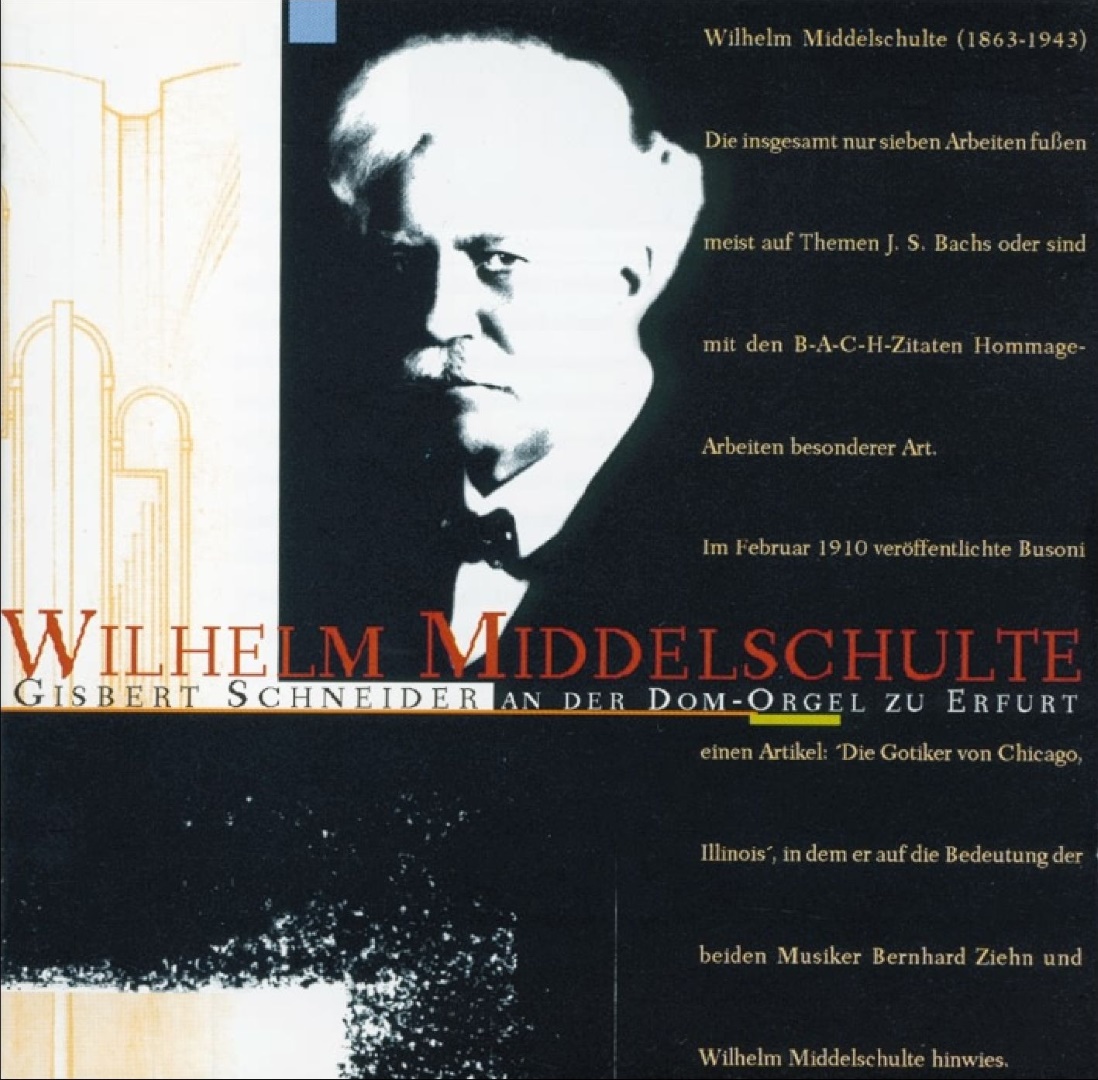
Middelschulte was born on 3 April 1863 in Werve, today Kamen-Heeren, and grew up on his parents’ farm. After training as a teacher he studied from 1886 at the Königliches Akademisches Institut für Kirchenmusik in Berlin, among others with Karl August Haupt and Albert Löschhorn, pupils of August Wilhelm Bach, who in turn had taught Felix Mendelssohn Bartholdy; as Friedhelm Onkelbach explains in the booklet, Middelschulte thus stands in the tradition of the Berlin Bach revival. In 1891 he went to Chicago, studied with Bernhard Ziehn, became organist of the Thomas Orchestra, later the Chicago Symphony Orchestra, and taught at several conservatories. In 1942 he returned to Germany, and he died in Dortmund-Oespel on 4 May 1943.
No free composition by Middelschulte is known: his works are based on themes by Bach or quote B-A-C-H. Ferruccio Busoni placed him in line with Bach, Reger and Franck, drew attention to him and Ziehn in his 1910 article “Die Gotiker von Chicago, Illinois” and dedicated the first version of the Fantasia contrappuntistica to him. At Busoni’s request Middelschulte arranged it for organ, and in 1911 he played the solo part at the premiere of a version orchestrated by Friedrich Stock in the Reinoldikirche in Dortmund.
The Passacaglia in D minor, his best-known work, was written in 1897, premiered in Chicago in 1899 and published in 1901 by C. F. W. Siegel in Leipzig as his first printed work. Over a four-bar bass descending and ascending chromatically in triple time, Middelschulte unfolds 62 variations: as early as bar 2 the chords reach the chromatic total, B-A-C-H appears in the second four-bar unit, and from the 42nd variation onwards the chorale “Ein feste Burg ist unser Gott” dominates the final third. Three chordal blocks and a threefold B-A-C-H conclude the work.
The Concerto on a Theme by Johann Sebastian Bach, published by Kahnt in Leipzig in 1906, is a concerto for organ alone; its theme is that of the fugue from the Prelude and Fugue in E minor BWV 548. A Prelude in the form of a double fugue is followed by a Scherzo as an octave canon, an Adagio as a passacaglia, an Intermezzo as a virtuoso pedal solo and a Finale, again a passacaglia with 39 statements of the theme. The Canonic Fantasia on BACH and Fugue on 4 Themes by J. S. Bach opens with 42 canons in four-bar groups; the introduction then presents the four themes: the B-A-C-H of the unfinished fugue from the “Art of Fugue”, the fugue subject of the Toccata in D minor BWV 565, the “Confiteor” of the Mass in B minor and the theme of Frederick the Great from the “Musical Offering”. At the end of the fugue all four meet in their original form.
Gisbert Schneider, professor of organ and improvisation at the Folkwang-Hochschule Essen, recorded the three works from 10 to 12 November 1997 on the Alexander Schuke organ of Erfurt Cathedral, an instrument of 1992 with Rückpositiv, Hauptwerk, Schwellwerk and pedal.