
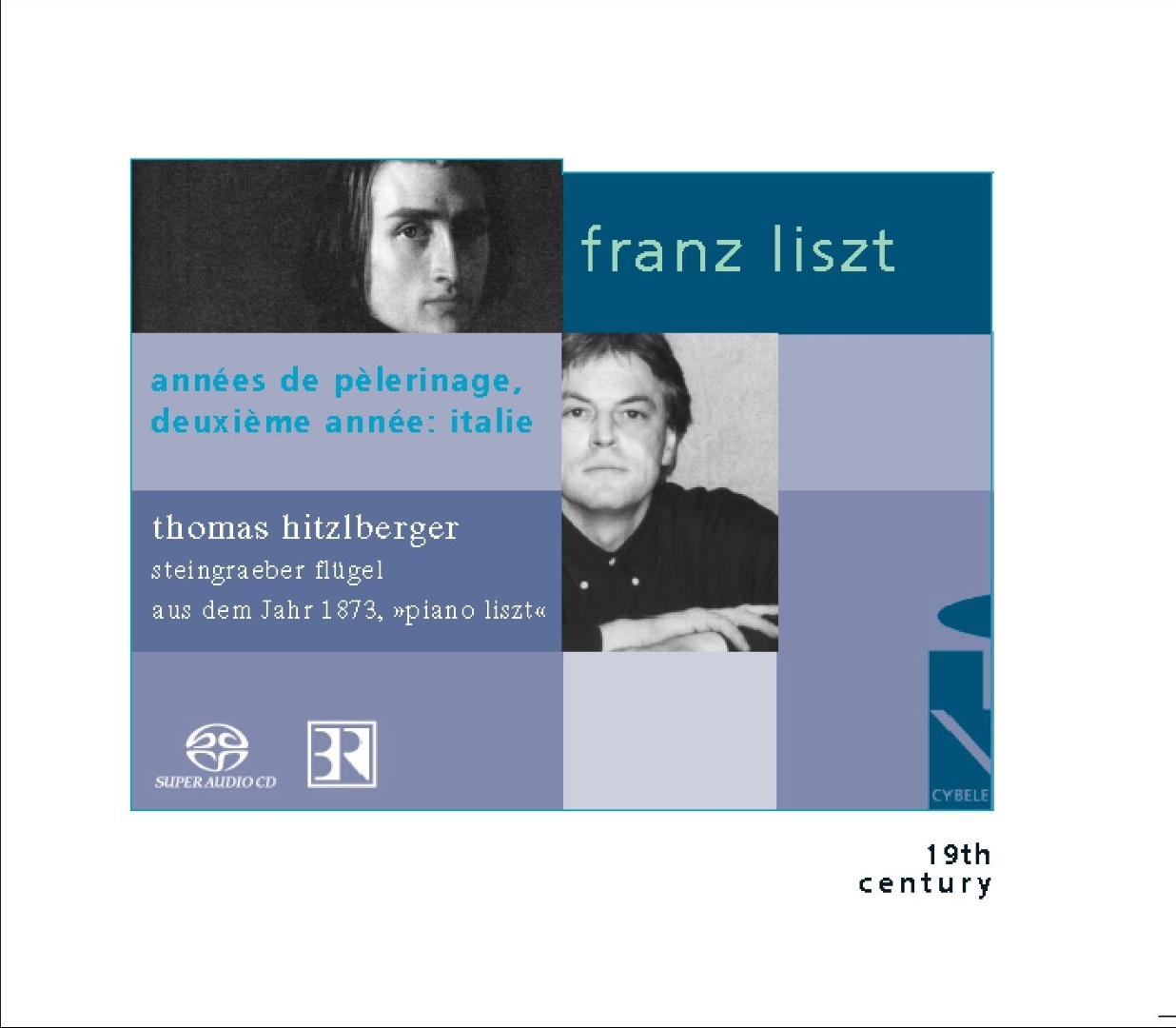
Cybele 150302 2003

24bit 48kHz 5.1 surround Stereo Classical music Romantic music 1:11:40

To the description

Franz Liszt: Années de pèlerinage, deuxième année: Italie

Contributors

Thomas HitzlbergerPianist

Composer

Franz Liszt

Short description

Franz Liszt: Années de pèlerinage, deuxième année – Italie, with La Notte added. Raphael, Michelangelo, Petrarch and Dante form the intellectual landscape of Liszt’s Italian year of pilgrimage. Hitzlberger uses the original sound character of the Steingraeber grand for luminous upper voices, speaking recitatives and the demonic force of the Dante Sonata. Thomas Hitzlberger – historical Steingraeber grand of 1873 (“Piano Liszt”). The careful production makes articulation, tone colours and spatial effect audible in fine gradation and opens up the programme as a coherent album.

Details

Format
Hybrid-SACD

Resolution
DSD64 / 2.8224 MHz 1 bit

Total playing time
71:40

Channels
Stereo

Scoring and instruments
Thomas Hitzlberger – historical Steingraeber grand of 1873 (“Piano Liszt”)

Programme
Franz Liszt: Années de pèlerinage, deuxième année – Italie, with La Notte added

Press reviews

SA-CD.net, 7/2006

Audiophile Audition, 5/2004

Specifications

Catalogue number
Cybele 150302
Year of release
2003
Genre
Classical music
Period
Romantic music
Instrumentation
Fortepiano, Piano, Solo instrument
Label
Cybele Records
Barcode
809548008420
GTIN
4099885254505
Booklet (pages)
32

Track listing

8 tracks · 1:11:40

  1. 01 Sposalizio Composer: Franz Liszt (1811-1886) Performer: Thomas Hitzlberger 9:41
  2. 02 Il Penseroso Composer: Franz Liszt (1811-1886) Performer: Thomas Hitzlberger 4:26
  3. 03 Canzonetta del Salvator Rosa Composer: Franz Liszt (1811-1886) Performer: Thomas Hitzlberger 2:51
  4. 04 Sonetto 47 del Petrarca Composer: Franz Liszt (1811-1886) Performer: Thomas Hitzlberger 6:54
  5. 05 Sonetto 104 del Petrarca Composer: Franz Liszt (1811-1886) Performer: Thomas Hitzlberger 7:39
  6. 06 Sonetto 123 del Petrarca Composer: Franz Liszt (1811-1886) Performer: Thomas Hitzlberger 7:33
  7. 07 Après une lecture du Dante – Fantasia quasi Sonata Composer: Franz Liszt (1811-1886) Performer: Thomas Hitzlberger 18:42
  8. 08 La notte Composer: Franz Liszt (1811-1886) Performer: Thomas Hitzlberger 13:54

Description

Franz Liszt: Années de pèlerinage, deuxième année: Italie places Sposalizio, Il Penseroso, Canzonetta del Salvator Rosa, Sonetto 47 del Petrarca and Sonetto 104 del Petrarca at the centre. The programme is laid out not as a loose sequence but as an audibly articulated whole: different pieces, textures and states of sound enter into relation with one another and give the album a profile of its own.

The selection belongs to the field of Classical music; stylistically it leads into Romantic music. Liszt, Franz is the decisive point of reference here. The booklet opens up the genesis of the works, their aesthetic premises and the connections between them, without reducing the music to mere commentary. Historical layers, formal ideas and personal spaces of expression remain present as an audible experience.

The scoring – Klaviermusik, Historisches Klavier – is essential to what this production has to say. Stops, articulation, resonance and silence are treated as shaping forces. Where lines overlap, rhythmic impulses gather or tone colours merge into one another, the recording preserves transparency while letting the physical presence of the instruments and voices be felt.

Thomas Hitzlberger joins interpretative precision to a natural musical breath. The playing follows the character of each individual work while keeping the long line in view: fragile moments retain their tension, virtuoso passages remain intelligible, and the transitions between repose, movement and concentration acquire a convincing inner logic.

The technical realisation supports this kind of listening without overstating the effect. CD allows a finely graded presentation of dynamics, space and tone colour; the total playing time of 71:40 is deliberately proportioned. Individual voices, ensemble balance and reverberation are thus not merely documented but become experienceable as part of the musical architecture.

As is typical of Cybele, this edition combines careful work on repertoire, editorial context and attentive sound direction. It addresses curious listeners as much as connoisseurs: the immediate musical impression remains central, while repeated listening opens up further connections, details and perspectives.