
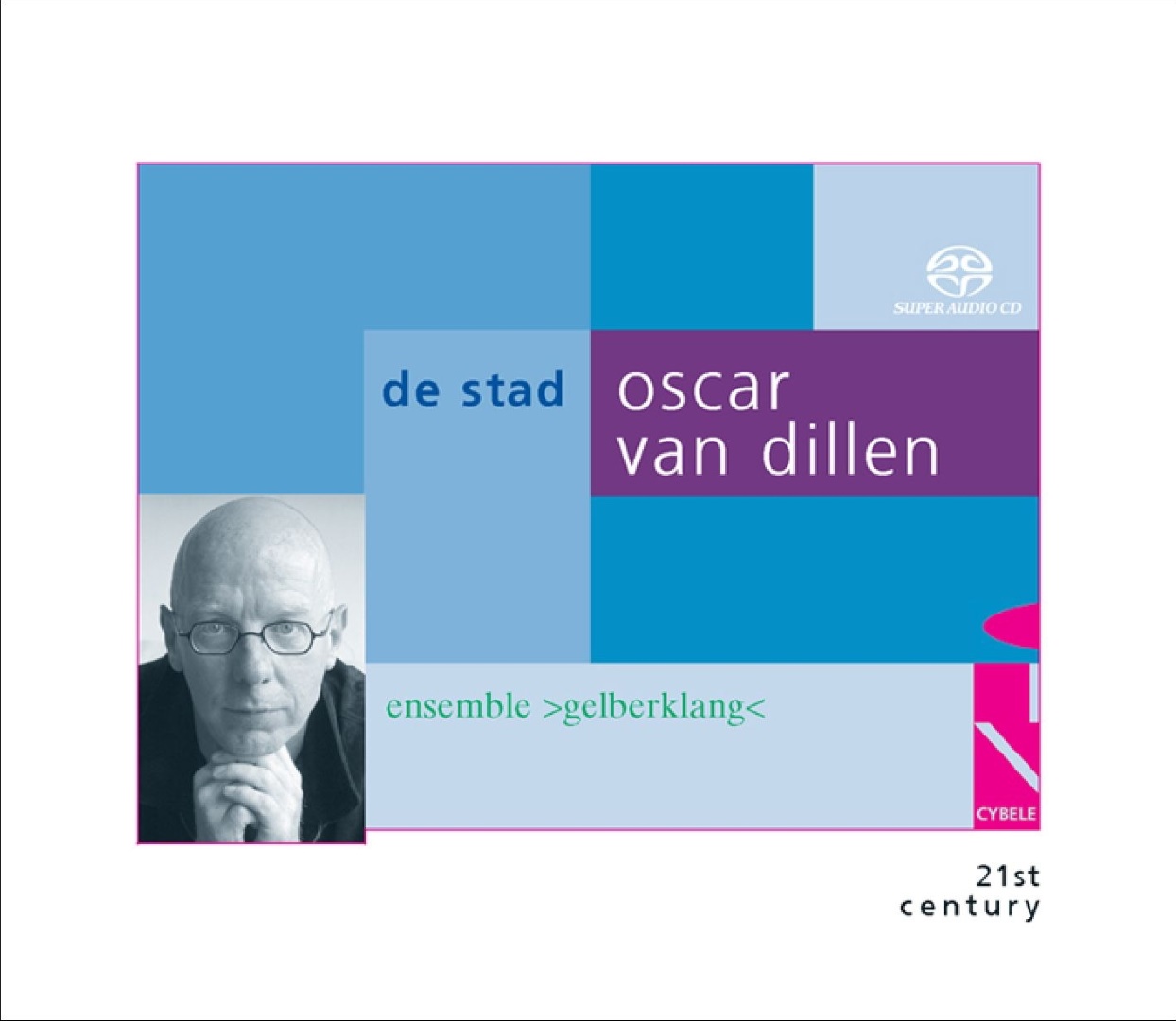
When the Historical Museum Rotterdam was putting together its exhibition on the city’s history, it was clear to Jacques Börger and Paul van de Laar from the outset that music had to be part of it: in collective memory sounds are at least as important as pictures and texts. The exhibition was designed as a directed theatre in which objects, photographs, film fragments, spoken quotations and music form a unity. The question of a “symphony of the city” met with great interest from Oscar van Dillen; he was quick and clear in his choice of instrumentation and ensemble, spoke of arcs of tension and sound colours, and delivered his score exactly on the agreed date. The title de Stad points to an important source of inspiration for the exhibition: Ben Stroman’s book Stad.
The history told there begins in 1880, at the moment when the expansion of the city was planned — that was meant to strike visitors like a Vivace. The growth of city and port draws people from the south of the Netherlands: a choir of dialects. With the opening of the Passage in 1879 comes the culture of consumption, and the sounds of an entertainment orchestra lure people in. The building of the new city hall on the Coolsingel means the end of the folk music from the pubs of the Zandstraat quarter, which had inspired singers such as Louis Davids and Koos Speenhoff in their popular songs.
On the Coolsingel the rhythmic rattle of typewriters and telegraphs sounds from the new offices, interrupted by the bells of the trams; around the Hofplein the rhythms of entertainment swing. To all of it a sudden halt is called: the whistling and roar of the bombardment, the crackle of the fires, a requiem on the bleakness of that period. After the war the machines of reconstruction roar at once. The music does not only help the history of the exhibition stay in the memory, the curators write; it also tells the story of Rotterdam with an order and a dynamic of its own.
Van Dillen himself describes the city as a place of hope, of diversity and contradiction, of collective loneliness, of poverty and luxury, of culture, noise and the brightness of night — a thicket, historical, architectural, infrastructural, social, economic, cultural, scarcely to be disentangled and charged with history and stories. It never stands still; it grows layer upon layer, upwards, downwards and in every direction; the city walls of former times have long ceased to be boundaries, and so have natural barriers. Cities, he writes, are like scores: they overflow with details and connections, some of which open up at once while much remains hidden and is released only after long and exact analysis.
The ensemble version of de Stad lasts 44:23 and falls into six parts; it is scored for bass and contrabass clarinet, bass trombone, percussion, accordion, piano, violin, viola, cello and double bass. The Ensemble gelberklang plays under the composer’s direction; the recording was made on 3 and 4 July 2003 in the Theater an der Halle in Ostfildern-Nellingen. There follows Stadsgeschiedenis, the thirty-minute electroacoustic montage of the same material made for the multimedia exhibition at the Historical Museum Rotterdam. The hybrid SACD runs to 74:23 in stereo and 5.1 surround; the booklet has 36 pages in German and English with Dutch notes. The production was supported by Royal Philips Electronics.