
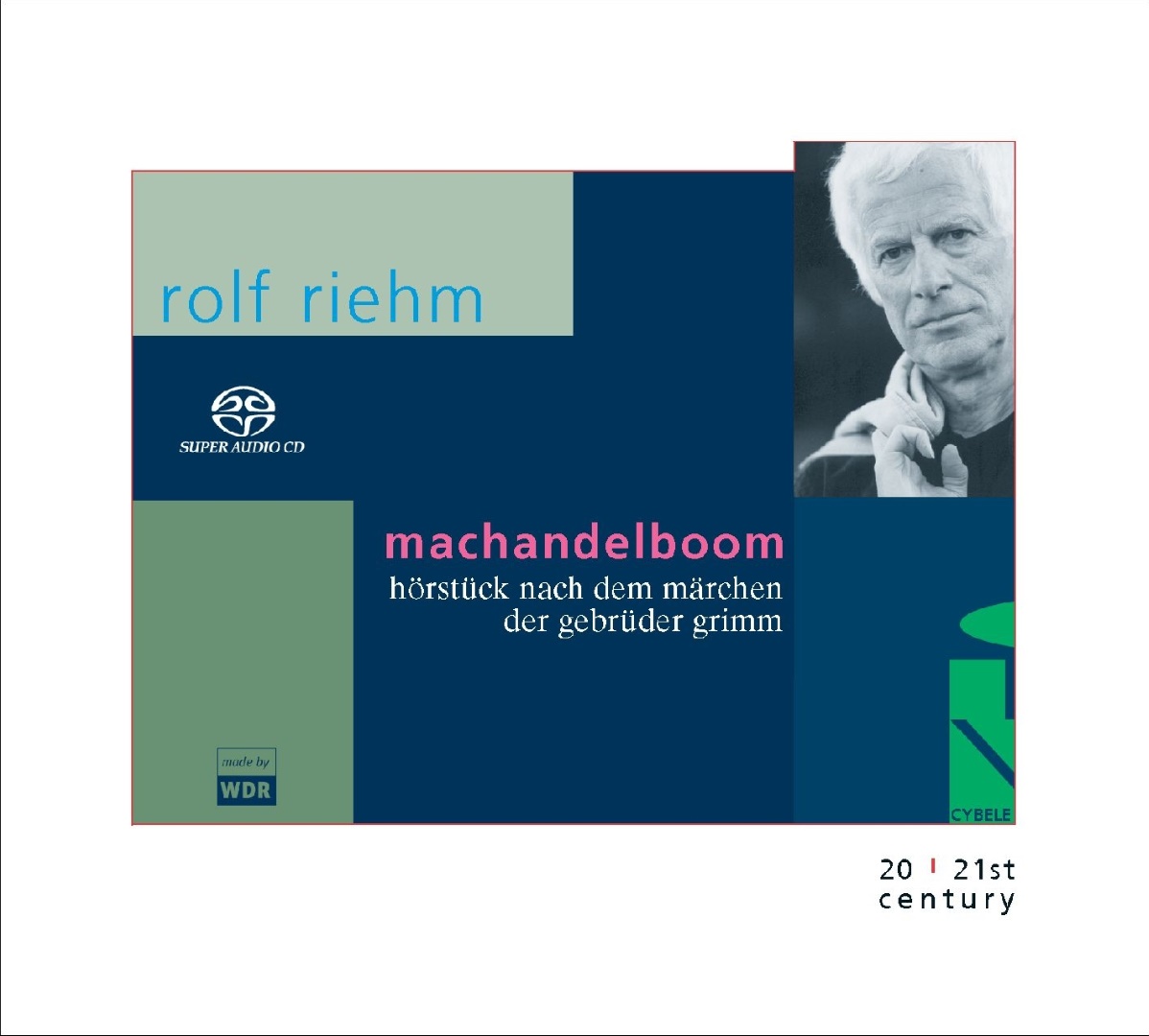
Rolf Riehm had known the tale of the juniper tree since childhood but had always skipped it. In a 1983 conversation with Wolfgang Hamm, reprinted in the booklet, he explains what attracted him: the escalation of violence in personal relationships, depicted openly and without sentimentality. He drew connections with the political present, with Reagan’s justifications of his arms policy and with the scenes involving the “father of the neutron bomb” in a film by Alexander Kluge; for him the fairy tale conveys historical experience. The stepmother kills the son and cooks him in a stew that the father eats; the brother returns as a bird and avenges the murder. Riehm also reads the tale as a drama about women: as a second wife, the stepmother was financially badly off and wanted to secure the son’s inheritance for her own daughter.
Instead of a single narrator, who would create a closed, reassuring atmosphere, Riehm distributes the text among many voices, young and old, amateur and professional; with two exceptions, none is heard twice. The multiplicity is meant to disorientate listeners and bring the fairy tale right up close to them. Riehm told each speaker the whole tale, so that much arose from the participants’ own understanding of it. He made the recordings partly in the studio, often elsewhere and with inadequate equipment as chance dictated, and left the traces audible. Among the voices are, besides individuals, upper-school pupils of the Ziehenschule and women of the church choir of St. Bernhard in Frankfurt am Main. Unlike most fairy tales, this one is not meant to return reconciled to its starting point, but to remain open at every moment.
In the sounds, too, Riehm sought what cannot be precisely categorised. Alongside saxophones and clarinets (Alfred Harth), electric and acoustic guitar and cello (Heiner Goebbels), electric guitar and drums (Christoph Anders), harp (Karin Franke) and organ (Karl Riehm), he himself plays cor anglais, electric organ, harpsichord, double bass, synthesiser, rhythm machine, melodica, toy instruments and bells, and produces noises with doors, tins, cutlery, bricks, an electric toothbrush, a food mill or a hole punch. He chose the sounds for each scene individually, so that there is no break between instruments and noises, and deliberately avoided any musical system: free jazz elements, synthesiser sounds and twelve-tone moments stand side by side. At the centre is the song of the bird, through which, as Riehm says, the abhorrent murder story acquires a new essence: one is enchanted by it.
Rolf Riehm, born in Saarbrücken in 1937, studied composition with Wolfgang Fortner in Freiburg from 1958, worked as a solo oboist and taught composition and music theory at the Musikhochschule Frankfurt am Main from 1974 to 2000; from 1976 to 1981 he played in the Sogenanntes Linksradikales Blasorchester. The WDR production was made between February and October 1982; production and realisation were in Riehm’s own hands, with Otto Fries as sound engineer. Besides the conversation with Wolfgang Hamm, the booklet contains an essay by Bernd Leukert and the text of the 14 scenes in German and English.