
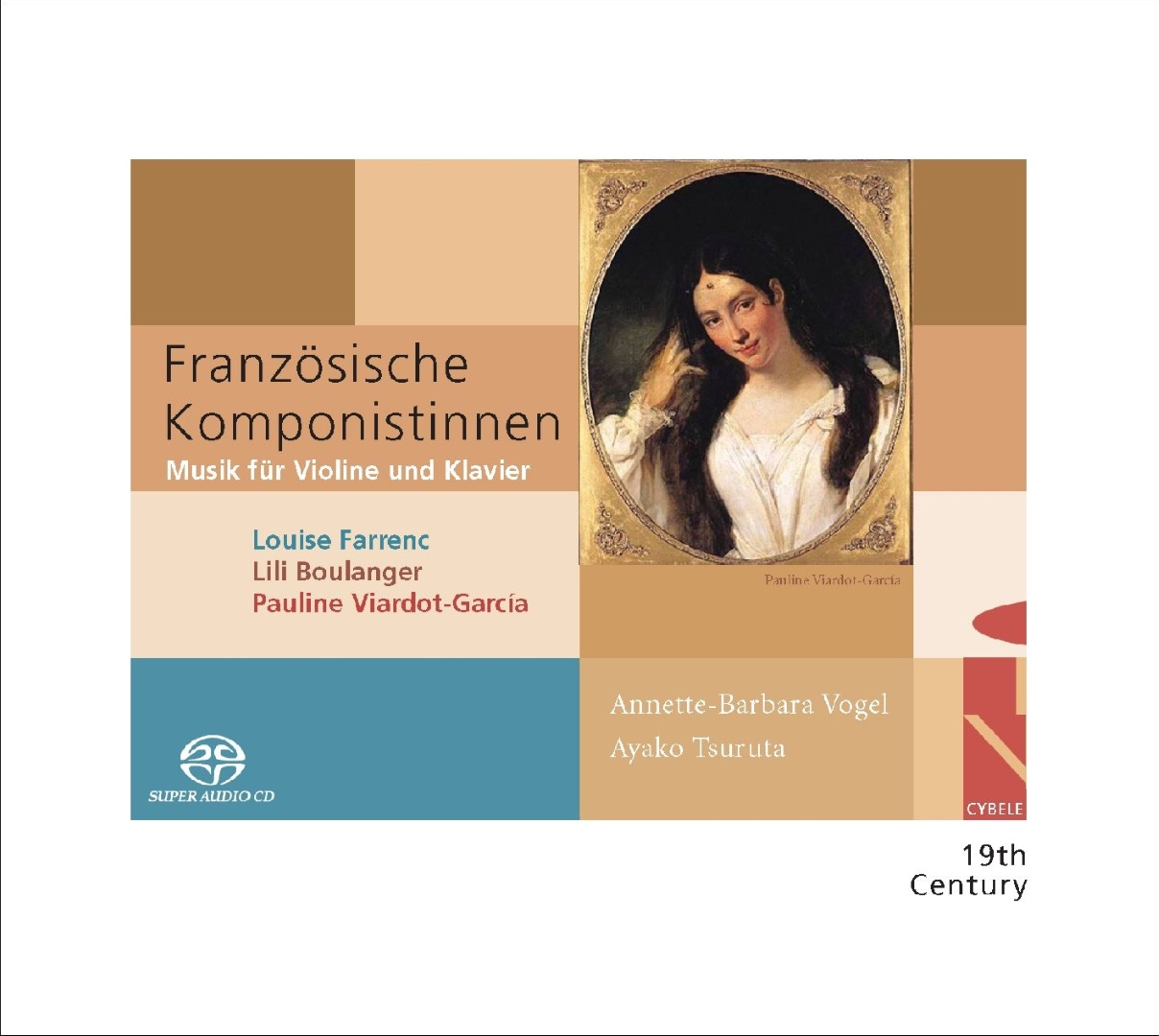
When Louise Farrenc was born in 1804, Napoleon Bonaparte was having himself crowned emperor in Paris; when Lili Boulanger died in 1918, the “world of yesterday” was collapsing in the First World War. Between them lay an era of unprecedented upheaval in which, from the middle of the nineteenth century, women demanded not only the vote but the right to work, to education and to equality. None of the three composers was a deliberate campaigner for that movement, and the booklet expressly warns against retrieving their works from the archives merely because they were written by women: what is needed is an appraisal free of value judgements, of the kind granted to their male colleagues.
Louise Farrenc must count as the most underestimated French composer of the nineteenth century. Berlioz credited her with “a gift such as is rarely found in women”, and Robert Schumann found her piano pieces “so sensible in execution, so finished in a word, that one cannot help becoming fond of them”. That her path remained stony was not only a matter of her sex: her concentration on serious, abstract music in the spirit of Mozart and Beethoven lay far from Parisian taste with its preference for opera, virtuosity and the salon. Of her 51 numbered works about 40 appeared in print; for her chamber music she received the Prix Chartier in 1861 and 1869. With her husband, the flautist Aristide Farrenc, she edited “Le Trésor des Pianistes”, a many-volumed anthology that contributed to the revival of early music. In the second violin sonata in A major Op. 39 (1850–55) she walks the paths of Viennese classicism so skilfully that one believes one is hearing a piece from that earlier age.
Lili Boulanger came from an artistic family that had helped shape Parisian musical life since the eighteenth century. What her father Ernest Boulanger had achieved in 1835, the daughter matched in 1913: with the cantata “Faust et Hélène” she became the first woman in the 110-year history of the Prix de Rome to win French musical life’s most important award — her elder sister Nadia had been the first woman to reach the final, but never got beyond second prizes. Little time remained to her: the stay in Rome was broken off at the outbreak of war, tuberculosis had lain over her life since childhood, and her last works could only be dictated. She died on 15 March 1918, not yet 25, ten days before her great model Claude Debussy. The Nocturne of 1911 still moves in the distinctive harmony of Gabriel Fauré, a friend of the family who had accompanied her at the piano as a child.
Pauline Viardot-Garcia, daughter of the Spanish tenor Manuel Garcia and sister of the short-lived Maria Malibran, triumphed at all the great opera houses of Europe with a voice that moved effortlessly from soprano to contralto; a lifelong friendship bound her to Ivan Turgenev. She spoke five languages, was an excellent pianist — Franz Liszt was among her teachers — and composed piano and chamber music, songs, choruses and operettas. Much of it was intended for the private concerts in her villa in Baden-Baden, where she had moved in 1863 with her husband, the theatre director Louis Viardot; in the audience sat Wilhelm and Augusta of Prussia, Bismarck, Wagner, Theodor Storm and Anton Rubinstein. The Franco-Prussian War ended those years. The album presents the Sonatine in A minor of 1874 and the six Morceaux of 1867, from the Romance by way of the Bohémienne and the Berceuse to the Tarentelle.
Annette-Barbara Vogel and Ayako Tsuruta recorded the programme from 14 to 19 December 2001 in the Clapp Recital Hall of the University of Iowa in Iowa City, at 24 bit and 44.1 kHz, released as a hybrid SACD with stereo and 5.0 surround layers. The production was supported by the Kunststiftung NRW and the University of Iowa; the booklet runs to 28 pages in German and English. The recording received the IRR Outstanding Award of the International Record Review.