
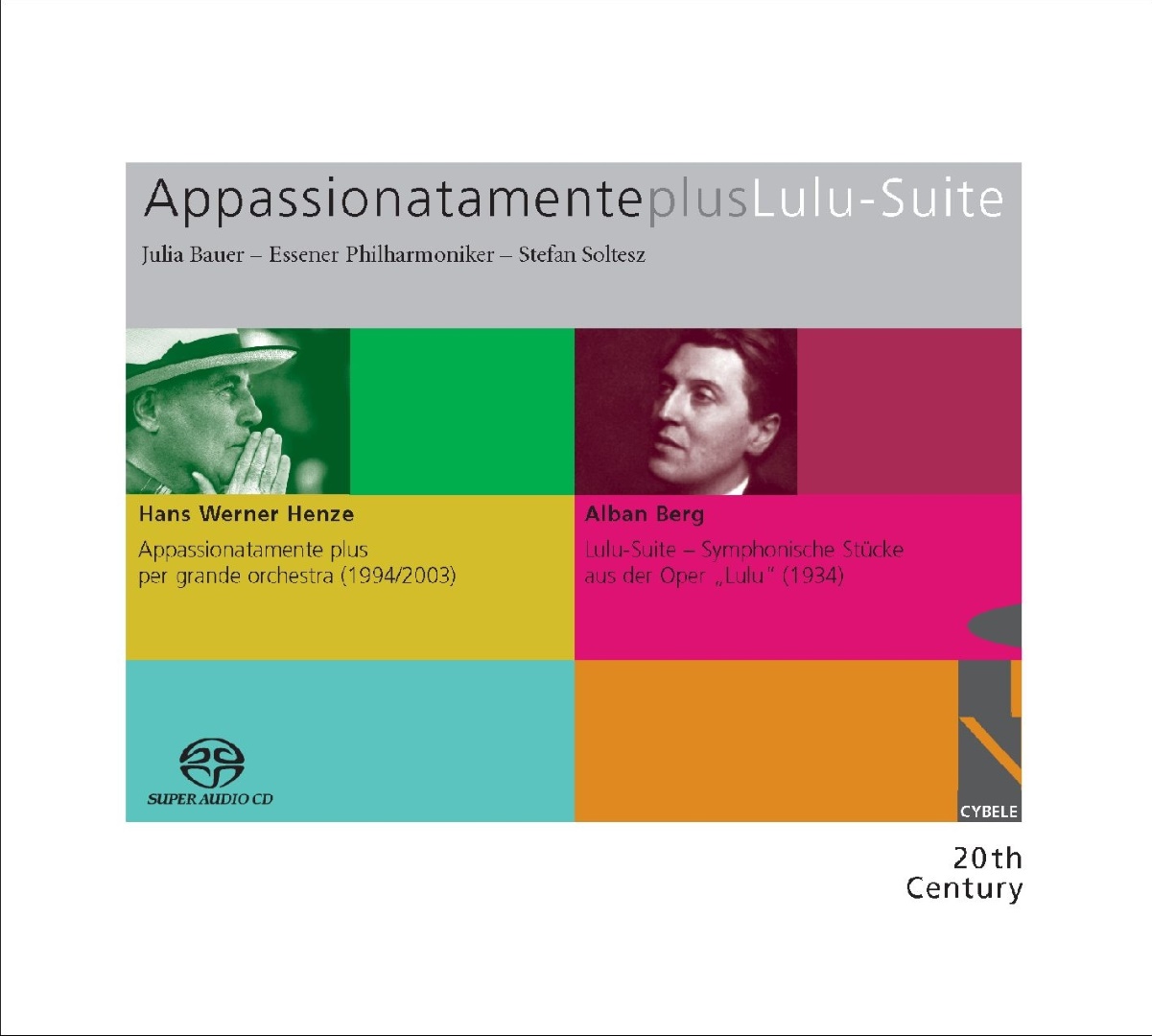
In 1934 Alban Berg interrupted eight years of work on his second opera, Lulu, based on Frank Wedekind’s plays “Erdgeist” and “Die Büchse der Pandora”, and compiled the Lulu Suite – Symphonic Pieces from the opera “Lulu” (1934) for the concert hall. A staging of the opera in Nazi Germany was out of the question, but Erich Kleiber gave the first performance of the suite with the Staatskapelle Berlin on 30 November 1934; Berg was absent because he could not raise the money for the journey from Carinthia. Like Paul Hindemith’s symphony “Mathis der Maler”, it was, as Klaus Oehl writes in the booklet, one of the last displays of artistic rebellion against the regime; Kleiber was forced to resign that December. Berg dedicated the score to Arnold Schönberg for his 60th birthday. He was unable to complete the opera’s final act and died of blood poisoning in 1935.
At the centre stands Lulu’s Song, in which the title heroine describes herself as a kind of female Don Juan: “If men have killed on my behalf, my value is undiminished.” From permutations of her twelve-tone row Berg derives the music of the other characters. The Rondo, with its alto saxophone, revolves around Alwa, whom Berg turned from an actor into a composer and with whom he identified; the mirror-symmetrical Ostinato, for Theodor W. Adorno “a breathless, compact piece of film music”, was intended to accompany a film showing Lulu’s arrest and release. The Variations lead a ballad by Wedekind through ever new orchestrations until it is revealed as a barrel-organ tune; the Adagio ends with Lulu’s death cry over a twelve-tone chord.
Hans Werner Henze’s Appassionatamente plus (1994-2003) per grande orchestra likewise owes its existence to an opera. From the original version of Das verratene Meer (1986–1989), after Yukio Mishima’s novel “Gogo no eiko”, Henze took interludes and in 1994 combined them into the orchestral fantasy Appassionatamente; the expanded version was written in 2003 in the course of revising the opera. The opera is set in Yokohama: a gang of boys around the thirteen-year-old Noboru kills the sailor Ryuji, who has “betrayed” the sea out of love for Noboru’s mother Fusako. As in a kaleidoscope, the characters remain present in the orchestral writing. Noboru’s monologue is heard at the beginning on the soprano saxophone, a nod to Berg; the piano with its étude-like figures embodies the adolescent, and the large percussion section, here with nine players, the violence of the gang, which Henze wanted to sound hard, cutting, machine-like and angry.
Ryuji’s dream, in the opera the transformation music between the second and third scenes, is a mighty orchestral storm in which Henze traces a storm tide: “I wrote seven or nine surges of waves.” The tender love duet of Ryuji and Fusako with strings, harp and woodwind is followed by the hammering blows of the gang; the climax is formed by the final scene of the opera, Ryuji’s death.
Stefan Soltész, then general music director of the Essener Philharmoniker and director of the Aalto Theatre, conducted Appassionatamente plus on 28 May 2010 in the Philharmonie Essen as part of the Henze project of the European Capital of Culture RUHR.2010; the recording was made at the concert. The Lulu Suite was recorded in the same hall in November 2009. Julia Bauer, who made her debut as Lulu at the Aalto Theatre in Essen, sings Lulu’s Song and the Adagio. The SACD was nominated for a Grammy in 2011 in the category Best Contemporary Composition and for the International Classical Music Awards; The Sunday Times included it among its Top 100 Albums of 2010.