
A human being, an artist above all, must not drift into grey everyday life without having spoken out. (Karl Amadeus Hartmann)
An artist’s work speaks for itself. Yet artists not infrequently feel that they and their work are not understood, or are misunderstood. Often the wary reserve towards what is new and unfamiliar persists long after the artist’s death.
What is plainly needed, then, is a bridge of understanding that makes access to the work easier for those interested in art and culture — if it does not make it possible in the first place. However rough, trackless and unfathomable the creative terrain of the artist as builder may appear at first sight, there are nonetheless paths that lead through it, and impressions that change one’s view and let the essential be seen. From that moment on, exploring the unfamiliar becomes an adventure one gladly embarks upon.
The bridge we wish to build with our Edition Künstler im Gespräch is access to the person behind the work of art, within the field of tension of their circumstances, the political situation, their family, their physical and mental condition and the times in which they live or lived.
This shared ground of being human connects us with the artist, forms a bridge to their work, and can contribute substantially to understanding it by leading us through the lock-gate of the familiar into the unfamiliar.
Anyone to whom the composer Apostel means anything at all will know him first of all as a pupil of Arnold Schönberg, later of Alban Berg too, as a member of the Schönberg circle, and perhaps as the most gifted lyricist among Schönberg’s pupils — one who nevertheless went on to develop towards purely instrumental writing.
Alongside Apostel’s complete output for string quartet (5 quartets, four of them first recordings), you will hear the original voice of Hans Erich Apostel and a conversation that Mirjam Wiesemann held with Apostel’s pupil Prof. Dr. Rainer Bischof führte. Rainer Bischof recalls characteristic anecdotes, describes Apostel’s artistic and personal development and illuminates some of his distinctive traits. Just as he describes the edelweiss in Berg’s tradition — Berg too kept a flower on his desk — and the skull in Schönberg’s tradition as a symbol of transience, Bischof also describes Apostel himself: the man between Alban Berg and Arnold Schönberg, between amiability and brusqueness, who on the one hand feared life outside his study and on the other created musical micro-lives of a singular readiness for adventure (Dr. Harald Kaufmann) — Apostel, the strict humanist, architect and intellectual, the emphatically thinking musician to whom every form of sentimental aesthetics was repugnant, but to whom choleric outbursts were no more foreign than a panic fear of falling ill or losing his mind.
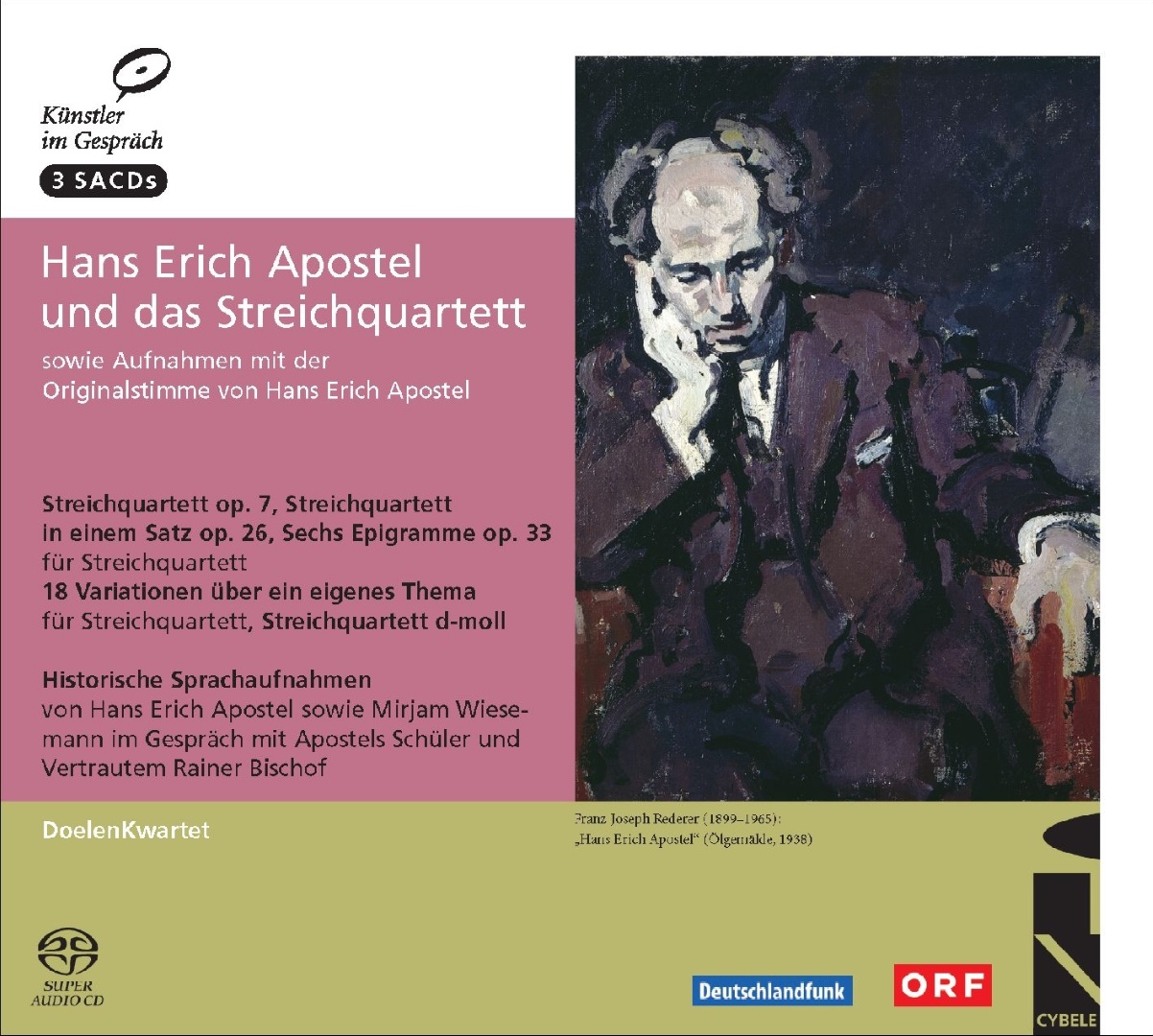
Cybele KiG002 2010
5.0 surround DSD Stereo Classical music Word & language Classical modernism 3:19:22
Hans Erich Apostel und das Streichquartett
Contributors
DoelenKwartetHans Erich ApostelComposer / AuthorMirjam WiesemannRainer BischofAuthor
Composer
Hans Erich Apostel
Streaming & download
Short description
Hans Erich Apostel und das Streichquartett is devoted to Hans Erich Apostel’s string quartets, historical spoken recordings and a conversation with Rainer Bischof by Apostel, Hans Erich. DoelenKwartet, Hans Erich Apostel, Mirjam Wiesemann, Rainer Bischof shapes the recording with clear contour, a feeling for tone colour and an eye for the inner dramaturgy of the programme. String quartet, speaker, audiobook shape the album’s profile and make the relations between form, gesture and space directly audible. A carefully produced Cybele edition that brings together repertoire, context and sonic presence.
Details
Edition Künstler im Gespräch Vol. 2 – Career and private life
At home, among books, paintings and drawings, the edelweiss one climbed for oneself on the table and a skull beside it – that is the right setting for an artist. (Hans Erich Apostel)
SACD 1, tracks 1-16, SACD 2 tracks 1-22: Doelenkwartet: Frank de Groot (violin I) – Maartje Kraan (violin II) – Karin Dolman (viola) – Hans Woudenberg (cello)
SACD 1, tracks 17-24: Hans Erich Apostel (speaker), also in conversation with the artists Karl Scheit, Elias Canetti and Fritz Wotruba
SACD 2, Track 23-30; SACD 3, Track 1-21: Rainer Bischof, Mirjam Wiesemann (speaker)
Recording Producer: Ingo Schmidt-Lucas
Total playing times: 64:14 (SACD 1) / 74:33 (SACD 2) / 60:42 (SACD 3)
ISBN: 978-3-937794-08-2
Booklet languages: German, English (72 pages in a digipak)
A co-production with Deutschlandfunk and ORF
Awards
Deutscher Hörbuchpreis 2011 — Best publishing achievement
International Classical Music Awards (ICMA) — Nomination
MUSICA — 5 stars
klassik.com — Recommended by klassik.com
Specifications
- Catalogue number
- Cybele KiG002
- Year of release
- 2010
- Genre
- Classical music, Word & language
- Period
- Classical modernism
- Instrumentation
- Audiobook, Speaker, String quartet
- Label
- Cybele Records
- Barcode
- 809548013929
- GTIN
- 4068992490137
- Booklet (pages)
- 72
Track listing
75 tracks · 3:19:22
CD 1
- 01 Streichquartett Op. 7 (1935) – I. Allegro risoluto Composer: Hans Erich Apostel (1901-1972) Performer: DoelenKwartet 8:05
- 02 Streichquartett Op. 7 (1935) – II. Largo con variazioni Composer: Hans Erich Apostel (1901-1972) Performer: DoelenKwartet 8:03
- 03 Streichquartett Op. 7 (1935) – III. Presto ma non troppo Composer: Hans Erich Apostel (1901-1972) Performer: DoelenKwartet 2:56
- 04 Streichquartett Op. 7 (1935) – IV. Largo assai Composer: Hans Erich Apostel (1901-1972) Performer: DoelenKwartet 5:51
- 05 Streichquartett in einem Satz Op. 26 (1956) – Adagio (Introduktion) Composer: Hans Erich Apostel (1901-1972) Performer: DoelenKwartet 0:36
- 06 Streichquartett in einem Satz Op. 26 (1956) – I. Allegro moderato Composer: Hans Erich Apostel (1901-1972) Performer: DoelenKwartet 4:59
- 07 Streichquartett in einem Satz Op. 26 (1956) – IIa. Grave (Passacaglia) Composer: Hans Erich Apostel (1901-1972) Performer: DoelenKwartet 2:12
- 08 Streichquartett in einem Satz Op. 26 (1956) – III. Allegro vivace (Scherzo) Composer: Hans Erich Apostel (1901-1972) Performer: DoelenKwartet 2:17
- 09 Streichquartett in einem Satz Op. 26 (1956) – IIb. Grave (Fortsetzung Passacaglia) Composer: Hans Erich Apostel (1901-1972) Performer: DoelenKwartet 2:50
- 10 Streichquartett in einem Satz Op. 26 (1956) – IV. Allegro vivo (Rondo) Composer: Hans Erich Apostel (1901-1972) Performer: DoelenKwartet 4:32
- 11 Sechs Epigramme für Streichquartett Op. 33 (1962) – I. Grave, Für vier gleichgeltende Stimmen Composer: Hans Erich Apostel (1901-1972) Performer: DoelenKwartet 1:08
- 12 Sechs Epigramme für Streichquartett Op. 33 (1962) – II. Adagio, Solist Violoncello Composer: Hans Erich Apostel (1901-1972) Performer: DoelenKwartet 0:58
- 13 Sechs Epigramme für Streichquartett Op. 33 (1962) – III. Moderato, Solist Viola Composer: Hans Erich Apostel (1901-1972) Performer: DoelenKwartet 0:49
- 14 Sechs Epigramme für Streichquartett Op. 33 (1962) – IV. Allegretto grazioso, Solist 2. Violine Composer: Hans Erich Apostel (1901-1972) Performer: DoelenKwartet 1:03
- 15 Sechs Epigramme für Streichquartett Op. 33 (1962) – V. Allegro molto, Solist 1. Violine Composer: Hans Erich Apostel (1901-1972) Performer: DoelenKwartet 1:59
- 16 Sechs Epigramme für Streichquartett Op. 33 (1962) – VI. Vivace, Für 4 gleichgeltende Stimmen Composer: Hans Erich Apostel (1901-1972) Performer: DoelenKwartet 1:54
- 17 Hans Erich Apostel spricht über das Streichquartett. Composer: Hans Erich Apostel (1901-1972) Performer: Hans Erich Apostel 0:50
- 18 Wie komponiert Hans Erich Apostel – Der Schaffensprozess. Composer: Hans Erich Apostel (1901-1972) Performers: Hans Erich Apostel, Mirjam Wiesemann 1:34
- 19 Hans Erich Apostel, der Lyriker. Composer: Hans Erich Apostel (1901-1972) Performers: Hans Erich Apostel, Mirjam Wiesemann 0:28
- 20 Das neue Hören, die Zwölftonreihe – Ein Beispiel, von Hans Erich Apostel persönlich am Klavier vorgetragen. Composer: Hans Erich Apostel (1901-1972) Performers: Hans Erich Apostel, Mirjam Wiesemann 2:37
- 21 Hans Erich Apostel geht neue Wege. Vom Lyriker zum absoluten Musiker – Das Klavierkonzert. Composer: Hans Erich Apostel (1901-1972) Performers: Hans Erich Apostel, Mirjam Wiesemann 1:19
- 22 Hans Erich Apostel und sein Künstlerfreund, der Gitarrist Karl Scheit, sprechen über Apostels 6 Musiken für Gitarre. Composer: Hans Erich Apostel (1901-1972) Performers: Hans Erich Apostel, Mirjam Wiesemann 2:14
- 23 Der Schriftsteller Elias Canetti und der Bildhauer Fritz Wotruba, ziehen in einem Gespräch mit ihrem Freund Apostel Composer: Hans Erich Apostel (1901-1972) Performers: Hans Erich Apostel, Mirjam Wiesemann 1:44
- 24 Hans Erich Apostel hält eine Laudatio anlässlich des 50. Geburtstages seines Komponistenfreundes Karl Schiske. Composer: Hans Erich Apostel (1901-1972) Performers: Hans Erich Apostel, Mirjam Wiesemann 3:13
CD 2
- 01 18 Variationen über ein eigenes Thema (1925) – Thema, Im Volkston. Moderato Composer: Hans Erich Apostel (1901-1972) Performer: DoelenKwartet 0:32
- 02 18 Variationen über ein eigenes Thema (1925) – I. Variation, Langsam Composer: Hans Erich Apostel (1901-1972) Performer: DoelenKwartet 0:39
- 03 18 Variationen über ein eigenes Thema (1925) – II. Variation, Ruhige punktierte Halbe Composer: Hans Erich Apostel (1901-1972) Performer: DoelenKwartet 0:20
- 04 18 Variationen über ein eigenes Thema (1925) – III. Variation, Allegro moderato Composer: Hans Erich Apostel (1901-1972) Performer: DoelenKwartet 1:30
- 05 18 Variationen über ein eigenes Thema (1925) – IV. Variation, Allegro vivace Composer: Hans Erich Apostel (1901-1972) Performer: DoelenKwartet 0:18
- 06 18 Variationen über ein eigenes Thema (1925) – V. Variation (Hebräisch), Ganz langsame Viertel Composer: Hans Erich Apostel (1901-1972) Performer: DoelenKwartet 0:59
- 07 18 Variationen über ein eigenes Thema (1925) – VI. Variation, Allegro Composer: Hans Erich Apostel (1901-1972) Performer: DoelenKwartet 1:07
- 08 18 Variationen über ein eigenes Thema (1925) – VII. Variation, Tempo di Marche funèbre Composer: Hans Erich Apostel (1901-1972) Performer: DoelenKwartet 1:11
- 09 18 Variationen über ein eigenes Thema (1925) – VIII. Variation, Allegro vivace Composer: Hans Erich Apostel (1901-1972) Performer: DoelenKwartet 0:51
- 10 18 Variationen über ein eigenes Thema (1925) – IX. Variation, Rasche Achtel Composer: Hans Erich Apostel (1901-1972) Performer: DoelenKwartet 0:45
- 11 18 Variationen über ein eigenes Thema (1925) – X. Variation, Moderato Composer: Hans Erich Apostel (1901-1972) Performer: DoelenKwartet 0:21
- 12 18 Variationen über ein eigenes Thema (1925) – XI. Variation, Rasche Achtel Composer: Hans Erich Apostel (1901-1972) Performer: DoelenKwartet 0:54
- 13 18 Variationen über ein eigenes Thema (1925) – XII. Variation, Sehr langsame Achtel Composer: Hans Erich Apostel (1901-1972) Performer: DoelenKwartet 1:04
- 14 18 Variationen über ein eigenes Thema (1925) – XIII. Variation, Allegro Composer: Hans Erich Apostel (1901-1972) Performer: DoelenKwartet 0:42
- 15 18 Variationen über ein eigenes Thema (1925) – XIV. Variation (Pastorale), Allegro moderato Composer: Hans Erich Apostel (1901-1972) Performer: DoelenKwartet 1:33
- 16 18 Variationen über ein eigenes Thema (1925) – XV. Variation (Intermezzo), Allegro Composer: Hans Erich Apostel (1901-1972) Performer: DoelenKwartet 0:25
- 17 18 Variationen über ein eigenes Thema (1925) – XVI. Variation, Langsame Viertel Composer: Hans Erich Apostel (1901-1972) Performer: DoelenKwartet 0:55
- 18 18 Variationen über ein eigenes Thema (1925) – XVII. Variation, Andante Composer: Hans Erich Apostel (1901-1972) Performer: DoelenKwartet 0:34
- 19 18 Variationen über ein eigenes Thema (1925) – XVIII. Variation, Langsame, getragene Achtel Composer: Hans Erich Apostel (1901-1972) Performer: DoelenKwartet 7:03
- 20 Streichquartett d-Moll (1926) – I. Moderato Composer: Hans Erich Apostel (1901-1972) Performer: DoelenKwartet 9:16
- 21 Streichquartett d-Moll (1926) – II. Allegro vivace Composer: Hans Erich Apostel (1901-1972) Performer: DoelenKwartet 4:28
- 22 Streichquartett d-Moll (1926) – III. Moderato Composer: Hans Erich Apostel (1901-1972) Performer: DoelenKwartet 10:13
- 23 Mein geliebter Lehrer – Das Kennenlernen Composer: Hans Erich Apostel (1901-1972) Performers: Rainer Bischof, Mirjam Wiesemann 7:08
- 24 Erster Unterricht – 'Bevor ich Genie bin, bin ich Handwerker.' Composer: Hans Erich Apostel (1901-1972) Performers: Rainer Bischof, Mirjam Wiesemann 2:38
- 25 Der Widersprüchliche – Zwischen Schönberg und Berg Composer: Hans Erich Apostel (1901-1972) Performers: Rainer Bischof, Mirjam Wiesemann 3:32
- 26 Ein in sich gekehrter, einsamer Mensch Composer: Hans Erich Apostel (1901-1972) Performers: Rainer Bischof, Mirjam Wiesemann 2:21
- 27 Künstlerfreundschaften Composer: Hans Erich Apostel (1901-1972) Performers: Rainer Bischof, Mirjam Wiesemann 1:19
- 28 Totenschädel und Edelweiß Composer: Hans Erich Apostel (1901-1972) Performers: Rainer Bischof, Mirjam Wiesemann 3:18
- 29 Der begabteste Lyriker unter den Schönberg-Schülern Composer: Hans Erich Apostel (1901-1972) Performers: Rainer Bischof, Mirjam Wiesemann 3:20
- 30 Musik als Lebensraum – Natur als Vorbild Composer: Hans Erich Apostel (1901-1972) Performers: Rainer Bischof, Mirjam Wiesemann 5:15
CD 3
- 01 Gehört das Leben eines Künstlers der Allgemeinheit Composer: Hans Erich Apostel (1901-1972) Performers: Rainer Bischof, Mirjam Wiesemann 3:08
- 02 Der Schönberg-Kreis und das innere Programm Composer: Hans Erich Apostel (1901-1972) Performers: Rainer Bischof, Mirjam Wiesemann 3:11
- 03 Der Rückzug in die eigene Waffenkammer Composer: Hans Erich Apostel (1901-1972) Performers: Rainer Bischof, Mirjam Wiesemann 1:00
- 04 Glaube, Disziplin und Handwerk Composer: Hans Erich Apostel (1901-1972) Performers: Rainer Bischof, Mirjam Wiesemann 3:19
- 05 Nur Keimzellen für neue Werke während der Nazi-Zeit Composer: Hans Erich Apostel (1901-1972) Performers: Rainer Bischof, Mirjam Wiesemann 3:33
- 06 Humanismus durch Schock Composer: Hans Erich Apostel (1901-1972) Performers: Rainer Bischof, Mirjam Wiesemann 1:21
- 07 Isolation während des Kriegs und die Zeit danach Composer: Hans Erich Apostel (1901-1972) Performers: Rainer Bischof, Mirjam Wiesemann 0:27
- 08 Schöpferische Pausen – 'Ich kann jetzt nicht.' Composer: Hans Erich Apostel (1901-1972) Performers: Rainer Bischof, Mirjam Wiesemann 0:45
- 09 Die erste Ehe, Hans Erich und Erna Apostel Composer: Hans Erich Apostel (1901-1972) Performers: Rainer Bischof, Mirjam Wiesemann 2:56
- 10 Monsieur Apostel' – Die Ehe mit Madeleine Composer: Hans Erich Apostel (1901-1972) Performers: Rainer Bischof, Mirjam Wiesemann 2:19
- 11 Herta und Erna Apostel – In der zweiten Reihe stehen Composer: Hans Erich Apostel (1901-1972) Performers: Rainer Bischof, Mirjam Wiesemann 3:20
- 12 Die Eltern – negative Vaterbeziehung Composer: Hans Erich Apostel (1901-1972) Performers: Rainer Bischof, Mirjam Wiesemann 0:46
- 13 Was ist ein guter Lehrer Composer: Hans Erich Apostel (1901-1972) Performers: Rainer Bischof, Mirjam Wiesemann 9:29
- 14 Kunstwerk als lebendiger Organismus Composer: Hans Erich Apostel (1901-1972) Performers: Rainer Bischof, Mirjam Wiesemann 3:18
- 15 Lieber Vollmenschen als Halbgötter Composer: Hans Erich Apostel (1901-1972) Performers: Rainer Bischof, Mirjam Wiesemann 3:19
- 16 Apostel und der Tod Composer: Hans Erich Apostel (1901-1972) Performers: Rainer Bischof, Mirjam Wiesemann 3:50
- 17 Was geblieben ist – Unendliche Liebe Composer: Hans Erich Apostel (1901-1972) Performers: Rainer Bischof, Mirjam Wiesemann 4:25
- 18 Das Kunstwerk entsteht nur durch die Liebe Composer: Hans Erich Apostel (1901-1972) Performers: Rainer Bischof, Mirjam Wiesemann 2:37
- 19 Das Überdauern von Musik Composer: Hans Erich Apostel (1901-1972) Performers: Rainer Bischof, Mirjam Wiesemann 4:04
- 20 Apostels Lebensbotschaft Composer: Hans Erich Apostel (1901-1972) Performers: Rainer Bischof, Mirjam Wiesemann 1:57
- 21 Kein Abschied Composer: Hans Erich Apostel (1901-1972) Performers: Rainer Bischof, Mirjam Wiesemann 1:36