
On 19 October 1989 Michael Vyner, the director of the London Sinfonietta, died of AIDS at the age of 46. Hans Werner Henze had witnessed his friend’s slow physical decline and at the beginning of 1990 started an instrumental work in his memory; its first part, the Introitus, was heard on 6 May 1990 at a memorial concert in London. Five days later Henze stood at the grave of Luigi Nono in Venice. From a piano quintet, a trumpet concerto for Hakan Hardenberger and further movements there grew by 1992, also under the impact of the Gulf War, the nine-movement Requiem (1990-92), premiered in 1993 at the Cologne Philharmonie by the Ensemble Modern under Ingo Metzmacher.
Henze dispenses entirely with voices, but adopts the titles of the Latin Mass for the Dead, reorders them and adds an Ave verum corpus; the instrumentalists, Henze wrote, are expected to think the words. The subtitle recalls Heinrich Schütz’s Kleine geistliche Konzerte. Drawing on Peter Petersen, Klaus Oehl describes in the booklet how Henze transfers the images of the liturgy to experiences of this world: bell-like sounds of piano, celesta, vibraphone and harp in the Introitus, “alarm signals” and “muffled execution rhythms” in the Dies irae, the memory of the mortally ill Vyner in the Ave verum corpus, “summer light of childhood” and cicadas in the Lux aeterna.
Rex tremendae is the speech of a bloodthirsty dictator, embodied by the solo trumpet and underpinned by quotations from military marches, among them the “Badenweiler”; in the Tuba mirum the strings fall silent and a military band with two bass trumpets roars out of the orchestra. Between them stands the Agnus dei for piano and eleven solo strings, a brief, compassionate pause. The hymnic Sanctus concludes the work: with the calls of the solo trumpet and two trumpets placed in the hall, Henze wanted, in his own words, to open up a Tiepolo sky.
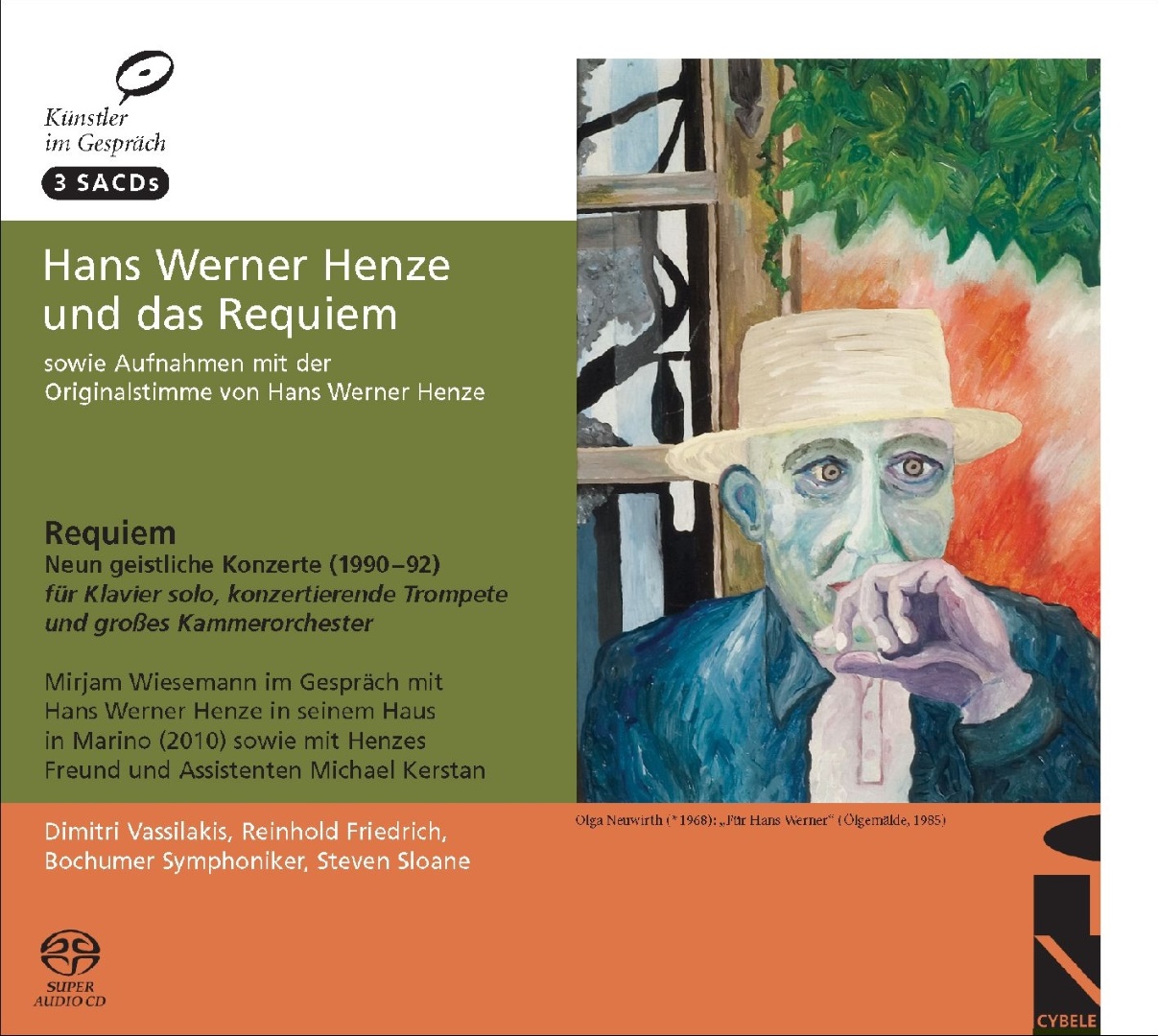
The only previous recording, released in 1994 under Ingo Metzmacher, was no longer available in 2010. The new one was made live on 12 June 2010 in the Alfried Krupp Saal of the Philharmonie Essen, as part of the Henze Project of the European Capital of Culture RUHR.2010, which Steven Sloane called probably the largest retrospective ever devoted to a living artist. Sloane, general music director of the Bochumer Symphoniker since 1994, conducts; Dimitri Vassilakis, soloist of the Ensemble Intercontemporain, plays the piano part and Reinhold Friedrich the solo trumpet.
Mirjam Wiesemann held the conversations on 17 August 2010 at Henze’s house in Marino near Rome, where he had settled with his partner Fausto Moroni. The conversation with Henze follows the movements of the Requiem: he talks about the war and his father, about Moroni, Ingeborg Bachmann and his daily routine, and about his music theatre piece “Gisela!” for young people. Michael Kerstan, stage director, dramaturge and Henze’s assistant, tells of their joint music projects with young people, for instance in Deutschlandsberg, and of working with Henze. The album was nominated for the International Classical Music Awards; MusicWeb International chose it as Recording of the Month.