
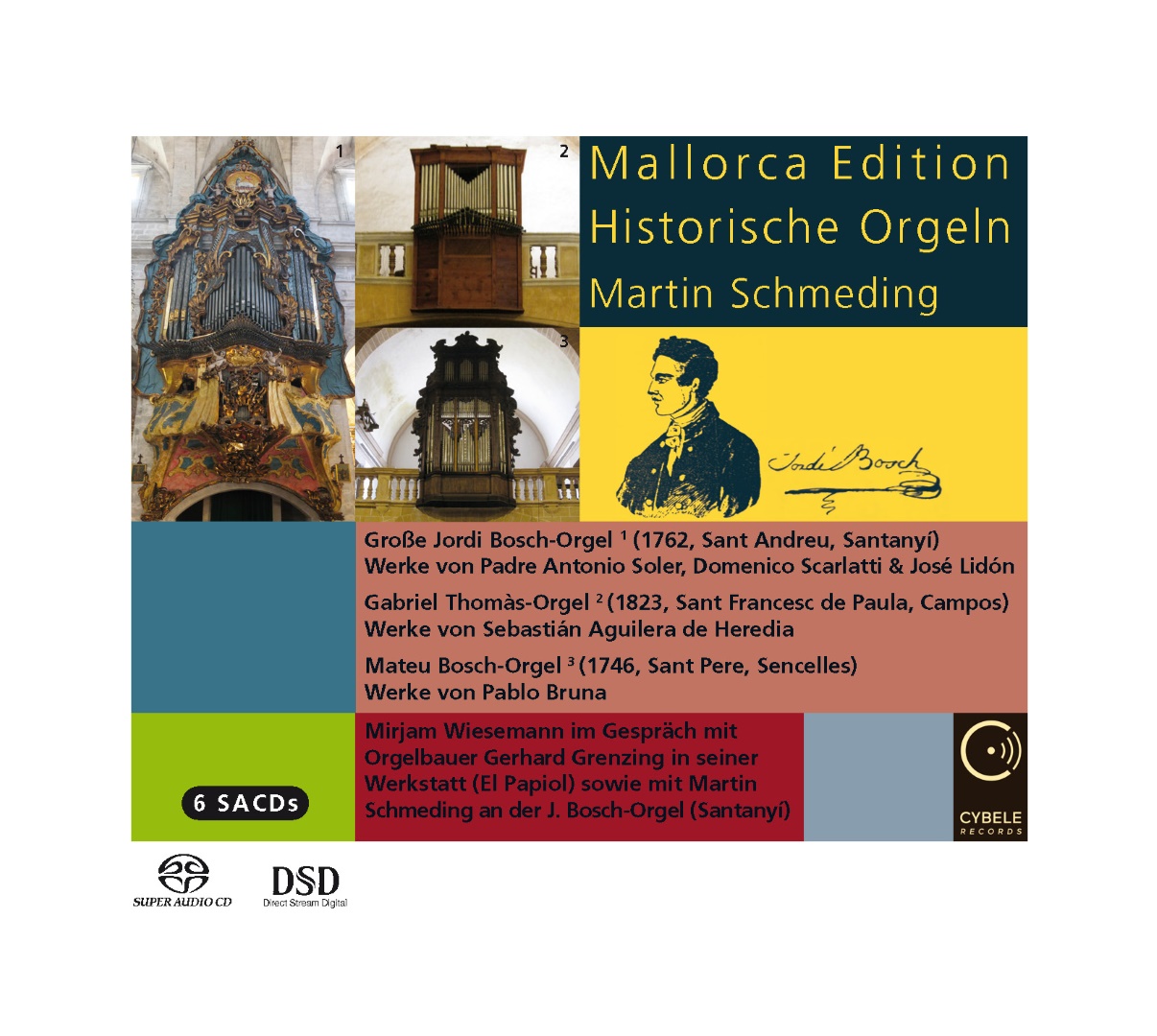
The Mallorca Edition Historic Organs comprises five SACDs of organ music, recorded by Martin Schmeding in 2011 on three historic instruments of the island, and a sixth with conversations that Mirjam Wiesemann held with him and with the organ builder Gerhard Grenzing. Each composer is given a disc of his own. The first three volumes, with works by Padre Antonio Soler, Domenico Scarlatti and José Lidon, were made in Santanyi; with these composers, as Schmeding writes in the booklet, music takes the step from the high Baroque to Classicism and early Romanticism.
Like Scarlatti, Soler was the son of a musician. As a boy he sang in the Escolania of the monastery of Montserrat, where his teachers included José Elias, a pupil of Juan Bautista Cabanilles, and in 1744, aged just 15, he became director of music at Lleida Cathedral. He later joined the Hieronymite order; from 1752 he was organist, director of music and cleric at the royal monastery of El Escorial. Besides sacred vocal music he wrote some 120 keyboard sonatas there, chiefly for the instruction of Prince Don Gabriel. Whether his description of himself as “scolare di Sr. Scarlatti” in a letter to Padre Martini refers to a direct teacher–pupil relationship is uncertain.
Soler adopted Scarlatti’s two-part sonata form but favoured shorter phrases, interpolated fermatas for improvised cadenzas, abruptly contrasting motifs and frequent modulations. The alternation of tonal and modal turns, augmented intervals, virtuoso repetitions of motifs within a narrow compass and Spanish dance rhythms mark the Sonata 48 en Modo Dorico, the Sonata 80 en Modo Dorico and the Sonata 117 en Modo Dorico (Re Menor). He was equally at home in Baroque polyphony, as the Sonata 65 shows, an intento that works out its theme and inversion on a large scale; the Sonata 33 en Sol Mayor and the Sonata 44 en Do Mayor, by contrast, recall the sonata movements of Viennese Classicism.
Most of Soler’s sonatas were probably conceived for harpsichord; the Sonata 4 en Sol Mayor, the Sonata 12 “de la Coroniz” en Sol (Fa) Mayor and the Sonata de Clarines 54 en Do Mayor, however, reveal an organist who knew the fanfare effects of the Spanish trompeteria intimately. The Sonata 28 en Do Mayor and the Sonata pastoril 42 en Mi Mayor take up the pastoral manner of the time with simple ostinato bass figures. The album ends with the Fandango, at over 13 minutes its longest piece: an almost endless chain of virtuoso variations over an ostinato harmonic framework, as is characteristic of the dance, originally accompanied by guitar and castanets. Soler exploits the resources of the harpsichord style developed by Scarlatti, inserts Classical turns of phrase and even lets pungent bitonal harmonies stand side by side.
The recordings were made in April 2011 in the parish church of Sant Andreu, the heart of the small town of Santanyi in south-eastern Mallorca. Its organ had been built by Jordi Bosch in 1762 for the Dominican monastery in Palma; after the dissolution of the monastic orders it came to Santanyi in 1837, where lack of space meant it was only partially re-erected. Gerhard Grenzing has looked after the instrument since 1982. The edition was placed on the Bestenliste 3/2017 of the Preis der deutschen Schallplattenkritik, nominated for the International Classical Music Awards (ICMA) 2017 (Best Collection) and named Recording of the Month by MusicWeb International.