
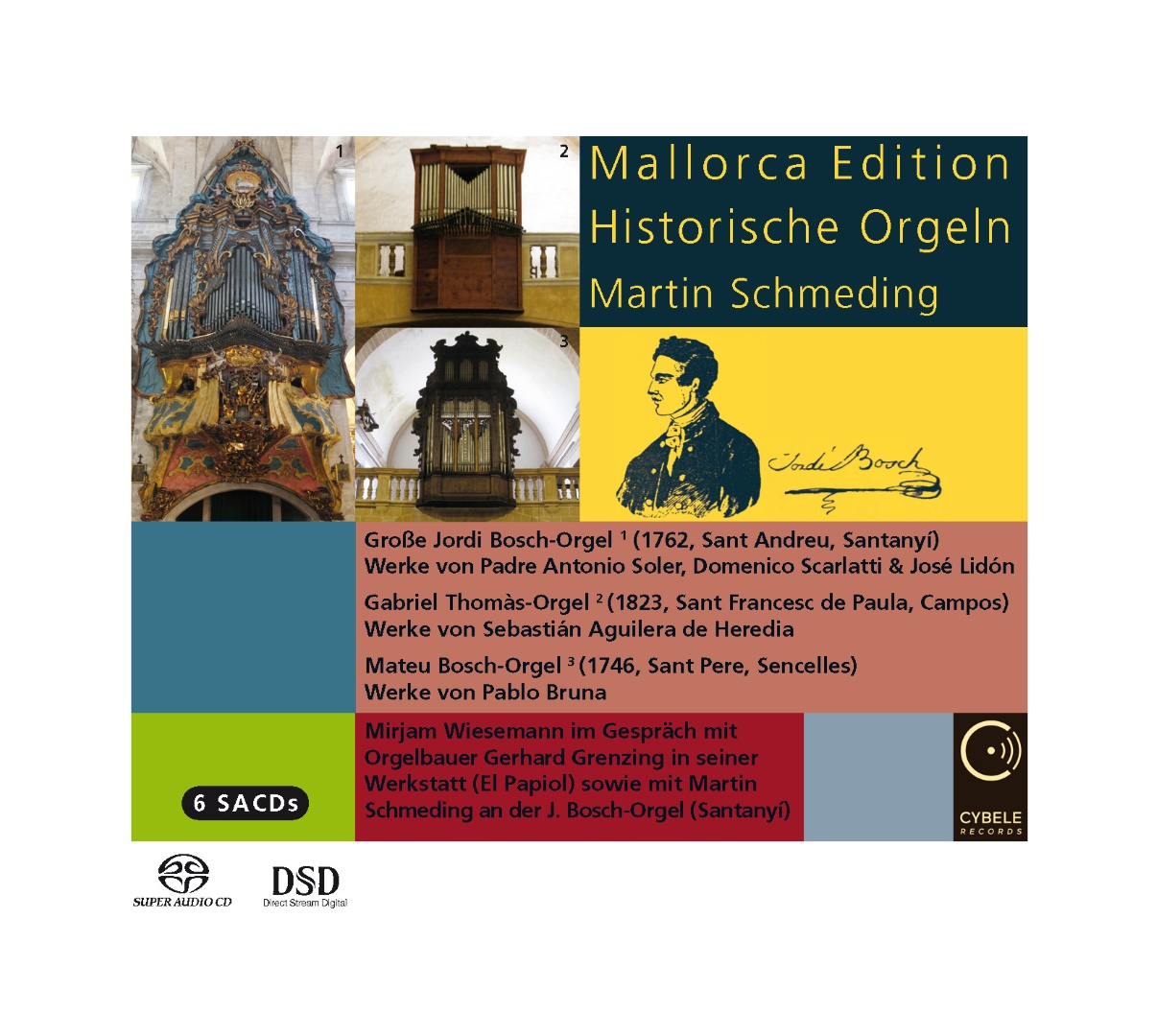
Cybele 001404-2 2017

DSD Stereo Surround Classical music Baroque music 1:16:41

To the description

Mallorca Edition Historic Organs (Vol. 2)

Contributors

Martin SchmedingOrgan

Composer

Domenico Scarlatti

Short description

More than 500 sonatas by Domenico Scarlatti have survived, most of them written for harpsichord. For the second volume of the Mallorca Edition Historic Organs Martin Schmeding has chosen 25 that suit the organ: fugues such as the Sonata K. 30 in G minor, known as the “Cat Fugue”, two sonatas with original indications of manuals and stops, pieces in fanfare style, birdsong, a pastorale and virtuoso sonatas full of runs and hand-crossings. He plays them on Jordi Bosch’s great organ of 1762 in Sant Andreu, Santanyi, whose trompeteria and flautas dobles lend several of these pieces their colour.

Details

Carrier format
Hybrid SACD

Resolution
DSD64 / 2.8224 MHz 1 bit

Total playing time
76:44

Channels
Stereo, 5.0 surround

Organ
Great Jordi Bosch organ (1762; 2 manuals and pedal), Sant Andreu, Santanyi (Mallorca)

Recording
April 2011, Sant Andreu, Santanyi (Mallorca)

Booklet
German and English, 96 pages, digipak

Recording Producer: Ingo Schmidt-Lucas

With kind support from Orgelbau Gerhard Grenzing

Awards

Preis der deutschen Schallplattenkritik — Best-of list 3/2017

International Classical Music Awards (ICMA) — Nomination 2017, Best Collection

MusicWeb International — Recording of the Month

Diapason — 5 Diapason of the Month

klassik.com — Recommended by klassik.com

Press reviews

Specifications

Catalogue number
Cybele 001404-2
Year of release
2017
Genre
Classical music
Period
Baroque music
Instrumentation
Organ, Solo instrument
Label
Cybele Records
Barcode
809548015022
GTIN
4099885249181
Booklet (pages)
96

Track listing

25 tracks · 1:16:41

  1. 01 Sonata K. 159 in C major (B flat major) Composer: Domenico Scarlatti (1685-1757) Performer: Martin Schmeding 2:39
  2. 02 Sonata K. 1 in D minor – Allegro Composer: Domenico Scarlatti (1685-1757) Performer: Martin Schmeding 2:55
  3. 03 Sonata K. 32 in D minor – Aria Composer: Domenico Scarlatti (1685-1757) Performer: Martin Schmeding 1:14
  4. 04 Sonata K. 33 in D major Composer: Domenico Scarlatti (1685-1757) Performer: Martin Schmeding 3:16
  5. 05 Sonata K. 93 in G minor – Fuga Composer: Domenico Scarlatti (1685-1757) Performer: Martin Schmeding 4:17
  6. 06 Sonata K. 274 in F major – Andante Composer: Domenico Scarlatti (1685-1757) Performer: Martin Schmeding 2:43
  7. 07 Sonata K. 2 in G major – Presto Composer: Domenico Scarlatti (1685-1757) Performer: Martin Schmeding 2:10
  8. 08 Sonata K. 287 in C major “Per Organo da camera con due Tastatura Flautato è Trombone” – Andante Allegro Composer: Domenico Scarlatti (1685-1757) Performer: Martin Schmeding 2:36
  9. 09 Sonata K. 288 in C major – Allegro Composer: Domenico Scarlatti (1685-1757) Performer: Martin Schmeding 2:02
  10. 10 Sonata K. 61 in A minor Composer: Domenico Scarlatti (1685-1757) Performer: Martin Schmeding 3:40
  11. 11 Sonata K. 30 in G minor – Fuga. Moderato Composer: Domenico Scarlatti (1685-1757) Performer: Martin Schmeding 4:42
  12. 12 Sonata K. 82 in F major Composer: Domenico Scarlatti (1685-1757) Performer: Martin Schmeding 3:03
  13. 13 Sonata K. 380 in D major (E major) – Andante comodo Composer: Domenico Scarlatti (1685-1757) Performer: Martin Schmeding 3:00
  14. 14 Sonata K. 328 in G major – Andante comodo Composer: Domenico Scarlatti (1685-1757) Performer: Martin Schmeding 3:12
  15. 15 Sonata K. 12 in G minor – Presto Composer: Domenico Scarlatti (1685-1757) Performer: Martin Schmeding 2:10
  16. 16 Sonata K. 417 in D minor – Fuga. Allegro moderato Composer: Domenico Scarlatti (1685-1757) Performer: Martin Schmeding 5:28
  17. 17 Sonata K. 52 in D minor – Andante moderato Composer: Domenico Scarlatti (1685-1757) Performer: Martin Schmeding 4:53
  18. 18 Sonata K. 31 in G minor – Allegro, Andante, Allegro Composer: Domenico Scarlatti (1685-1757) Performer: Martin Schmeding 2:53
  19. 19 Sonata K. 255 in C major – Allegro Composer: Domenico Scarlatti (1685-1757) Performer: Martin Schmeding 2:49
  20. 20 Sonata K. 473 in B flat major – Allegro molto Composer: Domenico Scarlatti (1685-1757) Performer: Martin Schmeding 2:36
  21. 21 Sonata K. 58 in C minor – Fuga Composer: Domenico Scarlatti (1685-1757) Performer: Martin Schmeding 3:18
  22. 22 Sonata K. 330 in C major – Allegro Composer: Domenico Scarlatti (1685-1757) Performer: Martin Schmeding 2:10
  23. 23 Sonata K. 513 in C major – Pastorale. Moderato, Molto allegro, Presto Composer: Domenico Scarlatti (1685-1757) Performer: Martin Schmeding 3:10
  24. 24 Sonata K. 377 in B minor – Allegrissimo Composer: Domenico Scarlatti (1685-1757) Performer: Martin Schmeding 2:32
  25. 25 Sonata K. 517 in D minor – Prestissimo Composer: Domenico Scarlatti (1685-1757) Performer: Martin Schmeding 3:13

Description

In the spring of 1708 two 23-year-old musicians met for a contest at the palazzo of Cardinal Pietro Ottoboni in Rome, Georg Friedrich Händel and Domenico Scarlatti; at the organ, Scarlatti himself is said to have conceded Händel’s superiority. The son of Alessandro Scarlatti, who had already made his name as an opera composer, court organist and maestro di cappella in Naples, Venice and Rome, became maestro di cappella at St Peter’s in 1714. In 1719 he moved to the court in Lisbon, where his chief task was teaching Princess Maria Barbara, in whose retinue he remained until his death in 1757. After her marriage to the Spanish Crown Prince Ferdinand VI in 1729, he concentrated on teaching and composing for harpsichord, first in Seville and from 1733 in Madrid.

In his more than 500 surviving sonatas Scarlatti combines technical refinement with a delight in harmonic, rhythmic and melodic experiment. Spanish folk music was not mere local colour for him but entered the substance of his works, taking him away from the conservative, polyphonic aesthetic of the Spanish Baroque composers. According to Charles Burney (1773), Scarlatti held that a man of genius need observe scarcely any rule other than not to displease the ear.

Since fugal form is especially suited to the organ, this volume includes several fugues. The Sonata K. 30 in G minor from the “Essercizii”, printed in London in 1738, acquired the nickname “Cat Fugue”: in its unaccompanied opening the notes of the theme sound like an atonal succession, as if a cat were leaping across the keys, although all of them can be heard as leading notes within the underlying harmony. The Sonata K. 58 in C minor draws its appeal from the descending chromaticism of its theme; in the expansive Sonata K. 417 in D minor a continuous quaver counterpoint leads to a closing stretto in which the old fugal style and the modern figurative style meet. The Sonata K. 93 in G minor is more conservative in design, its long final pedal point pointing to the organ.

Some sonatas bear traces of being meant for the organ. The Sonata K. 287 in C major “Per Organo da camera con due Tastatura Flautato è Trombone” and the Sonata K. 288 in C major contain original indications of the two manuals, the registration and, with arrows, the changes of manual; in the Sonata K. 328 in G major passages are marked Organo and Flauto. Sonatas in fanfare style such as the Sonata K. 159 in C major (B flat major) can be transferred to the trompeteria, and the dissonant suspensions of the Sonata K. 52 in D minor sound on the flautas dobles, two flute stops tuned to beat against each other.

The organ of Sant Andreu, on which Schmeding recorded in April 2011, has two manuals, Organo Mayor and Cadireta, with stops divided into bass and treble, and a pedal of eight notes. In the booklet Gerhard Grenzing describes how Jordi Bosch broke with the tradition of the island, whose organs still reflected the spirit of the Renaissance: he built a mixture of 22 to 25 ranks which, with 1128 of the organ’s 2472 pipes, is considered the largest in the world, a magnificent trompeteria, a wooden 16’ trombone, broad slots for tuning the pipes and a double wind chest. Diapason awarded the edition “5 Diapason”, and klassik.com recommended it.

Concert calendar