
Cybele 001404-3 2017

DSD Stereo Surround Classical music Baroque music 1:14:08

To the description

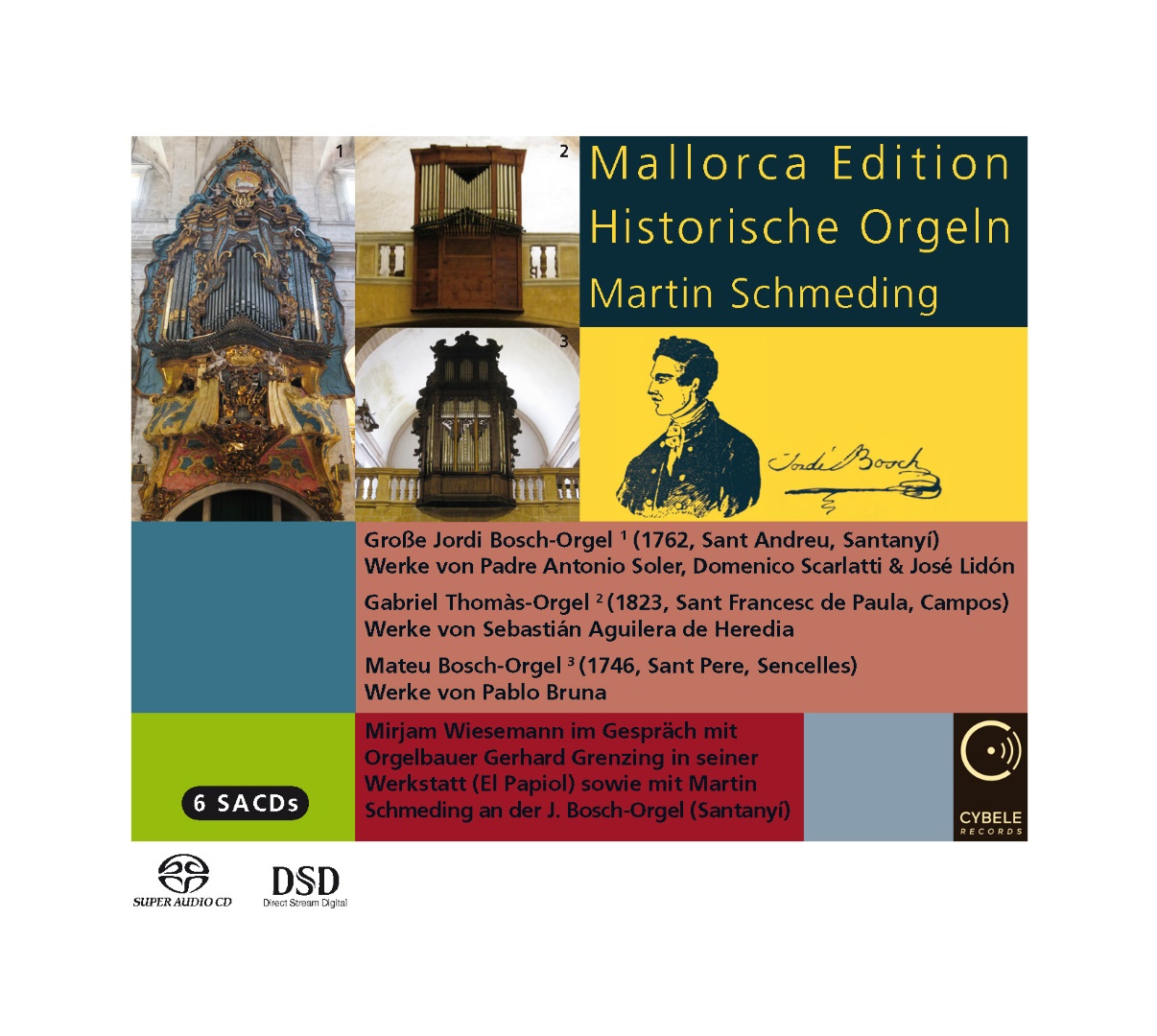
Mallorca Edition Historic Organs (Vol. 3)

Contributors

Martin SchmedingOrgan

Composer

José Lidon

Short description

José Lidon (1748–1827) became first organist of the Royal Chapel in Madrid in 1787, where he played an organ built by Jordi Bosch in 1778. His organ works, as Martin Schmeding shows in the booklet, are tailored precisely to the type of organ that Bosch had created in 1762 with the instrument that now stands in Santanyi. On that very organ Schmeding plays, in the third volume of the Mallorca Edition Historic Organs, versets and pieces for the Mass, sonatas for the trumpet stops, miniatures in the Classical style and the large-scale Sonata de 6° tono in F major.

Details

Carrier format
Hybrid SACD

Resolution
DSD64 / 2.8224 MHz 1 bit

Total playing time
74:09

Channels
Stereo, 5.0 surround

Organ
Great Jordi Bosch organ (1762; 2 manuals and pedal), Sant Andreu, Santanyi (Mallorca)

Recording
April 2011, Sant Andreu, Santanyi (Mallorca)

Booklet
German and English, 96 pages, digipak

Recording Producer: Ingo Schmidt-Lucas

With kind support from Orgelbau Gerhard Grenzing

Awards

Preis der deutschen Schallplattenkritik — Best-of list 3/2017

International Classical Music Awards (ICMA) — Nomination 2017, Best Collection

MusicWeb International — Recording of the Month

Diapason — 5 Diapason of the Month

klassik.com — Recommended by klassik.com

Press reviews

Specifications

Catalogue number
Cybele 001404-3
Year of release
2017
Genre
Classical music
Period
Baroque music
Instrumentation
Organ, Solo instrument
Label
Cybele Records
Barcode
809548015022
GTIN
4099885249228
Booklet (pages)
96

Track listing

20 tracks · 1:14:08

  1. 01 Seis Piezas o Sonatas sueltas – I. Largo, Yntento Composer: José Lidon (1748-1827) Performer: Martin Schmeding 4:35
  2. 02 Seis Piezas o Sonatas sueltas – II. Allegro Composer: José Lidon (1748-1827) Performer: Martin Schmeding 4:22
  3. 03 Seis Piezas o Sonatas sueltas – III. Without indication Composer: José Lidon (1748-1827) Performer: Martin Schmeding 4:29
  4. 04 Seis Piezas o Sonatas sueltas – IV. Allegretto Composer: José Lidon (1748-1827) Performer: Martin Schmeding 5:01
  5. 05 Seis Piezas o Sonatas sueltas – V. Without indication Composer: José Lidon (1748-1827) Performer: Martin Schmeding 4:02
  6. 06 Seis Piezas o Sonatas sueltas – VI. Allegretto Composer: José Lidon (1748-1827) Performer: Martin Schmeding 2:40
  7. 07 Sonata para Clave in G major Composer: José Lidon (1748-1827) Performer: Martin Schmeding 2:55
  8. 08 Sonata de 1er tono Composer: José Lidon (1748-1827) Performer: Martin Schmeding 3:31
  9. 09 Capricho de organo Composer: José Lidon (1748-1827) Performer: Martin Schmeding 2:51
  10. 10 Adagio y Allegro comodo Composer: José Lidon (1748-1827) Performer: Martin Schmeding 3:29
  11. 11 4 Piezas para la Misa – I. Cantabile para organo al alzar en la Misa (Andante amoroso) Composer: José Lidon (1748-1827) Performer: Martin Schmeding 4:53
  12. 12 4 Piezas para la Misa – II. Ofertorio (Allegro) Composer: José Lidon (1748-1827) Performer: Martin Schmeding 2:32
  13. 13 4 Piezas para la Misa – III. Elevacion (Andante devoto) Composer: José Lidon (1748-1827) Performer: Martin Schmeding 4:59
  14. 14 4 Piezas para la Misa – IV. Allegro Composer: José Lidon (1748-1827) Performer: Martin Schmeding 3:06
  15. 15 Sonata in F major – Allegretto Composer: José Lidon (1748-1827) Performer: Martin Schmeding 4:32
  16. 16 Varios juegos por diferentes tonos de imitacion, en tema de sonata, para varios registros – I. Allegro Composer: José Lidon (1748-1827) Performer: Martin Schmeding 3:04
  17. 17 Varios juegos por diferentes tonos de imitacion, en tema de sonata, para varios registros – II. Allegro comodo Composer: José Lidon (1748-1827) Performer: Martin Schmeding 2:45
  18. 18 Sonata de 6° tono in F major – Preludio (Magestuoso. Allegro vivo, Allegro) Composer: José Lidon (1748-1827) Performer: Martin Schmeding 5:06
  19. 19 Sonata de 6° tono in F major – Andante gustoso Composer: José Lidon (1748-1827) Performer: Martin Schmeding 2:52
  20. 20 Sonata de 6° tono in F major – Allegro con spirito Composer: José Lidon (1748-1827) Performer: Martin Schmeding 2:24

Description

José Lidon’s life and work build on the tonal and compositional achievements of the late Baroque and point the way to early Romanticism. Like Padre Antonio Soler, Lidon came from a musical family; he was trained in the boys’ choir of the Royal Chapel in Madrid. His teacher, the organist and theorist José de Nebra, had years earlier influenced Soler and probably taught him as well. After early success as organist of Ourense Cathedral, as assistant organist of the Royal Chapel and as director of music to the Countess of Benavente, who was in close contact with Joseph Haydn, Lidon was appointed first organist of the Royal Chapel in 1787.

There he had at his disposal a Jordi Bosch organ of 1778 – the work of the same master who, as a young organ builder, had created in 1762 the instrument that now stands in Sant Andreu in Santanyi. According to Schmeding, Lidon’s organ works and their indications for performance are intended precisely for the type of organ that Bosch first realised in Santanyi and brought to completion in the royal organ in Madrid.

Lidon wrote two collections directly for use in the Mass. The Seis Piezas o Sonatas sueltas are conceived as versets in the eighth psalm tone, although the link with the psalmody shows through only loosely. For the 4 Piezas para la Misa he partly gives clear instructions for their liturgical use, as an offertory or for the elevation; they could equally serve as prelude, postlude or epistle sonata between the readings, for which Wolfgang Amadeus Mozart had already written his church sonatas for Salzburg Cathedral.

The other works, for organ or alternatively for clave, show Lidon’s roots in the Spanish style as well as his contact with Joseph Haydn’s Viennese style through his work as director of music. The Sonata de 1er tono, for organ with trumpet, follows Scarlatti and above all Soler in its two-part form and motifs. The Sonata in F major, intended for the Trompeta Real, goes further, combining fanfare motifs with Classical turns of phrase and motivic development. The Sonata de 6° tono in F major is on a particularly large scale. In the Preludio blocks of chords twice alternate with a filigree, virtuoso bicinium, the Andante gustoso uses the division of the Spanish organ into bass and treble for echo effects, and the Allegro con spirito counters with the full organ, the lleno. The Capricho de organo and the Varios juegos por diferentes tonos de imitacion, en tema de sonata, para varios registros bring Classical miniature forms in Spanish sonorities.

Jordi Bosch (1739–1801) was the son of the organ builder Mateu Bosch, who around 1746 built the organs of the monastery of Sant Jeroni in Palma and of Sencelles. Orphaned at twelve, he trained with his uncle Pere Josep and later with Leonardo Fernandez Davila in Granada. Of his large late works only the organ in the Royal Palace in Madrid survives. Gerhard Grenzing restored the Santanyi organ in three stages: the surviving material in 1982, the monumental mixture in 1986 and the large wooden pedal pipes in 2002. The work was also supported by donations; Irmgard Schörghuber made possible the reconstruction of the pedal pipes as well as the cleaning and tuning that Daniel Grenzing carried out in 2011 and without which, according to Gerhard Grenzing, this edition would not have been possible.

Concert calendar