
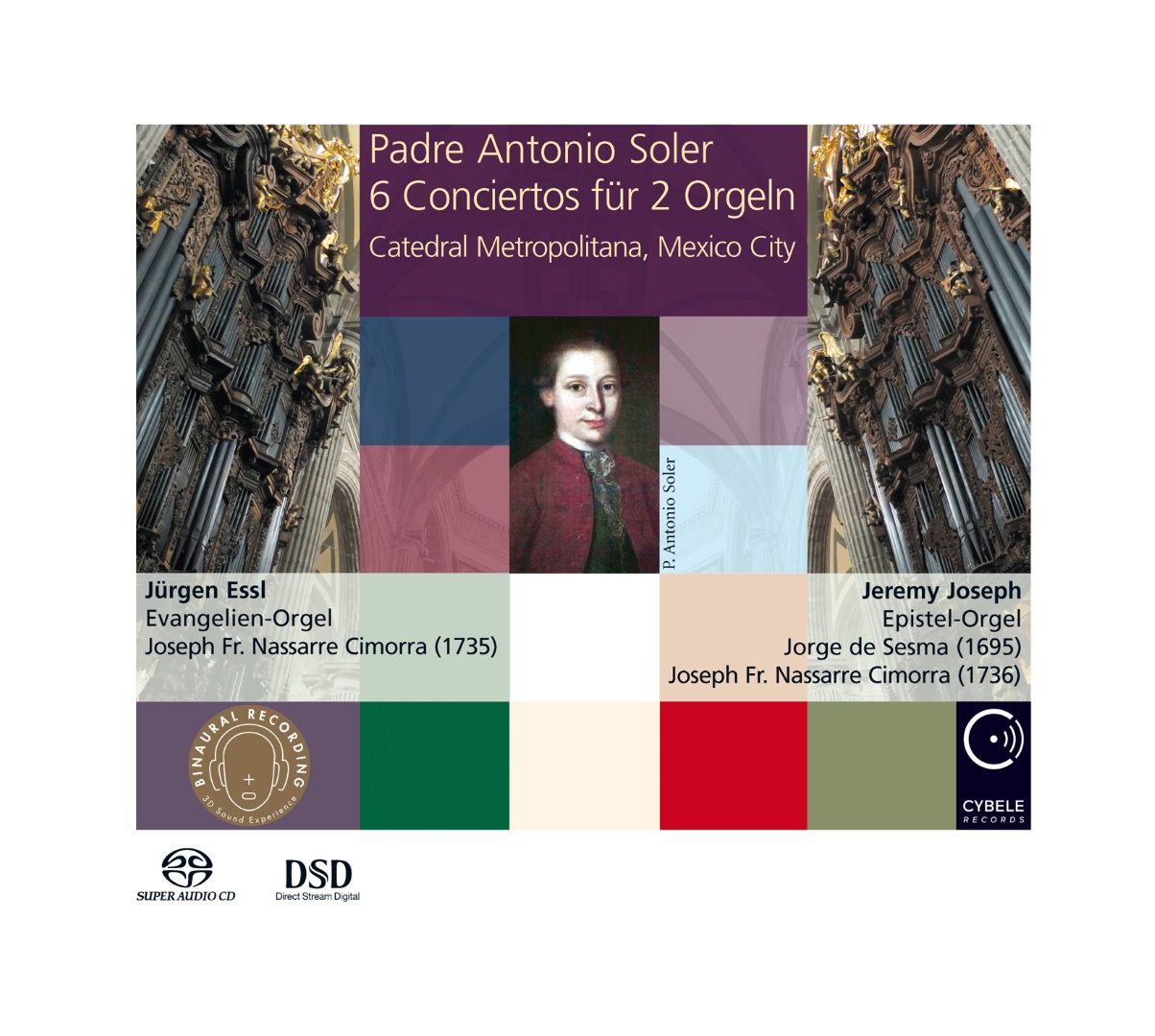
Padre Antonio Soler (1729–1783), after periods in Montserrat and Lérida, entered the Hieronymite order in 1752 at the Spanish court in El Escorial, the palatial monastery near Madrid; he took his vows in 1753 and became maestro de capilla and organist in 1757. There he met, among others, Domenico Scarlatti (1685–1757), the celebrated harpsichordist and composer of more than 550 harpsichord sonatas. Soler for his part added no fewer than 144 more to the genre of the (mostly single-movement) sonata. That the two were on good terms is evident from Soler’s style, which shows a strong kinship with Scarlatti — in the return of musical elements, in a form articulated by repetition and in the use of Spanish folk music, which we meet here and there in his six Conciertos für 2 Orgeln R. 463 (145) of 1770.
Form and content suggest that this is not music for a church with two facing organs but courtly entertainment music for a hall of the monastery of El Escorial.
For this SACD recording we chose two historical instruments of overwhelming colour, which offer sonic possibilities enough to distinguish the two parts in any situation one might wish. The two organs also represent ideally the sonic ideals and the wealth of colour of Spanish music in the middle of the 18th century. The presence of the echo manual and of the outer nave cases likewise gives a new dimension to the rendering of echoes, responses and continuo playing. The splendour of the reeds thus draws these works out of their chamber-music corner, and the possibilities of the two historical organs in the Catedral Metropolitana open up the cosmos of the score afresh.
Bigger, finer, louder: that might be one’s first impression of the two organs, and their patrons certainly had such notions of displaying immense wealth and overwhelming power. And yet the organ builder Joseph Francisco Nassarre Cimorra (1701–1737) succeeded in fitting the two instruments harmoniously into the choir stalls; the sheer size of the space even makes them appear delicate.
For the listener too it is thrilling to hear how the organists’ musical dialogues unfold and blossom in the magnificent space of the Catedral Metropolitana, captured very realistically both in 5.1ch surround sound and by the 3D binaural stereo recording technique. As historical instruments, the twin organs of 1735/36 also hold a very particular potential, so that on listening back the results sometimes surprise even the players themselves…