
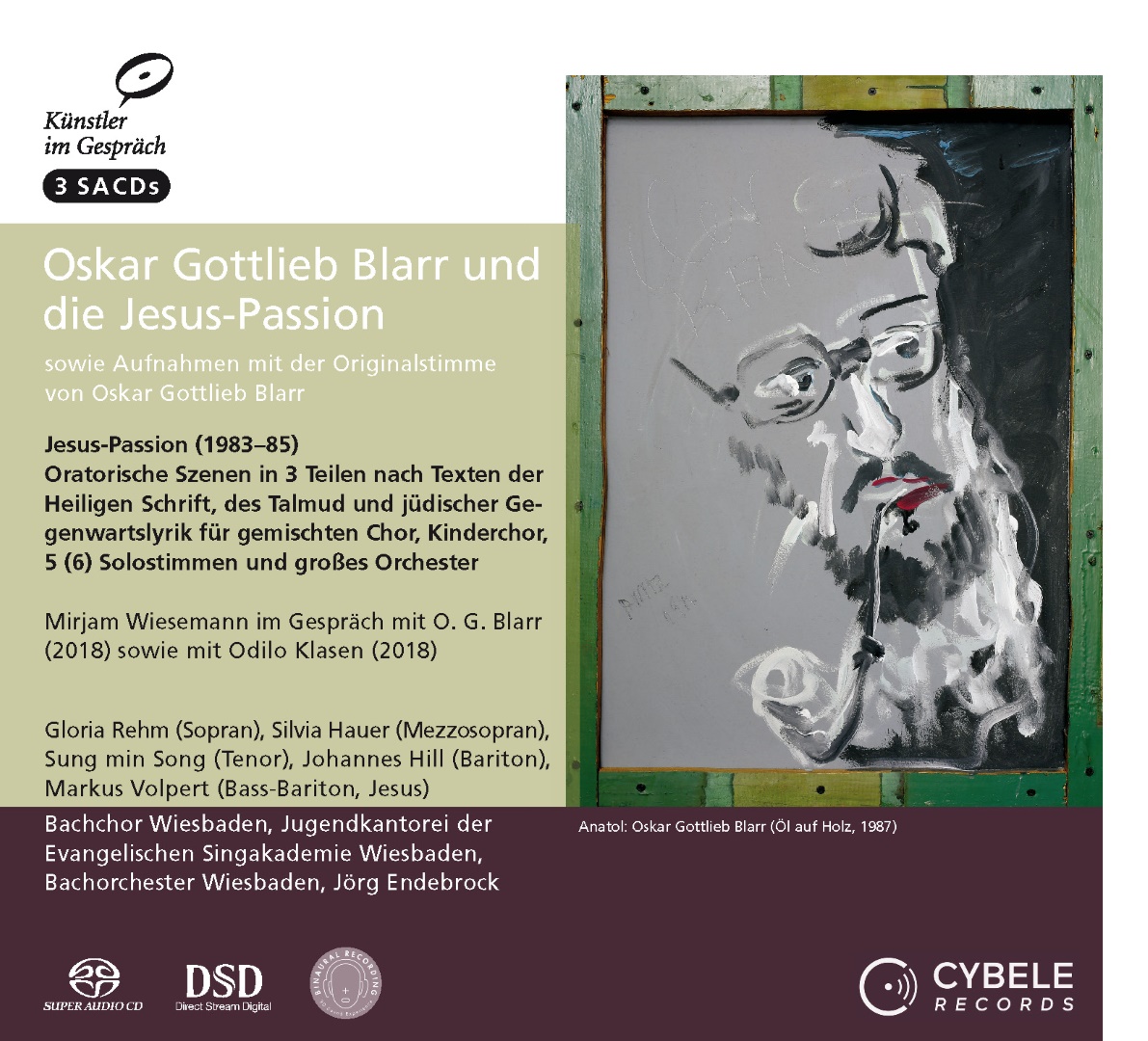
Edition Künstler im Gespräch Vol. 10 – If I do not believe, then the organ as the voice of God is a figment of the imagination (Oskar Gottlieb Blarr).
In conversation with Mirjam Wiesemann (SACD 2/3), O. G. Blarr answered every question together with the personal reflections, associations and memories that first breathe life into the whole. As the organist and composer Odilo Klasen (heard on SACD 3) so aptly observes in his doctoral thesis of more than 500 pages on O. G. Blarr:
„Blarr recognised very early that, if demanding contemporary music is to be understood, its reception needs something beyond the abstract — an image, a story, even an anecdote, a hint towards inspiration; in short, an element outside the absolutely musical, outside analysis, outside purely musical craft and substance.“
According to Klasen, the secret of the success of the Jesus-Passion (SACD 1/2) — a live recording of 30 March 2018 from the Lutherkirche Wiesbaden — likewise lies in one of the particular qualities of Blarr’s style: that it can be „grasped immediately“, „even by someone with no knowledge whatever of these complex processes“. The consistently enthusiastic response of audiences and press to the 26 performances of the oratorio given so far, between the première in 1985 and 2018, speaks for itself in this respect.
Beginning with his accounts of his youth in East Prussia, the flight of 1945 and the stations of his life up to 1961, when he settled in Düsseldorf, where he still lives today, one can follow with fascination how the seeds of many deep early impressions were able to develop and unfold almost in full over the course of his life: his grandfather’s black, broad-brimmed hat, symbol of the free and self-determined man, which became Blarr’s visual trademark; the great forge fire and the rhythmic noises in his father’s smithy, which prompted him to study percussion; and, crucially, the organ of Bartenstein, which left indelible impressions on the young Oskar Gottlieb Blarr: „I would certainly never have become an organ person if I had not played that organ in my earliest childhood years (1938-1945)… !“, as the composer puts it.
With his Jesus-Passion, Blarr sets out to tell a story free of antisemitism, and in his conversation with Mirjam Wiesemann he distances himself very clearly from J. S. Bach’s St John and St Matthew Passions.
In our own time, when hatred of Jews as well as hostility towards foreigners in general has again reached new and alarming proportions, this is an essential point, and one that sets an example.