
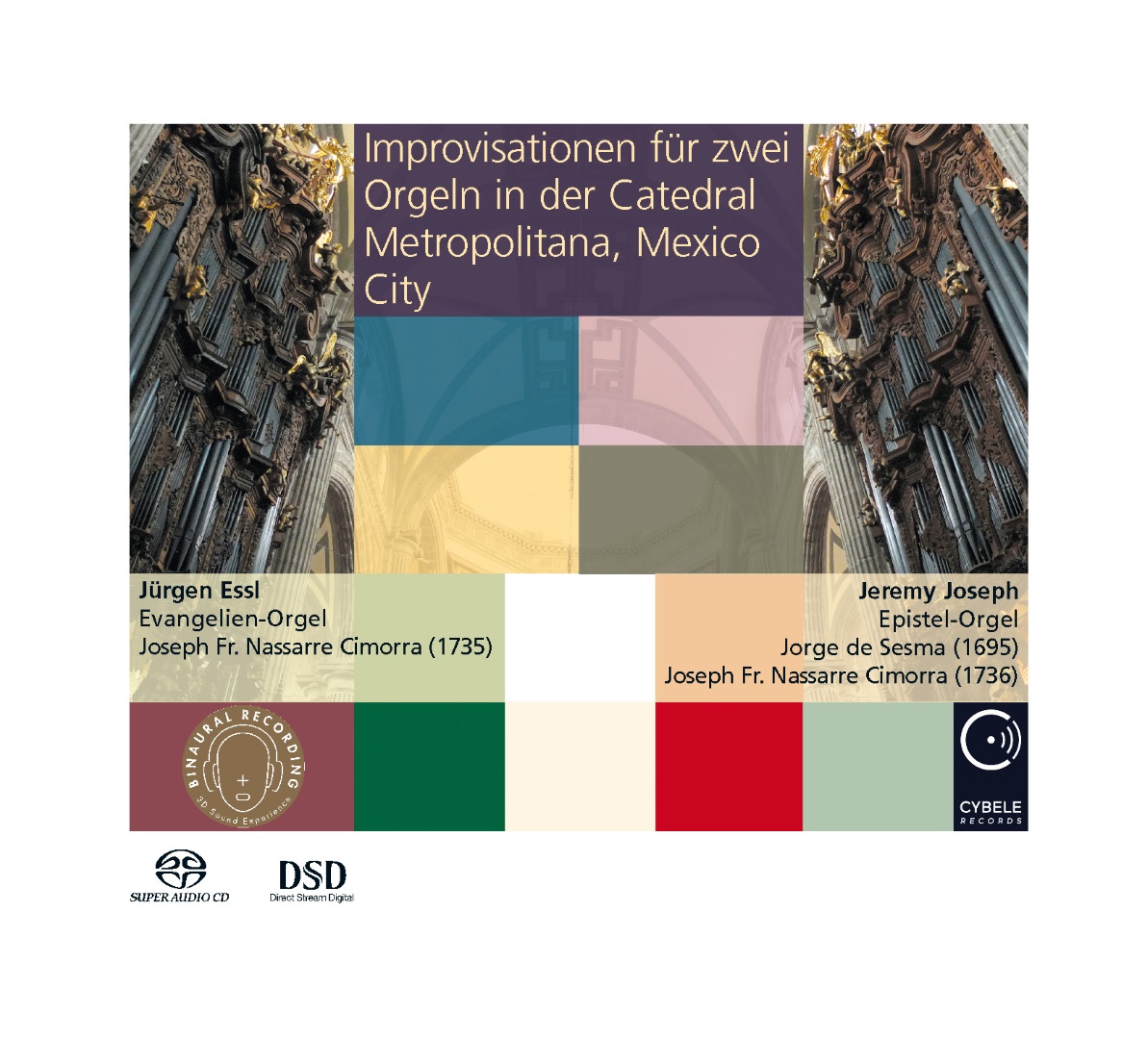
The Catedral Metropolitana stands on the Zocalo, officially the Plaza de la Constitucion, at the heart of Mexico City, together with the Palacio Nacional, the office of the president, and the Palacio Municipal. It is one of the largest city squares in the world and at the same time the centre of the country’s national identity. Inside, two historic twin organs face each other: the Gospel organ built by Joseph Francisco Nassarre Cimorra in 1735, and the Epistle organ of 1695 by Jorge de Sesma, rebuilt by Nassarre in 1736. Jürgen Essl plays the one, Jeremy Joseph the other.
“Art is not a hermetic matter,” the booklet says, “certainly not in the case of the Catedral Metropolitana.” The two organists were in the city from 30 April to 9 May 2018 and witnessed both Workers’ Day and the 5th of May, on which the battle at Puebla of 1862 is celebrated. At night a saxophonist played at the edge of the square; dancing drummers with rattling ankle cuffs filled the surroundings with a sound so penetrating that no recording was possible inside the church; out-of-tune barrel organs, once imported from Berlin, droned on with their European waltzes — fortunately only during the day, before the evening sessions. And when there was silence during the two organ concerts on 3 and 4 May, one could hear the miaowing of a kitten trapped behind the choir stalls; the organ tuner José Luis Acevedo set it free.
The programme is entirely improvised. Isang Yun’s sentence that music is not that which is to be composed but that which is to be birthed stands as the motto of the production. The eleven pieces arose from the interplay of the two instruments, separated from each other by the whole length of the nave — a distance that delays entries and makes the delay itself a musical device. Crossing the Unknown and Pasaje, at over eight and over ten minutes, are the most extended pieces, Torrent and Voladores the shortest; Voladores alludes to the flyers of Papantla, who descend head-first on ropes from a pole.
The recording was made on 3 and 4 May 2018 during two concerts and on 5, 6 and 9 May 2018 in the cathedral, in stereo, 5.1 surround and 3D binaural stereo. This production in particular lives from the spatial recording: the two organs stand far apart, and over headphones it becomes audible from which side each entry comes. The total playing time is 60:08; the booklet appears in three languages, German, English and Spanish, with photographs of the two instruments and of the square outside.