
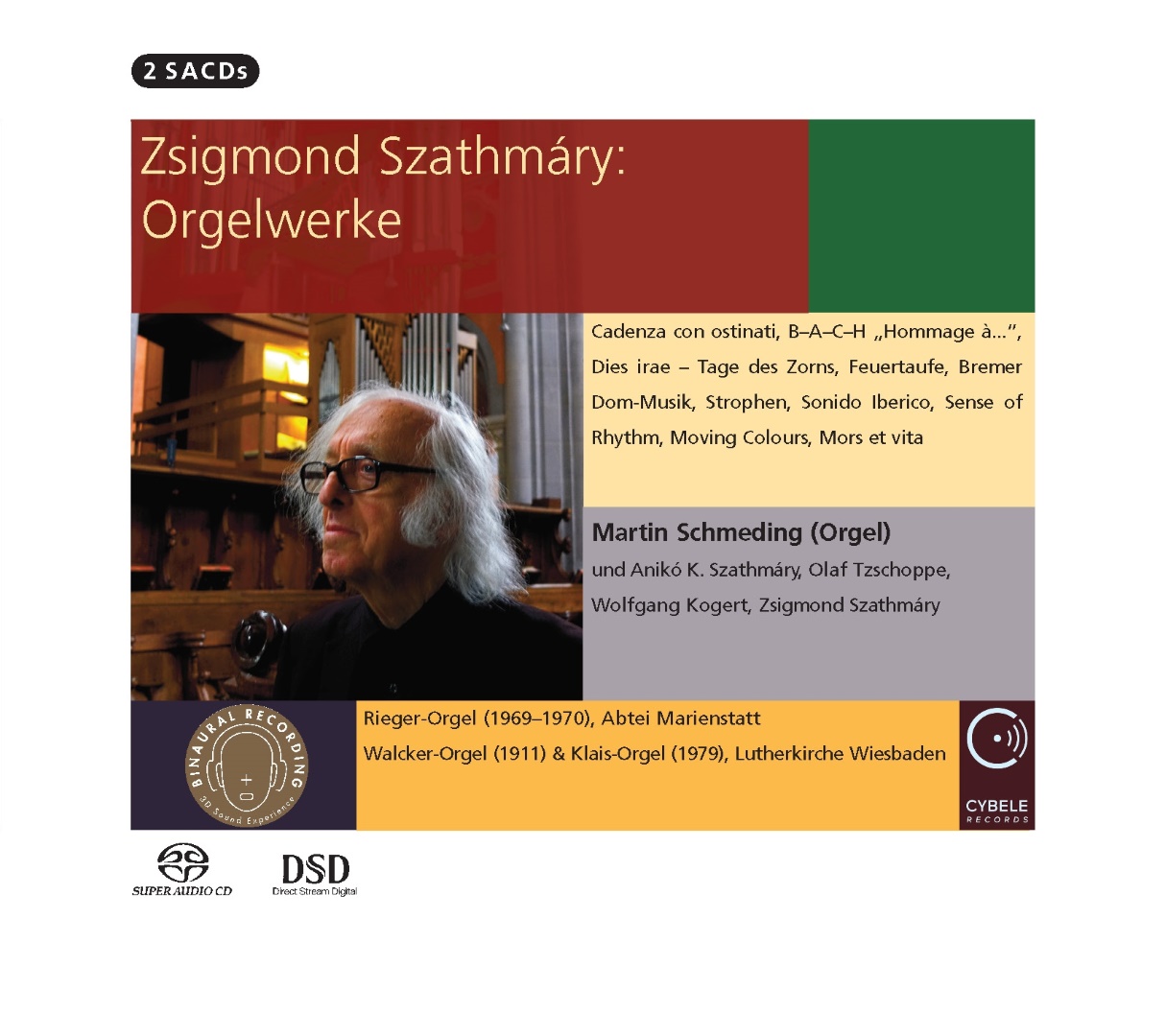
Zsigmond Szathmary, born in Hungary in 1939, unites in one person what has mostly been separate since the nineteenth century: composer, performer and improviser. In the composition class of Kodaly’s pupil Ferenc Szabo — Peter Eötvös was among his fellow students — he was shaped by a rhythmically charged musical language, by folk-music traditions and by the harmony of Bela Bartok. After emigrating to the West he came to know the avant-garde through lessons with Karlheinz Stockhausen and collaboration with György Ligeti. As an organist he succeeded Gerd Zacher in Hamburg-Wellingsbüttel, founded the series Forum Bremer Dom as cathedral organist in Bremen and passed on his knowledge from 1978 as professor of organ in Freiburg. Martin Schmeding, who plays nine of the ten pieces, describes Szathmary’s music as a “work in progress”: work on a piece is never over, every space and every instrument calls for new ideas.
B-A-C-H “Hommage à…” (1994) turns away from the long line of organ works on the name motif. Szathmary writes a virtuoso toccata fantasy in the succession of Buxtehude, Bruhns and Bach’s Fantasia in G minor BWV 542, in which the four notes above all define sonic spaces; the hommage is meant not as quotation but as compositional gesture — polyphony, canon, three-part structure. Cadenza con ostinati (1994) for violin and organ, written for his daughter Aniko and the organist Andreas Jacob, reverses the nineteenth-century division of roles: both instruments are equals, throwing motifs at each other over a repeated pedal trombone until three layers of ostinati break off abruptly. Feuertaufe (2004) was written for the organ festival of San Sebastian and its Cavaillé-Coll organ with its brilliant reeds — hence the double sense of the title, which Szathmary found only after composing. He sees the piece as a five-part toccata in the North German tradition, though without fugues; every contrasting registration is given a staff of its own.
Two works arose from the duo with the percussionist Olaf Tzschoppe. Sense of Rhythm (2011) Szathmary describes as a composition about musical communication: playing together, he says, is like a conversation, a quarrel, a reconciliation. Dies irae – Days of Wrath (2015) commemorates the end of the Second World War on its seventieth anniversary; organ and percussion may be placed apart in the room. Right at the start a siren grows for a full minute from the gentlest depths to the greatest volume, and the tubular bells recall the alarm ringing in the firestorm — one of the rare direct references in Szathmary’s works. Bremer Dom-Musik (2013) was written for the three-thousandth motet at Bremen Cathedral and its two main organs, the romantic Sauer organ in the west gallery and the neo-baroque Bach organ by Van Vulpen in the transept; here Martin Schmeding and Wolfgang Kogert play the Walcker and the Klais organs of the Lutherkirche in Wiesbaden.
Strophen (1988, revised 2001) sets a tape against the organ sound, containing manipulated organ sounds, harpsichord, piano, Japanese koto, noises such as polystyrene and electronically generated sounds. The impulse came from a concert Szathmary spent inside an organ, helping a colleague with mechanical faults: he heard the action rattling and the tremulant throbbing. The motto comes from a Hungarian folk song, which appears in altered form in the eighth of 10+1 strophes. Sonido Iberico (2014) was written for the copy of a Spanish baroque organ built by Joaquin Lois at the Hochschule für Musik in Mainz, after the model of the Batalha de 6o Tom by Pedro de Araujo; Szathmary takes over concepts of colour and form, but seeks above all the Iberian tone and the battaglia character. Moving Colours (2006), a commission from the International Organ Competition Schramberg, is by contrast written for the high-romantic Walcker organ of 1844; repetitions of notes as fast as possible turn sustained tones into moving surfaces, and recurring combinations of stops give the title its sense.
At the end stands Mors et vita (2015), inspired by the third strophe of the Easter sequence Victimae paschali laudes, whose German version Christ ist erstanden ranks among the oldest hymns: death and life fought a duel, the prince of life reigns living. The changing note of a second and the leap of a third at the start of the melody become the melodic and harmonic material; steeply ascending lines and harshly accented beats suggest the breaking of the tombstone. The piece became a requiem for and an hommage to Szathmary’s wife Ai, who died in 2016 and had accompanied him for more than fifty years, and to whose memory he dedicates this collection of his organ works — he plays it himself. The recording was made in the autumn of 2018 at Marienstatt Abbey and in the Lutherkirche in Wiesbaden, with the composer present throughout.