
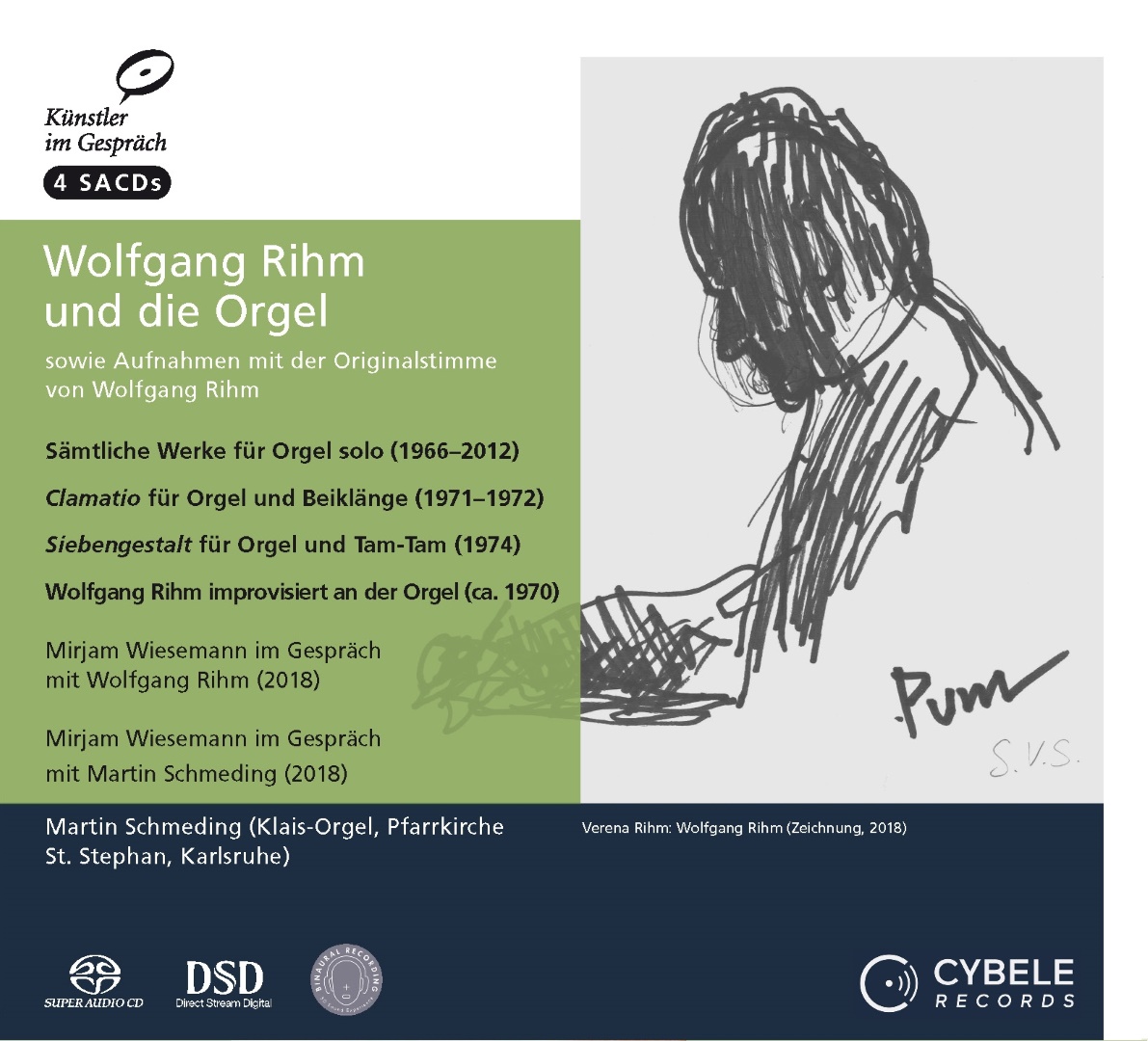
Wolfgang Rihm defies both classification and pigeonholing, Mirjam Wiesemann writes in the booklet — as a person and especially as a composer. In conversation he states, smiling mischievously: You can call what I do whatever you will; it is not something tangible. Even I do not get it… The inclusion of one of his creative phases under the “New Simplicity” label he calls a misinterpretation, a journalistic lapse. More important to him than naming is the wish to achieve something of which he does not yet know anything. He writes his letters, like his scores, by hand: a kind of physis that simultaneously releases the thought as a line from the finger and the writing tool.
From day one the point of departure for his creativity was taking delight in playing. In the 1960s, in his hometown of Karlsruhe, he began spending hours and hours at night improvising on various organs — not brainchildren, but very sensual fruits. The organ, as he says in conversation, was the only instrument he had access to on which he could produce something like a great sound. He began to compose at the age of eleven. That his parents’ household was not an artistic one he considers good fortune: I had no specifications or standards, I could grow wild. That he neglected school and had to repeat a year twice he explains briefly: I simply had too little time for school, I had to do.
Most of the music in this edition comes from those years. The works written between 1966 and 1972 — preludes, fantasias, chorale preludes, meditations, the five organ pieces PIETÀ, the 5 Reflections on the Pietà, Sinfoniae I (Missa), Parusie, Kyrie and Gloria, the Toccata with Fugue in C minor and Postlude — are works of a composer between fourteen and twenty, and two thirds of the organ works recorded here appear on disc for the first time. Three later pieces join them: Clamatio for organ and accompanying sounds (1971-1972) with violin, trombone, cello, percussion, two recorders and members of the Stephanus-Consort Karlsruhe, Siebengestalt for organ and tam-tam (1974) and Bann, Nachtschwärmerei (1980).
In February 2018 Wolfgang Rihm heard these early works at St. Stephan, the very place where they had been written, for the first time in decades and in part for the very first time — during the rehearsals with Martin Schmeding. The organist, who opened up Rihm’s organ output, puts it aptly in conversation with Mirjam Wiesemann: discovering such a blank spot on the organ map is a wonderful thing. Mirjam Wiesemann recorded both conversations in February 2018, with Wolfgang Rihm in his Karlsruhe flat among a huge quantity of books, scores and recordings, with Martin Schmeding in the organ loft of St. Stephan. Rihm speaks about his first attempts at composition, about a gloriously indecent music teacher and his oratorio choir, about the nights at the organ and about profession and private life, the theme of this anniversary volume.
At the close stand previously unreleased improvisations: Wolfgang Rihm at the organ built in 1965 by Wolfgang Scherpf in the parish church of St. Peter und Paul in Karlsruhe-Durlach, recorded by himself around 1970 on analogue tape at 19 cm/s and restored in 2019 at the Cybele Studios. The music was recorded in February and November 2018 on the great Klais organ of St. Stephan. The edition was listed on the Bestenliste of the Preis der deutschen Schallplattenkritik.