
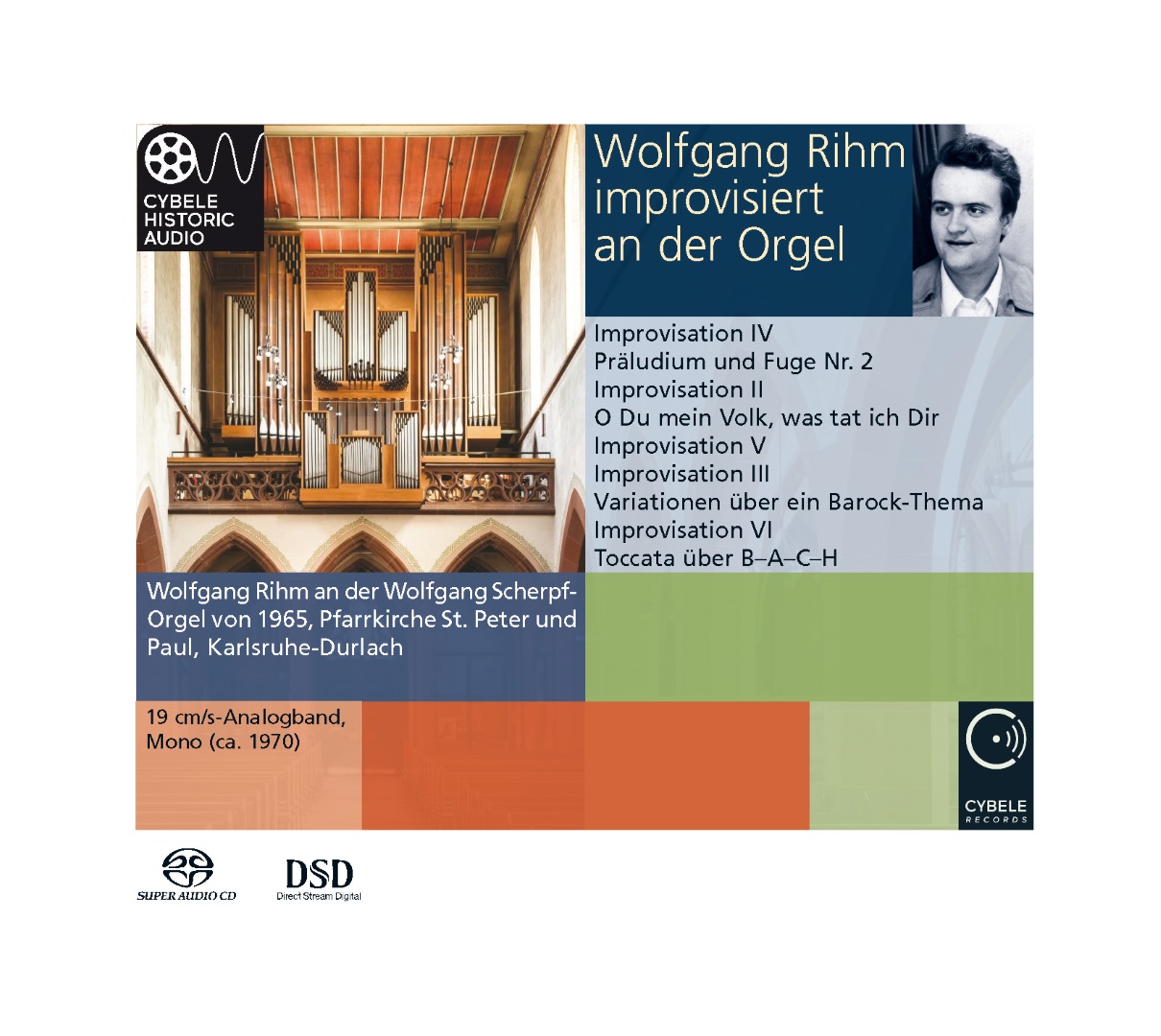
“I composed a lot of organ music back then, from around 1966 to 1970,” recalled Wolfgang Rihm, born in Karlsruhe in 1952, “many organ pieces, little that was pious, mostly resoundingly free-form, childishly pompous.” He never played from a score; with the church key in hand he pounded the organ half the night, with visions “such as being the reincarnation of Reger or the continuation of the French organ symphonists”. For him the organ was the instrument of “great sound”, because who wants to perform an orchestral work by a 15-year-old? Martin Schmeding, author of the booklet, sees in these sessions a root of later hallmarks of his work: “twisting toward something other” at the end of sections, his aversion to any system, his penchant for extremes.
Schmeding places Rihm in the long tradition of improvisation, which until well into the 19th century was a natural part of a musician’s training, and quotes Johann Mattheson’s “Vollkommener Capellmeister” of 1739. Rihm recorded some of his nocturnal “organ sessions” himself on a tape recorder, around 1970, on the organ that Wolfgang Scherpf of Speyer had built in 1965 for the Catholic parish church of St. Peter und Paul in Karlsruhe-Durlach. Almost two hours have survived; the mono tapes are held in the archive of the Paul Sacher Stiftung in Basel. Ingo Schmidt-Lucas digitised them in DSD quality and restored them for this SACD, the first volume of the Cybele Historic Audio series. Further improvisations are included in the edition “Wolfgang Rihm and the Organ” in the Artists in Conversation series.
Most of the nine improvisations selected are free fantasias; Rihm announces some of the titles himself on the tape. Three start from a concrete idea: the virtuoso Toccata on B-A-C-H takes the term “toccare” (to strike, to touch) literally and turns the motif melodically and harmonically in every direction, O Du mein Volk, was tat ich Dir is an improvisation on a song from the Catholic Good Friday liturgy, and in the Variations on a Baroque Theme, the ostinato model La Follia, models such as Arcangelo Corelli shine through behind Rihm’s own language.
Rihm exploits all the organ’s possibilities and “orchestrates” the sound: the softest flute and gedackt colours for sustained textures, string imitations from foundation stops tinged with reeds as in the French symphonic organ, crescendos via the general crescendo pedal up to full organ, and unusual mixtures such as low reeds with high mixtures. Harmonically the range extends from baroque and romantic pastiche through late-romantic chromaticism in the manner of Reger to freely atonal clusters; almost static textures alternate with pulsating ostinatos and rapid chord sequences across all the manuals. Rihm often establishes a clear basic idea, breaks it down or expands it – and at the end suddenly turns to a completely different thought.