
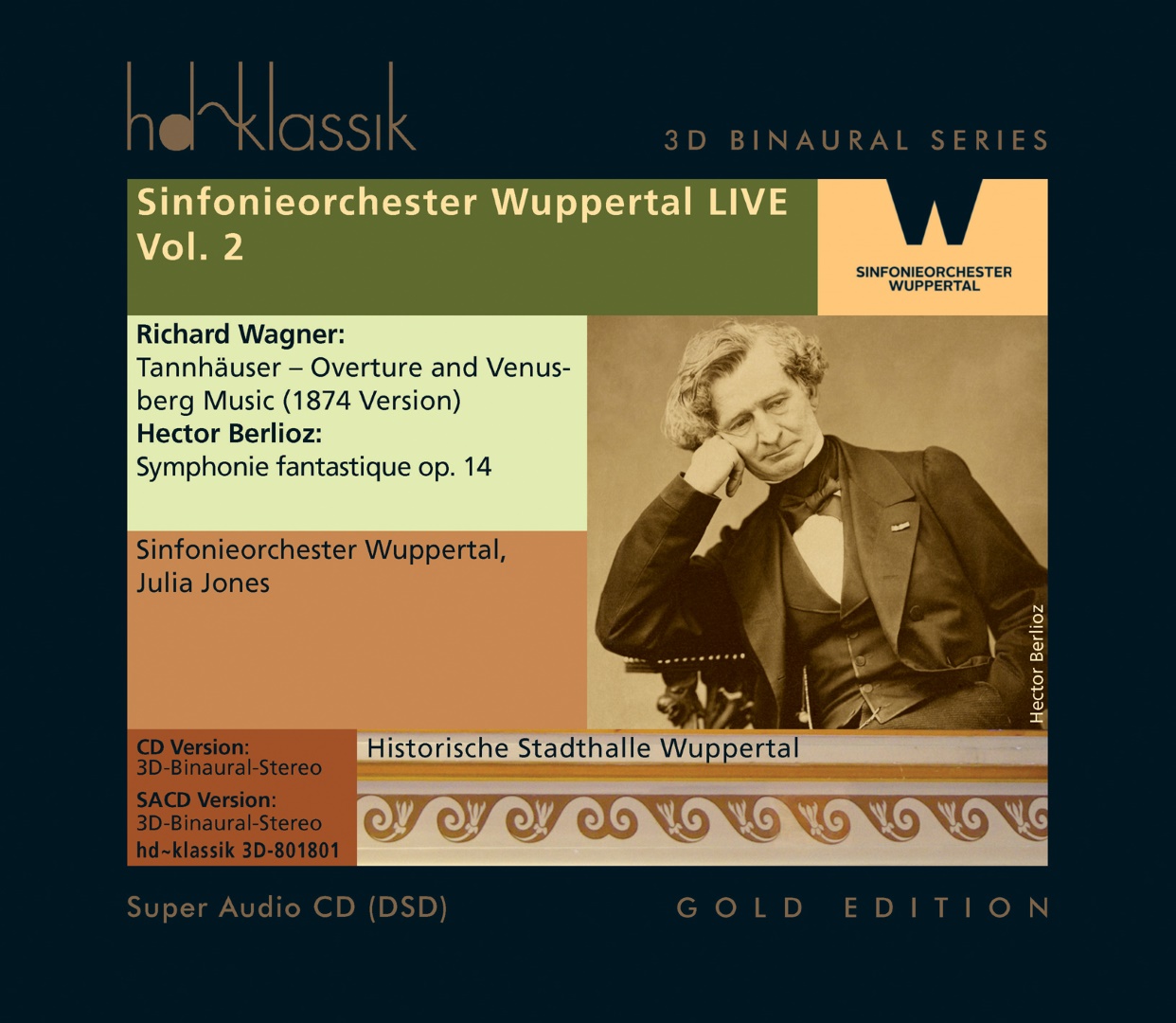
hd-klassik 3D-801801

hd-klassik 3D-801801 2018

3D binaural stereo DSD Classical music Romantic music 1:14:53

To the description

Sinfonieorchester Wuppertal LIVE (Vol. 2)

Contributors

Sinfonieorchester WuppertalOrchestraJulia JonesConductor

Composers

Hector Berlioz · Richard Wagner

Short description

Love, art and society are the theme of the second volume in the Wuppertal live series. Julia Jones, appointed general music director of the Sinfonieorchester Wuppertal in 2016, places Richard Wagner’s “Tannhäuser. Overture and Venusberg Music (1874 Version)” alongside Hector Berlioz’s Symphonie Fantastique Op. 14. In both works the artist’s passion becomes the subject: in Wagner, the conflict between the sensuality of the Venusberg and Elisabeth’s pure love; in Berlioz, a young artist’s unrequited love, which ends in fantasies of murder and punishment and a witches’ sabbath – rooted in the composer’s own passion for the actress Harriet Smithson. The recording was made in March 2018 in the Historische Stadthalle Wuppertal.

Details

Carrier format
Hybrid SACD

Resolution
DSD64 / 2.8224 MHz 1 bit

Total playing time
74:56

Channels
3D binaural stereo

Recording
11/12 March 2018, Historische Stadthalle, Wuppertal (live recording)

Booklet
German and English, 24 pages, digipak

Recording Producer: Ingo Schmidt-Lucas

Awards

International Classical Music Awards (ICMA) 2019 — Nomination, Orchestral Music category

Press reviews

Westdeutsche Zeitung, 5/2018

PREVIEW Magazin, 5/2018

MusicWeb-International.com, 7/2018

Pizzicato, 8/2018

Westdeutsche Zeitung, 8/2018

Crescendo Magazine, 9/2018

Das Orchester, 1/2019

Specifications

Catalogue number
hd-klassik 3D-801801
Year of release
2018
Genre
Classical music
Period
Romantic music
Instrumentation
Live concert, Orchestral music
Label
hd-klassik
Barcode
809548018528
GTIN
4099885250781
Booklet (pages)
24

Track listing

8 tracks · 1:14:53

  1. 01 3D-Binaural-Stereo Trailer Performer: Mirjam Wiesemann 0:36
  2. 02 Tannhäuser. Overture and Venusberg Music (1874 Version) – Overture Composer: Richard Wagner (1813-1883) Performers: Sinfonieorchester Wuppertal, Julia Jones 10:05
  3. 03 Tannhäuser. Overture and Venusberg Music (1874 Version) – Venusberg Music Composer: Richard Wagner (1813-1883) Performers: Sinfonieorchester Wuppertal, Julia Jones 11:43
  4. 04 Symphonie Fantastique Op. 14 – I. Reveries, Passions (Largo. Allegro agitato e appassionato assai) Composer: Hector Berlioz (1803-1869) Performers: Sinfonieorchester Wuppertal, Julia Jones 15:13
  5. 05 Symphonie Fantastique Op. 14 – II. A Ball (Valse. Allegro non troppo) Composer: Hector Berlioz (1803-1869) Performers: Sinfonieorchester Wuppertal, Julia Jones 6:30
  6. 06 Symphonie Fantastique Op. 14 – III. Scene in the Country (Adagio) Composer: Hector Berlioz (1803-1869) Performers: Sinfonieorchester Wuppertal, Julia Jones 15:03
  7. 07 Symphonie Fantastique Op. 14 – IV. March to the Scaffold (Allegretto non troppo) Composer: Hector Berlioz (1803-1869) Performers: Sinfonieorchester Wuppertal, Julia Jones 4:44
  8. 08 Symphonie Fantastique Op. 14 – V. Dream of a Witches’ Sabbath (Larghetto. Allegro) Composer: Hector Berlioz (1803-1869) Performers: Sinfonieorchester Wuppertal, Julia Jones 10:59

Description

In the booklet Ilka Seifert starts from the ideas of love that took shape in the 19th century – marriage for love, monogamy and fidelity – and from longings that are not easily fulfilled and sometimes bring love and madness close together. The artist, a kind of seismologist of society’s state of mind, was granted more passionate feelings than others; all the more did he seem destined to express the passions repressed by social consensus, even to excess, and so to allow his audience a catharsis. The lives and works of Hector Berlioz and Richard Wagner bear this out.

With “Tannhäuser und der Sängerkrieg auf Wartburg” Wagner conceived in 1842, right at the start of his career, a romantic opera about precisely this field of tension: the conflict between the instinctive emotions the title hero experiences in the Venusberg and Elisabeth’s “pure”, selfless love. He set the story in a mythical Middle Ages, combining the legend of Heinrich von Ofterdingen and the minstrels’ contest with that of the Venusberg (Hörselberg) near Eisenach; from here on he developed the leitmotif technique with ever greater refinement. With “Tannhäuser” he hoped to make his name in Paris in 1861. Since he refused to include a ballet in the second act, he inserted, at the management’s behest, a scene directly after the overture: the Overture passes attacca into the Venusberg Music, the Bacchanale in the Venusberg – not a ballet but a danced or mimed orgy, which Wagner’s stage directions in the score populate with nymphs, bacchantes, satyrs and fauns. The sold-out Paris performances were shouted down by the claque, which Wagner had not paid; he withdrew the opera after the third performance, but the scandal contributed not a little to his fame.

Hector Berlioz’s Symphonie Fantastique Op. 14 bears the actual title “Épisode de la vie d’un artiste” and was conceived as the first part of a monodrame lyrique whose sequel is called “Lélio ou le retour à la vie”. Instead of the customary four movements following similar formal plans, Berlioz wrote five movements of a different structure, through which a melody runs as an “idée fixe” in ever new guises; he enlarged the orchestra with additional instruments and prefaced the work with a detailed programme telling of a young artist’s obsessive, unrequited love, which leads through fantasies of murder and punishment to a witches’ sabbath. Robert Schumann reacted to this programme almost with irritation: the five main headings, from “Reveries, Passions” to “Dream of a Witches’ Sabbath”, would have sufficed. The crisis turned into music is autobiographical: at a guest performance of “Hamlet” in Paris the 23-year-old Berlioz had fallen in love at first sight with Harriet Smithson, who played Ophelia, and courted her in vain for more than two years. The premiere in 1830 at the Paris Conservatoire laid the foundation of his fame. In 1832, at a performance of “Lélio”, Smithson evidently realised that she herself was the “idée fixe” of this music; less than a year later the two were married, but they soon separated.

In August 2016 the British conductor Julia Jones became general music director of the Sinfonieorchester Wuppertal, which Toshiyuki Kamioka had led since 2004/2005. She had previously been chief conductor at the Theater Basel from 1998 to 2002 and at the Teatro Nacional de Sao Carlos and the Orquestra Sinfonica Portuguesa in Lisbon from 2008 to 2011; as an opera conductor she has made her name above all with Mozart and the Italian repertoire. Under Kamioka the orchestra had toured to Milan and Japan and made its debut at the Concertgebouw in Amsterdam in 2011. The recording was made at the concerts on 11 and 12 March 2018 in the Historische Stadthalle Wuppertal; following the volume with works by Dohnanyi and Brahms, it is the second instalment of the Wuppertal live series in hd-klassik’s 3D binaural stereo series.

Concert calendar

26. Oct 2026

19:30

2nd Chamber Concert – Sons de la Soirée(opens in a new tab)

Mitglieder des Sinfonieorchesters Wuppertal, Selina Lohmüller (Clarinet), Georg Sarkisjan (Violin), Francesco Punturo (Violin), Florian Glocker (Viola), Joël Wöpke (Cello)
Historische Stadthalle Wuppertal, Mendelssohn Saal, Wuppertal(map, opens in a new tab)

01. Feb 2027

19:30

3rd Chamber Concert – Spiritus Feminae(opens in a new tab)

Mitglieder des Sinfonieorchesters Wuppertal, Ulrike Siebler (Flute), Eva Högel (Violin), Anne Yumino Weber (Cello), Rayle Ernest Bligh (Double bass), Jee-Young Phillips (Piano)
Historische Stadthalle Wuppertal, Mendelssohn Saal, Wuppertal(map, opens in a new tab)

08. Mar 2027

19:30

4th Chamber Concert – Cantos y Danzas(opens in a new tab)

Mitglieder des Sinfonieorchesters Wuppertal, Liviu Neagu-Gruber (Violin), Axel Heß (Violin), Ayane Koga (Viola), Joël Wöpke (Cello), Manuela Randlinger (Harp), Sören Alexander Golz (Guitar)
Historische Stadthalle Wuppertal, Mendelssohn Saal, Wuppertal(map, opens in a new tab)

14. Mar 2027

11:00

8th Symphony Concert – Mahler Drei(opens in a new tab)

Sinfonieorchester Wuppertal, Remy Ballot (Direction), Anna Lucia Richter (Mezzo-soprano), Essener Domsingknaben, Elberfelder Mädchenkurrende
Historische Stadthalle Wuppertal, Wuppertal(map, opens in a new tab)

15. Mar 2027

19:30

8th Symphony Concert – Mahler Drei(opens in a new tab)

Sinfonieorchester Wuppertal, Remy Ballot (Direction), Anna Lucia Richter (Mezzo-soprano), Essener Domsingknaben, Elberfelder Mädchenkurrende
Historische Stadthalle Wuppertal, Wuppertal(map, opens in a new tab)

31. May 2027

19:30

5th Chamber Concert – Musik.Leben.Überleben(opens in a new tab)

Mitglieder des Sinfonieorchesters Wuppertal, Carola Seibt-Oberschelp (Violin), Seoran Kim (Violin), Jens Brockmann (Viola), Karin Nijssen-Neumeister (Cello), James Maddox (Piano)
Historische Stadthalle Wuppertal, Mendelssohn Saal, Wuppertal(map, opens in a new tab)

06. Jun 2027

11:00

11th Symphony Concert – La Mer(opens in a new tab)

Sinfonieorchester Wuppertal, Gregor Meyer (Direction), Susanne Bernhard (Soprano), Thomas Laske (Baritone), Chor der Konzertgesellschaft Wuppertal, Opernchor der Wuppertaler Bühnen
Historische Stadthalle Wuppertal, Wuppertal(map, opens in a new tab)

07. Jun 2027

19:30

11th Symphony Concert – La Mer(opens in a new tab)

Sinfonieorchester Wuppertal, Gregor Meyer (Direction), Susanne Bernhard (Soprano), Thomas Laske (Baritone), Chor der Konzertgesellschaft Wuppertal, Opernchor der Wuppertaler Bühnen
Historische Stadthalle Wuppertal, Wuppertal(map, opens in a new tab)

14. Jun 2027

19:30

6th Chamber Concert – Messieurs Dames(opens in a new tab)

Mitglieder des Sinfonieorchesters Wuppertal, Jaha Lee (Violin), Anne Yumino Weber (Cello), Udo Mertens (Flute), Bonnie Wagner (Piano), Alexander Puliaev (Harpsichord)
Historische Stadthalle Wuppertal, Mendelssohn Saal, Wuppertal(map, opens in a new tab)

15. Jul 2027

19:30

Uptown Classics /4 – Vivaldi Vokal(opens in a new tab)

Sinfonieorchester Wuppertal, Lukas Baumann (Direction), Ina Yoshikawa (Soprano), Jonathan Mayenschein (Countertenor), Wuppertaler Kurrende
Friedhofskirche Wuppertal, Wuppertal(map, opens in a new tab)

16. Jul 2027

19:30

Uptown Classics /4 – Vivaldi Vokal(opens in a new tab)

Sinfonieorchester Wuppertal, Lukas Baumann (Direction), Ina Yoshikawa (Soprano), Jonathan Mayenschein (Countertenor), Wuppertaler Kurrende
Immanuelskirche Wuppertal, Wuppertal(map, opens in a new tab)

hd-klassik 3D-801801