
With his two organ concertos, written between 1884 and 1894, Josef Gabriel Rheinberger entered new territory. The bourgeois concert halls of the 19th century were generally equipped with a large concert organ, yet no other composer of his time thought of combining it as a solo instrument with the orchestra; in his treatise on instrumentation Hector Berlioz had spoken of a “secret antipathy” between the two powers. Rheinberger, who attracted attention as an organist at the age of seven in his home church in Vaduz and later exercised great influence in Munich as royal court music director and professor of organ and composition, sidestepped these obstacles: he dispenses with woodwinds, whose sound is produced in a similar way to that of the organ, and sets against the organ a lush string orchestra, reinforced by trumpets, horns and timpani only for the climaxes.
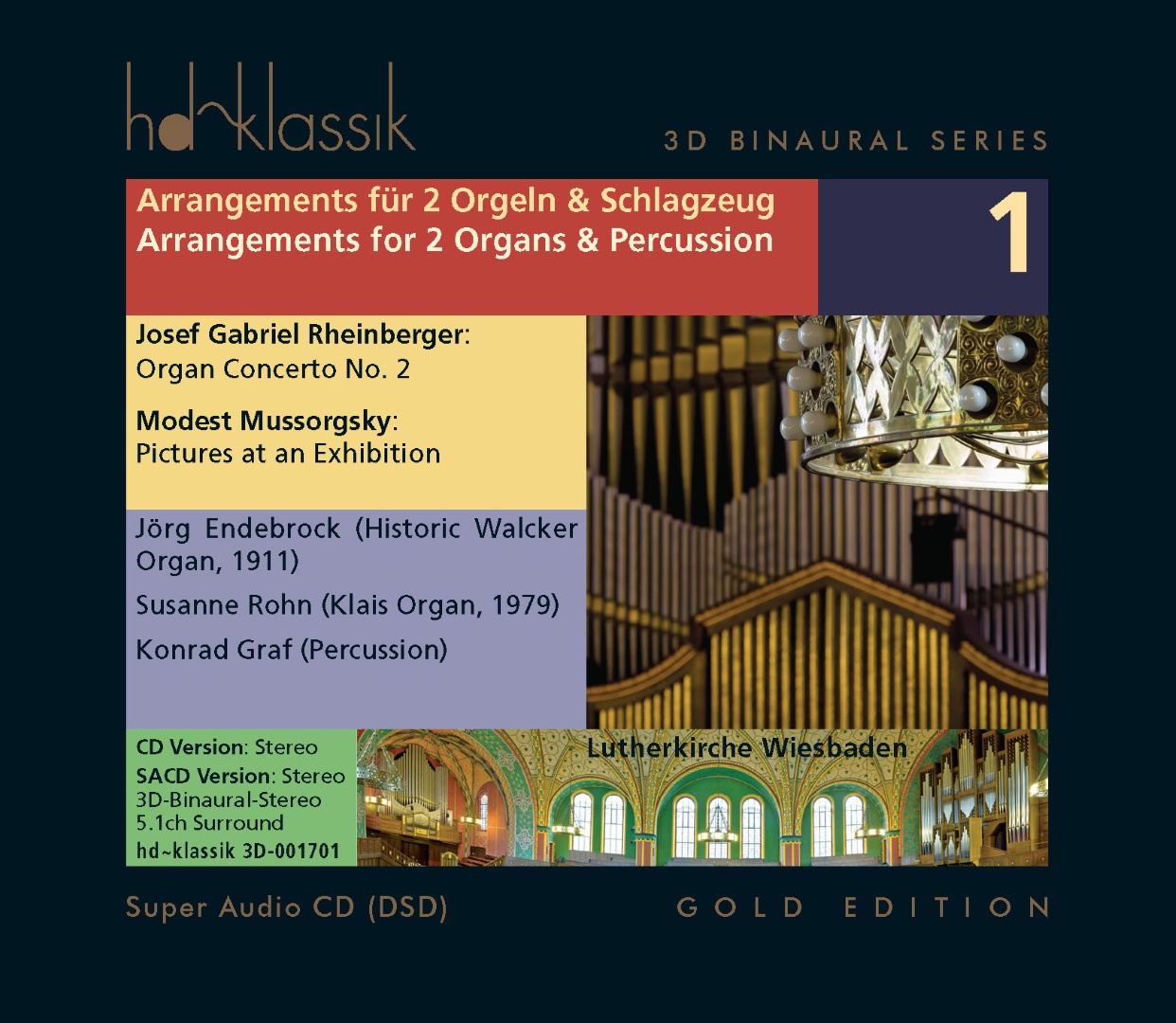
In Jörg Endebrock’s arrangement of the Organ Concerto No. 2 in G minor Op. 177 the Walcker organ takes over the orchestral part; its rounded, rather orchestral sound stands out clearly against the radiant neo-Baroque sound of the Klais organ. When a second organ takes the place of the orchestra, the problems Berlioz complained of disappear. At the same time it becomes clear that the work is no virtuoso showpiece: Rheinberger treats both bodies of sound as equals, so that the concerto resembles a symphony for two bodies of sound rather than a solo concerto, carried by cantabile melody and colourful harmony.
Modest Mussorgsky composed “Pictures at an Exhibition” for piano in 1874. The movements depict paintings and drawings by his friend Viktor Hartmann, who had died the year before, which Mussorgsky had seen at a memorial exhibition; promenades trace the viewer’s path from one picture to the next. Endebrock’s version is based on Maurice Ravel’s orchestration. The piano original is already rich in dialogue-like passages: the children playing in the Tuileries and the market criers of Limoges now call out to one another across the church, and the contrast between the poor and the rich Jew in the picture of Samuel Goldenberg and Schmuyle is divided between the two opposing instruments. The percussion parts from Ravel’s version give the Bogatyr Gate in Kiev its splendour; at the very end the Zimbelstern of the Klais organ can be heard.
The Lutherkirche in Wiesbaden, built in 1911, is an Art Nouveau building. At the front, on the so-called singers’ stage, stands the romantic-symphonic instrument by Walcker, one of the few surviving large organs of the Alsatian–New German organ reform, which is associated with Émile Rupp and Albert Schweitzer and sought to move from the powerful back to the beautiful organ sound; the Deutsche Stiftung Denkmalschutz classifies it as a monument of national importance. Opposite stands the three-manual Klais organ with 44 stops and mechanical action. Jörg Endebrock, born in Osnabrück in 1970, was in charge of the music at the Lutherkirche from 2008; Konrad Graf has been a percussionist in the hr-Sinfonieorchester Frankfurt since 1991. The recording was made in June 2017.