
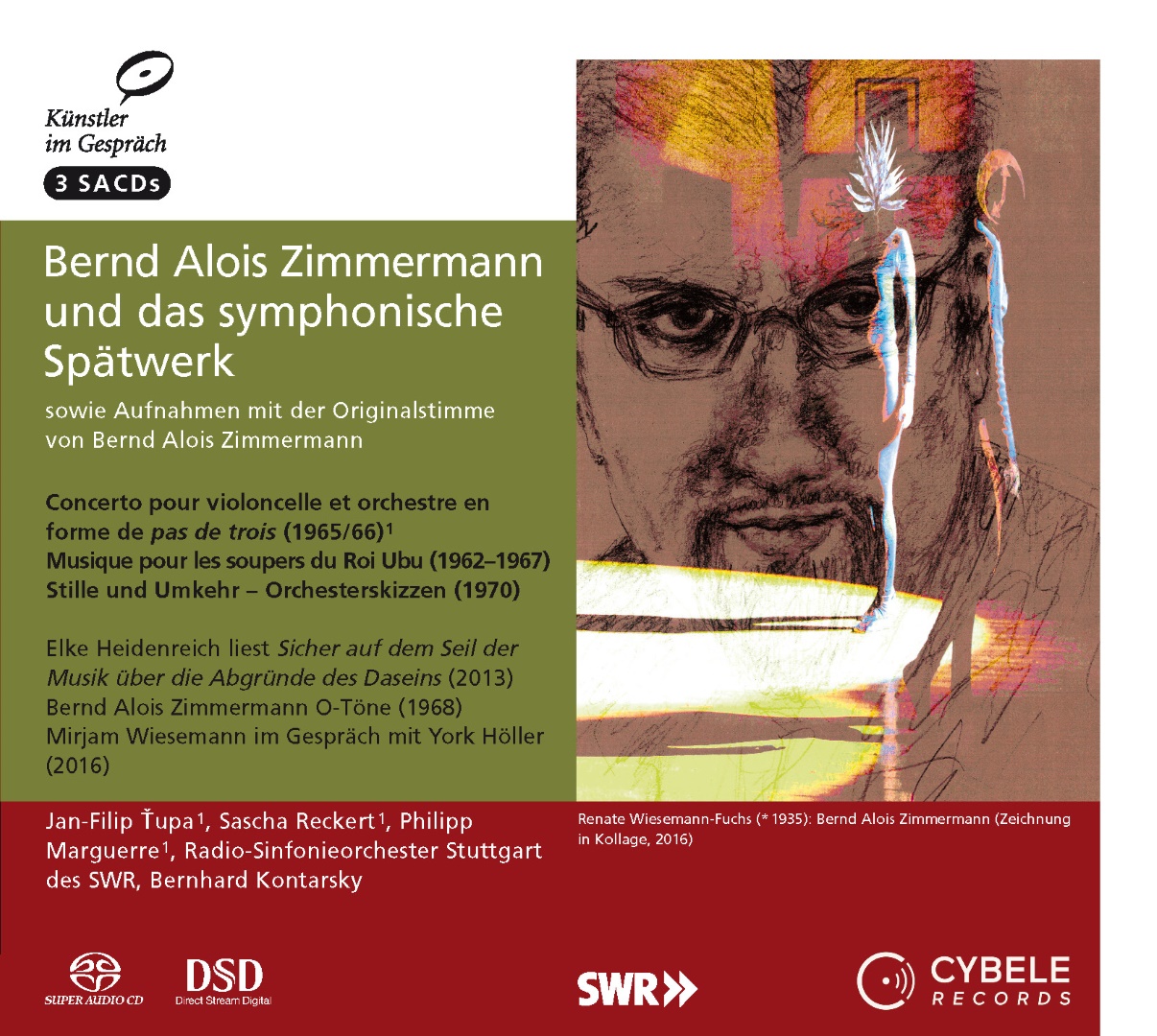
I am convinced that all these things, which are very complex processes, are laid out in such a way that every listener, no matter which intellectual or social class he belongs to, is gripped somewhere — thus Bernd Alois Zimmermann in the original recordings of this edition. His symphonic work is in some respects extremely demanding to realise, because it calls for instruments that are rarely heard: the glass harp in the cello concerto, for which players are hard to find, and the cimbalom. In his largest works he wanted to work through the most complex connections of contemporary events and of his own view of the world, as though each of these creations were the only one and perhaps also the last. At the same time he had to cope with terrible experiences of war that left him lastingly traumatised.
The Concerto pour violoncelle et orchestre en forme de “pas de trois” of 1965/66 appears here on disc with glass harp for the first time. Its five movements carry scenic titles — Dans la vallée des songes, La Fée, “Don Quichotte” et la Sentimentale, Les trois cygnes blancs, Les trois paladins and a closing Blues e Coda. Jan-Filip Tupa, cellist and Zimmermann specialist, plays the solo part; Sascha Reckert and Philipp Marguerre form the glass harp duo sinfonia di vetro.
The Musique pour les soupers du Roi Ubu, a ballet noir after Alfred Jarry’s royal grotesque, was written between 1962 and 1967 and passes through eight scenes from the Entrée de L’Académie to the Marche du décervelage. At the end of the first SACD stands a modern fairy tale by Elke Heidenreich, written and spoken by the author for this production: Safely on the tightrope of music above the abysses of existence, in eight images from the king who is not amused to the sentence Alwa has left. Stille und Umkehr, the orchestral sketches of 1970, are Zimmermann’s last completed work.
York Höller studied with Zimmermann from 1967 to 1970 — exactly the years in which these late works were written; he followed the work on the Roi Ubu at first hand. In conversation with Mirjam Wiesemann he recalls those final years and speaks about personal values, about his own works and about the existential significance of artistic work. Zimmermann himself is heard in recordings made in the summer of 1968 at his house in Großkönigsdorf: on his birth and his inherited musicality, on his student years and his early interest in the forbidden new music.
The orchestral recordings were made in 2012 at the SWR radio studio in Stuttgart, Elke Heidenreich’s fairy tale in August 2013 at the Cybele Studios in Düsseldorf and the conversation with York Höller on 16 June 2016 at his house in Cologne. The edition received the Jahrespreis 2017 of the Preis der deutschen Schallplattenkritik and the Opus d’Or Award from opushd.net.