
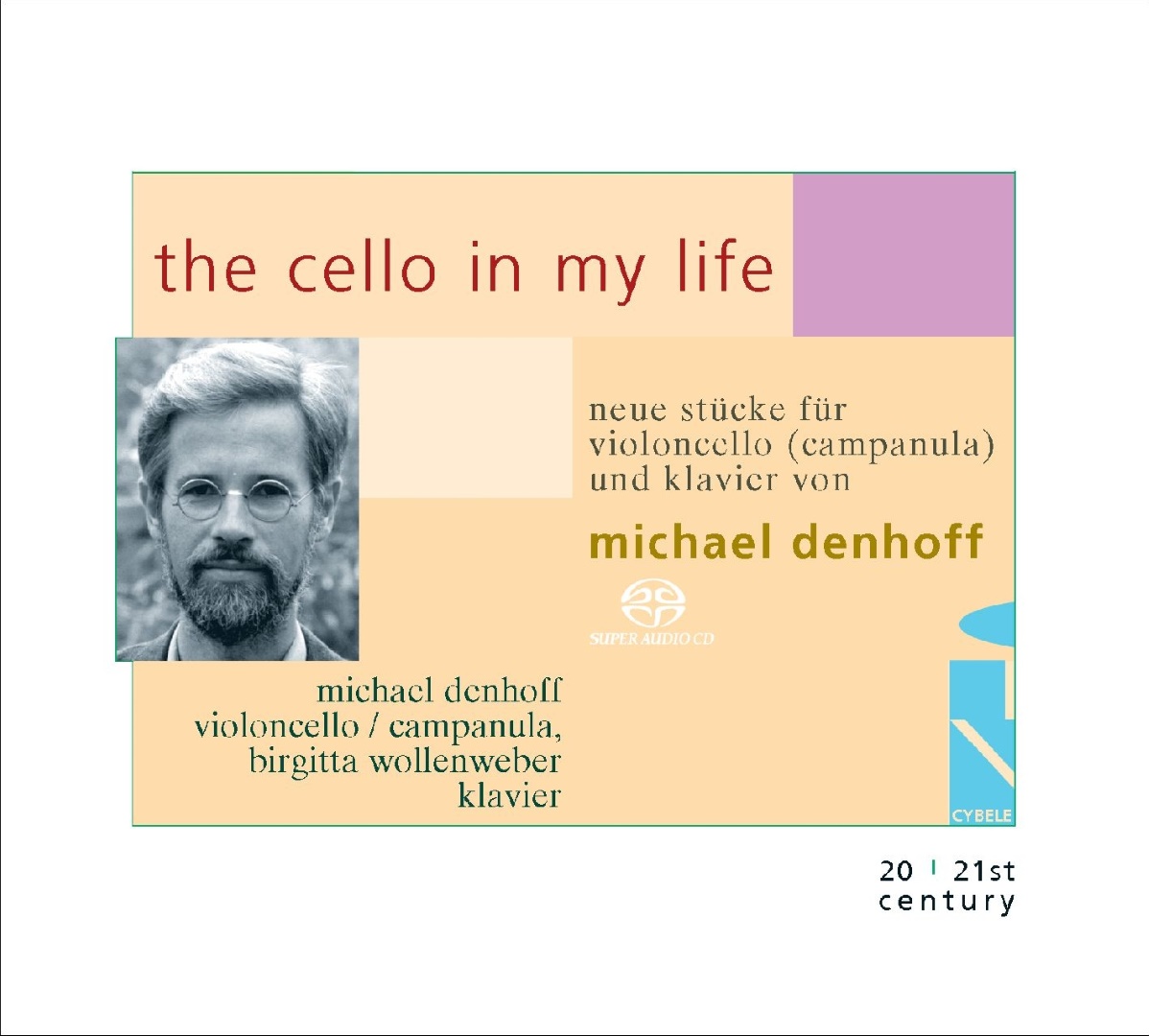
When a composer writes for “his” instrument, one expects him to exhaust its technical possibilities in the most virtuoso manner — one thinks of Liszt at the piano or Messiaen at the organ. Anyone approaching Denhoff’s cello works with that expectation will not find it met: fragile sound shapes, things hinted at as shadows, introverted reflection and an unsettlingly plain transparency of texture are the marks here. They demand close listening — and then a virtuosity of its own does appear in the handling of the instrument’s sonic possibilities, of a kind that can only come from someone who knows it in practice as well.
In Denhoff’s catalogue his own instrument long played no leading role — that belongs rather to the piano. But from the summer of 1996 a series of duos followed in close succession, beginning with … as when no words Op. 77. Behind it stands Samuel Beckett’s late prose text Worstward Ho: hardly any other book had gripped him so in those years, Denhoff writes — the bewildering beauty and musicality of the words, which as so often in Beckett make failure their theme, changed his work in ways he cannot name. Written in only five days in August 1996, the piece is variable in design: it can be played as a pure piano piece or with an added cello part, the cellist placed in an adjoining room or behind the audience, as far from the pianist as possible. At some points both musicians may speak fragments of Worstward Ho in the rhythm of the notes; like a sound colour, the words must subordinate themselves to the music. Consisting of thirty units, some extremely short, the music is repeatedly interlocked with itself — hinting, commenting, varying, unfolding and decomposing itself.
In Unreceding on Op. 83e, the fifth “side path” from the evening-length piano quintet Hauptweg und Nebenwege, literary quotations stand between the notes — legible only to the performers, “on whom they acted”, as Denhoff writes. They are words by Hölderlin, Celan, Kafka, Ungaretti, Heine and again Beckett, which leave traces in the music and colour the poetic mood of the piece. The quintet’s title deliberately refers to the famous painting by Paul Klee.
Trace d’Etoile Op. 87 is a homage to the Luxembourg sculptor Lucien Wercollier, whose works Denhoff encountered on a visit. A sculpture, he wrote for the première, accentuates the space around it as sounds set the air vibrating. The piece uses the sympathetic resonance of the campanula — a newly developed cello-like string instrument with sixteen resonating strings built by the instrument maker Helmut Bleffert. Through the prescribed scordatura and the restriction to the strings in pizzicato and their natural overtones in arco, a self-contained harmony arises, to which the piano too confines itself like a dialoguing echo; the two instruments merge astonishingly. Sobre tantas cuerdas Op. 72a, written in 2003, is the independent alternative version of Circula el tiempo Op. 72 for campanulas.
Denhoff wrote the Seven Bagatelles Op. 92 between 8 and 13 March 2001. The decisive impulse came from a concert in which he first heard new solo pieces by György Kurtag, played by the Hungarian cellist Miklos Perényi, whose unvain playing, wholly concentrated on the matter itself, impressed him deeply. The third bagatelle is dedicated to Perényi; its fast descending, shadowy and fleeting passages recall, almost as an act of homage, Kurtag’s solo piece “Shadow”, and the hotel mute, which gives the cello a pallid timbre, seems borrowed from there too. The other bagatelles are addressed to his teachers Siegfried Palm and Erling Blöndal Bengtsson and to cellists he admires or is friends with — small sounding greeting cards recalling Kurtag’s “Messages”. The recording was made on 28 and 29 September 2003 at Burg Langendorf; the hybrid SACD runs to 70:46 in stereo and 5.1 surround.