
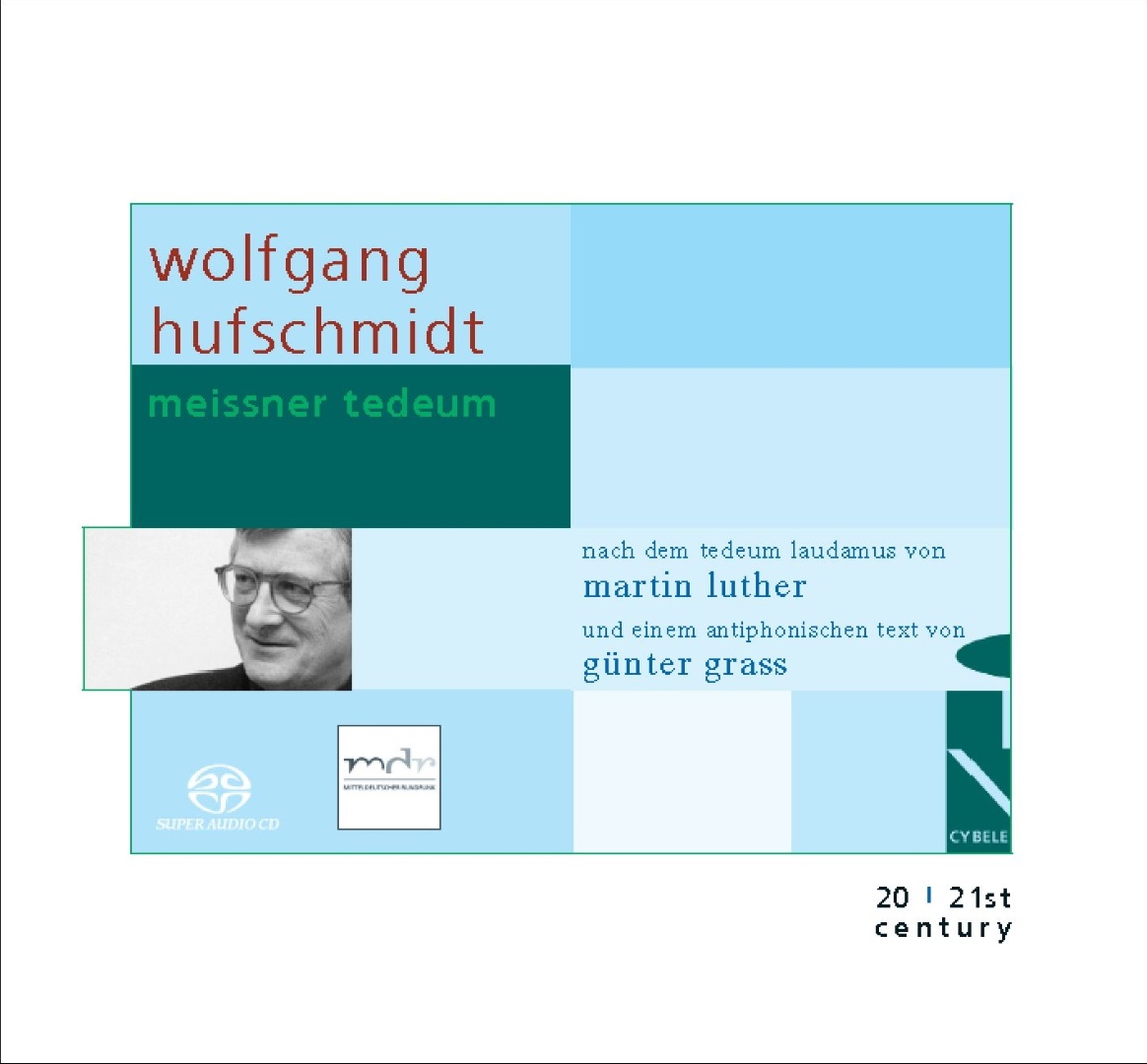
The commission came from the Internationale Heinrich-Schütz-Gesellschaft, financed by the then Ministry of All-German Affairs in Bonn; the publisher Karl Vötterle had recommended Hufschmidt, born in Mülheim an der Ruhr in 1934 and at that time a church musician in Essen, to Erich Schmidt, cantor of Meissen Cathedral. Hufschmidt had met Günter Grass through the flautist Aurèle Nicolet; in 1966 he told him of his idea of setting a contemporary text against the Te Deum, and Grass wrote an “antiphonal” counter-text. As Stefan Fricke writes in the booklet, both were concerned with an inter-German dialogue: an ensemble from West Germany was to rehearse the Grass text and the Meissner Kantorei 1961 the Luther text separately, the two groups meeting only at the premiere in the cathedral. Politics thwarted the plan.
Prompted by the space of Meissen Cathedral, the work takes up the liturgical tradition of antiphonal singing. On two opposite galleries stand a twelve-part choir with solo soprano, orchestra and organ, and a four-part vocal ensemble with solo baritone, wind quintet, piano and percussion; a tape played over loudspeakers distributed around the space supports the Grass group, which is at a disadvantage in sound. The material is derived from the melody of the hymn Te Deum laudamus, extended to twelve-tone writing and compressed into quarter tones; Hufschmidt always sets the counter-text using the inversion or retrograde of the original row. The title “Hymnus” stands for ritually petrified language and musical monumentality, into the “Fugue” the antiphons of the counter-text are “fugued in”, and the “Rondo” strings together short, pictorial verses in a hectic intensification. The “Ostinato” repeats the formula “Täglich, Herr Gott, wir loben dich” until the tension is released in the protest of the coda, in the inverted Amen: “NEMA!”
The premiere in Meissen Cathedral on 25 May 1968 took place under the supervision of state security and the People’s Police. The cathedral chapter had averted a ban only by five votes to five, Hufschmidt was allowed into the country only at the second attempt, the name of the Gewandhausorchester Leipzig was pasted over on the posters, and critics were not allowed to report. The singers were Barbara Hoene and Hartmut Haenchen with the Meissner Kantorei 1961 under Erich Schmidt. A chronology and documents in the booklet, among them a memo from the Central Committee of the SED and Hufschmidt’s report to Grass, trace this history.
The revival in Meissen Cathedral on 3 October 1997 was recorded by Mitteldeutscher Rundfunk. Antje Bitterlich (soprano), Martin Lucaß (baritone) and the choir, orchestra and vocal and instrumental soloists of the Folkwang-Hochschule Essen, of which Hufschmidt was rector from 1988 to 1996, perform under Hartmut Haenchen, the baritone of 1968; Anna Ikramova had remixed the tape in a four-channel version at the ICEM of the Folkwang-Hochschule. In addition, the edition contains Wolfgang Wahrich’s private analogue recording of the premiere on 25 May 1968. The album is a co-production with MDR, supported by the Kunststiftung NRW.