
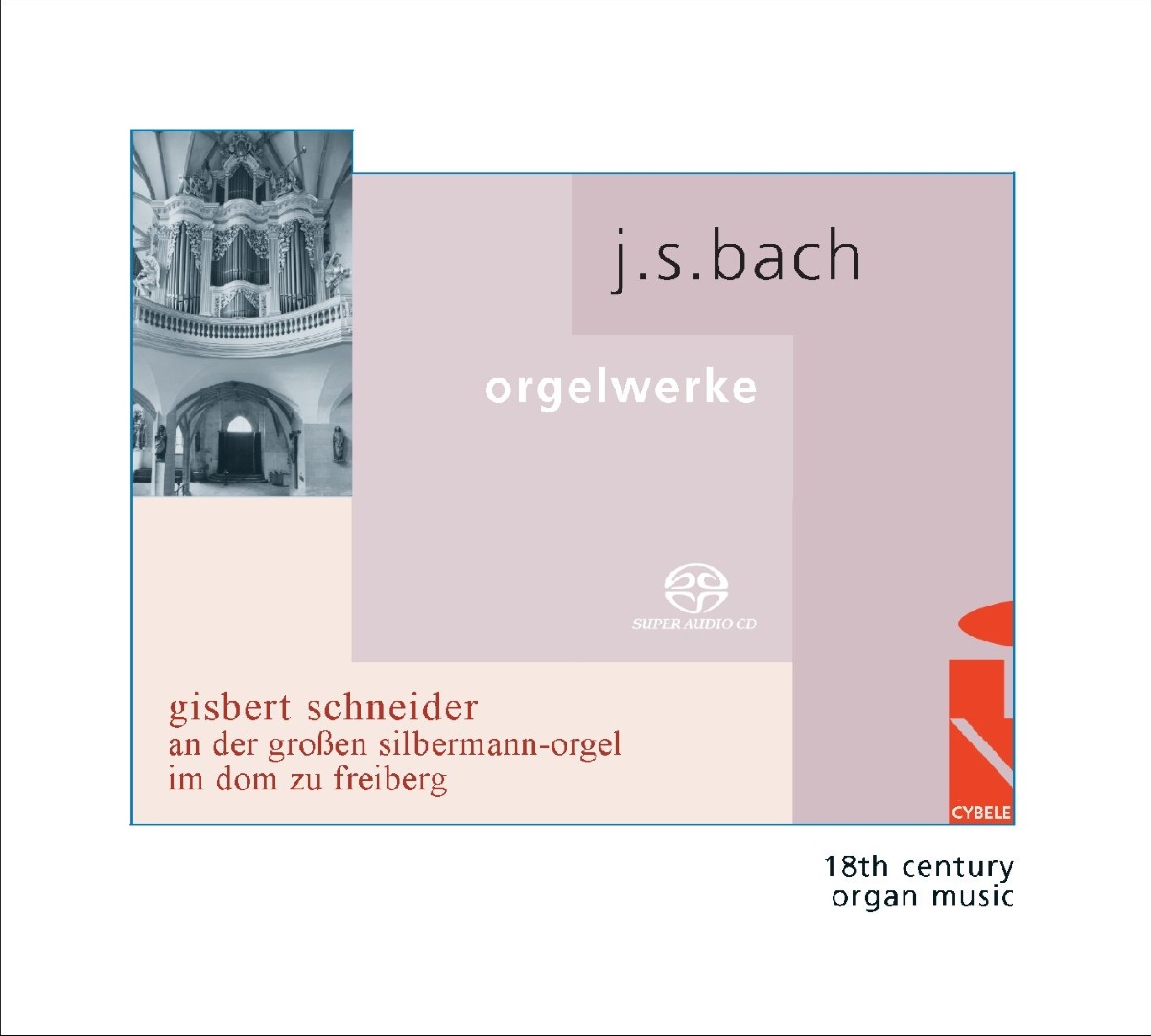
Cybele 030202 2002

24bit 48kHz 5.1 surround Stereo Classical music Baroque music 1:09:44

To the description

Johann Sebastian Bach: Organ Works on the great Silbermann organ in Freiberg Cathedral

Contributors

Gisbert SchneiderOrgan

Composer

Johann Sebastian Bach

Short description

Gisbert Schneider plays organ works by Johann Sebastian Bach on the great Silbermann organ in Freiberg Cathedral, the oldest surviving instrument by Gottfried Silbermann (1711–1714). The programme is framed by two works in C minor: the Prelude and Fugue in C minor BWV 546, which points to Bach’s Leipzig years, and the Passacaglia in C minor BWV 582, played here not as one great crescendo but as a plenum piece. Between them stand the Chorale Partita Sei gegrüßet, Jesu gütig BWV 768 in its final form, the Prelude and Fugue in C major BWV 547 and two Leipzig chorales with an ornamented solo line. The recording was made in October 2001.

Details

Carrier format
Hybrid SACD

Resolution
24 bit / 48 kHz

Total playing time
69:46

Channels
Stereo, 5.1 surround

Organ
Great Gottfried Silbermann organ (1711–1714; III/44), Freiberg Cathedral (Saxony)

Recording
12–13 October 2001, Freiberg Cathedral

Booklet
German and English, 28 pages, digipak

Recording Producer: Ingo Schmidt-Lucas

Press reviews

Specifications

Catalogue number
Cybele 030202
Year of release
2002
Genre
Classical music
Period
Baroque music
Instrumentation
Organ
Label
Cybele Records
Barcode
809548007324
GTIN
4068992487786
Booklet (pages)
28

Track listing

19 tracks · 1:09:44

  1. 01 Prelude and Fugue in C minor BWV 546 – Prelude Composer: Johann Sebastian Bach (1685-1750) Performer: Gisbert Schneider 6:31
  2. 02 Prelude and Fugue in C minor BWV 546 – Fugue Composer: Johann Sebastian Bach (1685-1750) Performer: Gisbert Schneider 6:04
  3. 03 Chorale Partita Sei gegrüßet, Jesu gütig BWV 768 Theme Composer: Johann Sebastian Bach (1685-1750) Performer: Gisbert Schneider 1:11
  4. 04 Chorale Partita Sei gegrüßet, Jesu gütig BWV 768 – Variation 1 Composer: Johann Sebastian Bach (1685-1750) Performer: Gisbert Schneider 2:45
  5. 05 Chorale Partita Sei gegrüßet, Jesu gütig BWV 768 – Variation 2 Composer: Johann Sebastian Bach (1685-1750) Performer: Gisbert Schneider 1:01
  6. 06 Chorale Partita Sei gegrüßet, Jesu gütig BWV 768 – Variation 3 Composer: Johann Sebastian Bach (1685-1750) Performer: Gisbert Schneider 0:45
  7. 07 Chorale Partita Sei gegrüßet, Jesu gütig BWV 768 – Variation 4 Composer: Johann Sebastian Bach (1685-1750) Performer: Gisbert Schneider 1:03
  8. 08 Chorale Partita Sei gegrüßet, Jesu gütig BWV 768 – Variation 5 Composer: Johann Sebastian Bach (1685-1750) Performer: Gisbert Schneider 1:10
  9. 09 Chorale Partita Sei gegrüßet, Jesu gütig BWV 768 – Variation 6 Composer: Johann Sebastian Bach (1685-1750) Performer: Gisbert Schneider 1:11
  10. 10 Chorale Partita Sei gegrüßet, Jesu gütig BWV 768 – Variation 7 Composer: Johann Sebastian Bach (1685-1750) Performer: Gisbert Schneider 1:44
  11. 11 Chorale Partita Sei gegrüßet, Jesu gütig BWV 768 – Variation 8 Composer: Johann Sebastian Bach (1685-1750) Performer: Gisbert Schneider 1:13
  12. 12 Chorale Partita Sei gegrüßet, Jesu gütig BWV 768 – Variation 9 Composer: Johann Sebastian Bach (1685-1750) Performer: Gisbert Schneider 1:33
  13. 13 Chorale Partita Sei gegrüßet, Jesu gütig BWV 768 – Variation 10 Composer: Johann Sebastian Bach (1685-1750) Performer: Gisbert Schneider 5:18
  14. 14 Chorale Partita Sei gegrüßet, Jesu gütig BWV 768 – Variation 11 Composer: Johann Sebastian Bach (1685-1750) Performer: Gisbert Schneider 1:35
  15. 15 Chorale Setting Allein Gott in der Höh sei Ehr BWV 663 Composer: Johann Sebastian Bach (1685-1750) Performer: Gisbert Schneider 7:17
  16. 16 Prelude and Fugue in C major BWV 547 – Prelude Composer: Johann Sebastian Bach (1685-1750) Performer: Gisbert Schneider 4:57
  17. 17 Prelude and Fugue in C major BWV 547 – Fugue Composer: Johann Sebastian Bach (1685-1750) Performer: Gisbert Schneider 5:41
  18. 18 Chorale Setting Nun komm, der Heiden Heiland BWV 659 Composer: Johann Sebastian Bach (1685-1750) Performer: Gisbert Schneider 4:26
  19. 19 Passacaglia in C minor BWV 582 Composer: Johann Sebastian Bach (1685-1750) Performer: Gisbert Schneider 14:19

Description

The Prelude and Fugue in C minor BWV 546 is a work of solemn gravity. The earliest manuscript was made by Johann Peter Kellner of Gräfenroda at a time when Bach had probably already composed most of his cantatas, and the music is close to the opening chorus of Cantata No. 47 “Wer sich selbst erhöhet” of 1726. The Prelude demonstrates Bach’s command of the Italian concerto form: ritornellos and fugal episodes alternate in six times 24 bars. The five-part Fugue in alla breve style forms a counterweight, even if there are signs that it was added later, perhaps by a pupil.

The Chorale Partita Sei gegrüßet, Jesu gütig BWV 768 is heard in its final form, which Matthias Schneider describes in the booklet as Bach’s concluding statement in the genre. Unlike the early partitas, still under the influence of his North German teachers, it is symmetrically designed: a simple four-part and a harmonically far-reaching five-part chorale setting frame the cycle, and further variations correspond in pairs in figuration and metre. The first six variations are to be played manualiter, the rest pedaliter. Bach worked on the piece at least three times, from his Weimar into his Leipzig years.

The Chorale Setting Allein Gott in der Höh sei Ehr BWV 663 and the Chorale Setting Nun komm, der Heiden Heiland BWV 659 belong to the Leipzig chorales, a collection begun in Weimar and revised in Leipzig. In BWV 663 the cantus firmus lies in the tenor, in dense counterpoint and as richly ornamented as is otherwise found in this register mainly in French music; in BWV 659 it lies in the soprano, and its calmly flowing coloratura inspired Ferruccio Busoni to make a piano version. Between the two stands the Prelude and Fugue in C major BWV 547: the Fugue begins manualiter, and only after several expositions does the pedal bass enter with the theme in augmentation.

The Passacaglia in C minor BWV 582 engages with the ostinato compositions of Dietrich Buxtehude, alongside which it has come down to us in the Andreas-Bach-Buch; a Christe by the Parisian organist André Raison, whose theme is identical with the first half of Bach’s, probably also served as a model. In the concluding fugue Raison’s theme becomes the fugue subject and Bach’s continuation the constant countersubject. Gisbert Schneider plays the work not as one great crescendo in the tradition of Franz Liszt but as a plenum piece whose dynamics arise from the changing number of voices and the alternation between the divisions of the organ.

Gottfried Silbermann built the organ of Freiberg Cathedral between 1711 and 1714, with 44 stops on three manuals and pedal, to a design by the young cathedral organist Elias Lindner. Jehmlich Orgelbau Dresden restored it from 1981 to 1983, bringing the wind pressures close to the values of 1711; it is tuned at choir pitch in an unequal temperament. Gisbert Schneider, professor of organ and improvisation at the Folkwang-Hochschule Essen, recorded the works on 12 and 13 October 2001.