
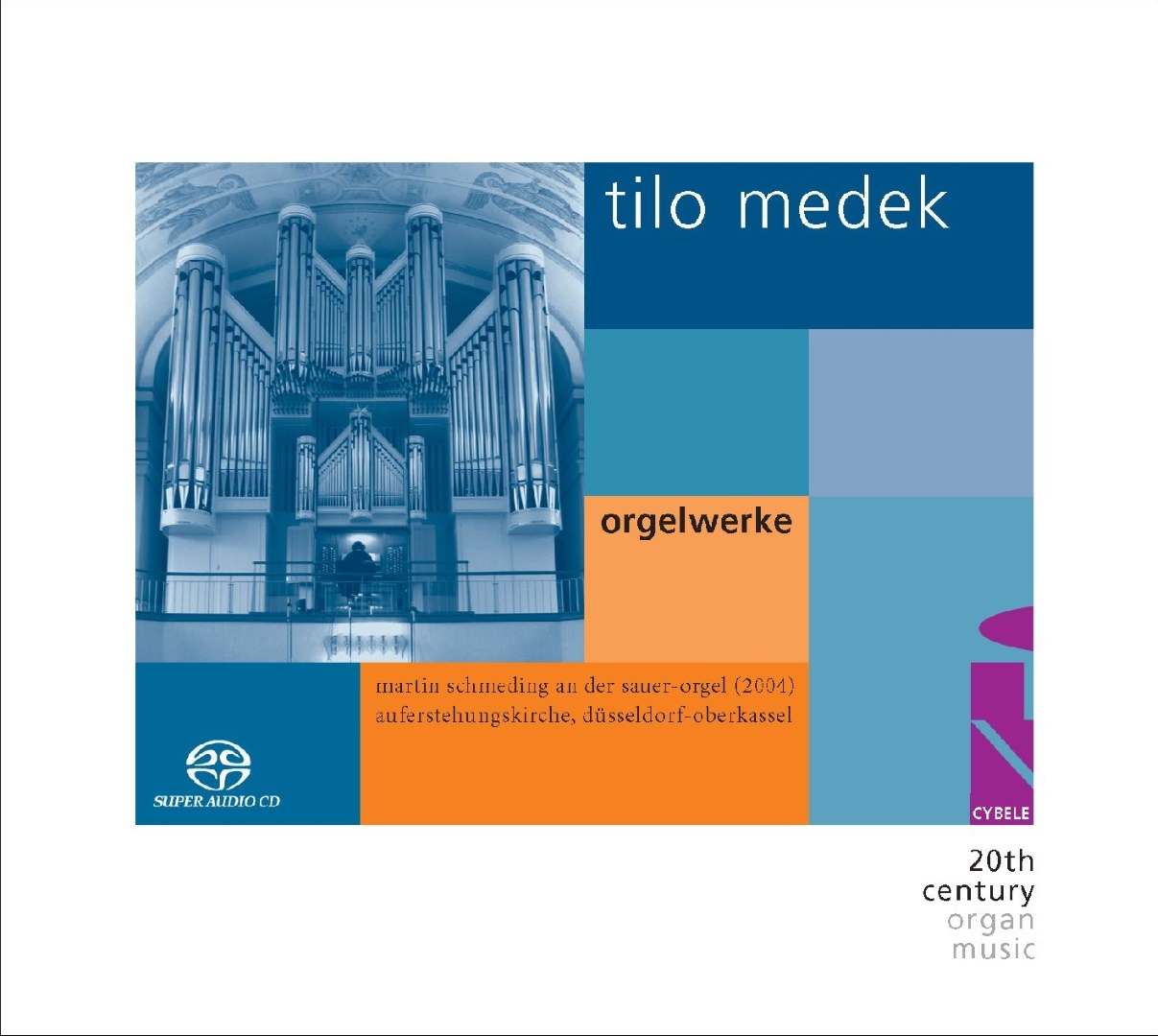
Tilo Medek was born on 22 January 1940 in Jena into a family of musicians and composed from the age of eleven. In 1957 he attended the Darmstadt summer courses, where he heard Nono, Scherchen and Stockhausen; from 1959 he studied musicology at the Humboldt University and composition with Rudolf Wagner-Régeny, whose master student he was for three years from 1964. From 1968 his work was obstructed in the GDR, triggered among other things by “Das Dekret über den Frieden” after Lenin; in 1977, after he had signed the protest against the expatriation of Wolf Biermann, came his “release from the citizenship of the GDR”. He moved with his family to the Rhineland and founded the music publishing house Edition Tilo Medek in Remagen in 1982.
The two early works were written for the great organ of Merseburg Cathedral and inspired by its sound. The instrument, built by Friedrich Ladegast between 1853 and 1855, had been heavily rebuilt by the Kühn firm in 1963: free reeds and string stops gave way to neo-baroque voices, among them the high Bauernflöte in the pedal — precisely that mixture of odd overtone colours and fundamental strings which marks Medek’s early pieces. Verschüttete Bauernflöte was written in the summer of 1969 and premièred on 19 April 1970 by the cathedral organist Hans-Günther Wauer; it received an award at the UNESCO International Rostrum of Composers. Medek wrote that the seemingly infinite combinations of stops had at first overwhelmed him; he then restricted himself to a few lines and extreme registers. At the end the 1’ pedal stop blossoms in its lonely height — in retrospect one understands why he had buried it beneath restless eruptions of clusters.
B-A-C-H, Four Notes for Organ deliberately places itself outside the Bach cult that has produced highly complex works on the same motif — Liszt’s Prelude and Fugue, likewise written for Merseburg, and Reger’s Fantasy and Fugue Op. 46. Medek confines himself to the four notes and illuminates them, extended by glissandi from half-drawn stops. He himself names the forms in which he works the motif: funeral march, Morse code, echoes of Mozart’s G minor symphony, cantus firmus, toccata, a little salon music and the obligatory final apotheosis — this last, however, on the wavering ground of the half-drawn B-A-C-H notes. Experimenting with sounds and forms of notation links both pieces: switching the blower on and off and half-drawing the sliders produce microtonal distortions, and beside bars and note values stand free notation, graphic symbols and cluster script.
In Gebrochene Flügel, written shortly before his move to West Germany, Medek proceeds most consistently: nearly all sounds are alienated by half-drawn stops, so that the notation resembles a fingering rather than a sound script. Switching off the blower, which until then had seemed to him “unworthy of art”, here becomes a principle — the whole course aims at this “beautiful” catastrophe. The Rückläufige Passacaglia was written in 1979 on a commission from the Kantorei of St Martin in Kassel, a centre of new sacred music, for the 8th Week of Sacred Music; it was premièred on a Bosch organ disposed by Helmut Bornefeld. This time there is no extensive commentary, only the appended remark: a passacaglia that runs backwards.
After an eight-year pause, the commission of the parish church of St Lamberti for the dedication of its new Karl Schuke organ in September 1989 gave rise to the Quatemberfeste. The Quatember are the days of fasting and prayer by which the four seasons were bound into the liturgical year; the four movements — Lambertussingen, Der Turmbläser, Engelsecho and Schnurrpfeifereien — depict less the seasons than typical situations around the church and the possibilities of a new organ. The Wandlungs-Passacaglia, finally, comes from the Pfingstmusik of 2000/2001 on texts by Andreas Gryphius; its title refers to the transformation of bread and wine. In the first part the two-bar theme moves every twelve bars from the bass through the middle voice to the upper voice, in the second part inverted and shortened to six bars, in the third in double and triple stretto. The recording was made from 25 to 27 March 2008; it appeared on the 2/2009 list of the Preis der deutschen Schallplattenkritik and was chosen Recording of the Month by MusicWeb International.