
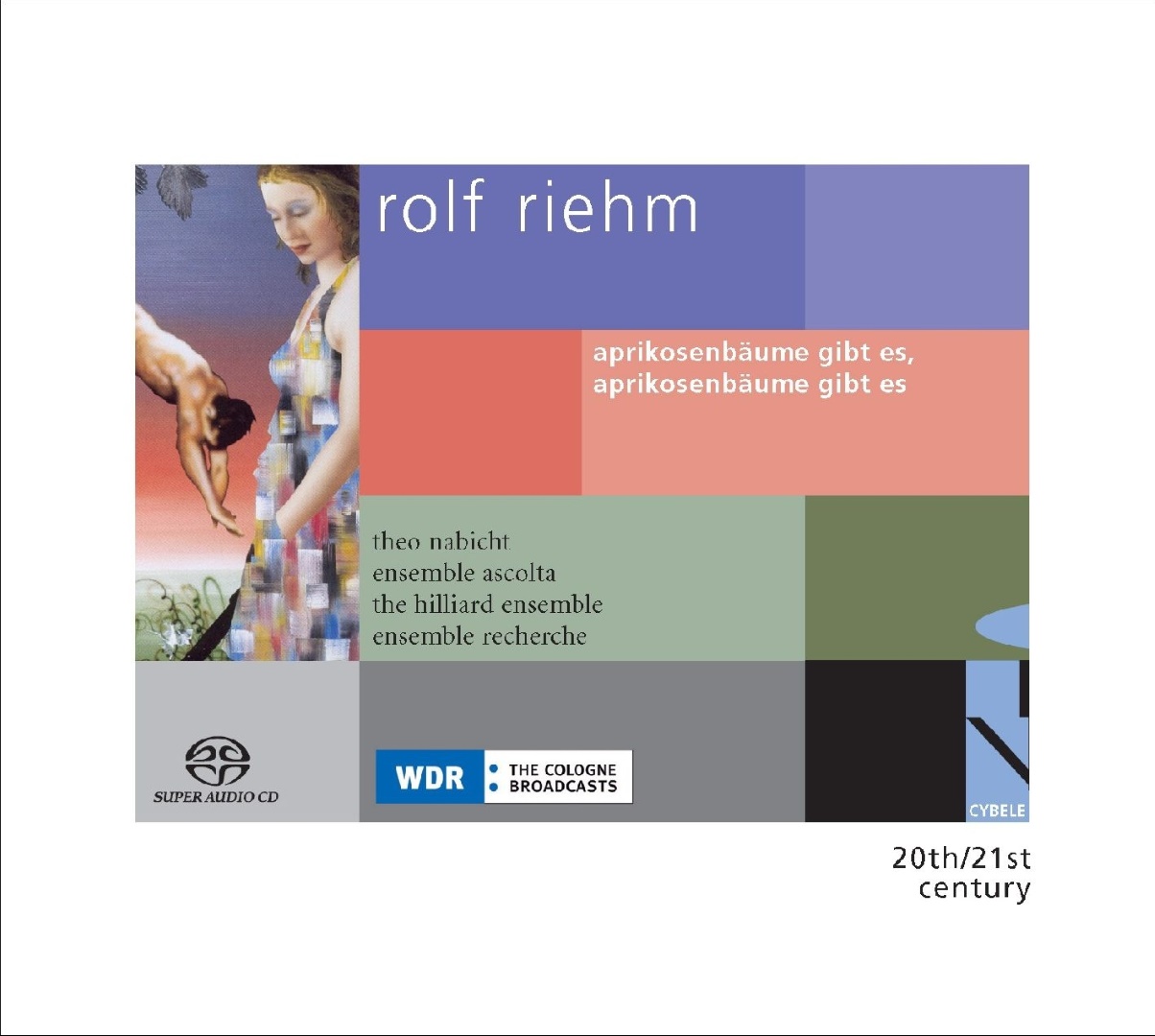
Cybele 860701 2008

5.0 surround DSD Stereo New music Contemporary music 41:03

To the description

Rolf Riehm: aprikosenbäume gibt es, aprikosenbäume gibt es

Contributors

Theo NabichtContrabass clarinet / Bass clarinet / SaxophoneEnsemble ascoltaEnsemble for new musicThe Hilliard-EnsembleVocal ensembleEnsemble rechercheEnsemble

Composer

Rolf Riehm

Streaming & download

Short description

Rolf Riehm wrote all three pieces on this SACD as WDR commissions for the Wittener Tage für neue Kammermusik, and all of them start from texts without setting them. In aprikosenbäume gibt es, aprikosenbäume gibt es (2004) Theo Nabicht’s contrabass clarinet takes over the role of reciter from the voice of Inger Christensen; in Ahi bocca, ahi lingua (1991-1994) the Hilliard Ensemble sings between the words of a dialogue by Rainald Goetz; Schlaf, schlaf John Donne, schlaf tief und quäl dich nicht (1997) stretches a single line after Jossif Brodskij over almost twenty minutes. The Ensemble ascolta and the Ensemble recherche also perform.

Details

Carrier format
Hybrid SACD

Resolution
DSD64 / 2.8224 MHz 1 bit

Total playing time
65:04

Channels
Stereo, 5.0 surround

Voices
voices (tracks 1 and 3) and recitation (track 3), each as recorded playback

Recording
Track 1: 19/21 December 2006 and 8 December 2007, Kleiner Sendesaal of the WDR, Cologne; track 2: 25 April 1994, Kleiner Sendesaal of the WDR, Cologne; track 3: 26 March 1998, Experimentalstudio Freiburg

Booklet
German and English, 32 pages, digipak

Balance engineer: Wolfgang Ellers

Stereo mix: Ingo Schmidt-Lucas (track 1), Wolfgang Ellers (tracks 2, 3); surround mix: Ingo Schmidt-Lucas (tracks 1, 2), Wolfgang Ellers (track 3)

Recording Producer: Ingo Schmidt-Lucas

Track 1: A co-production with Westdeutscher Rundfunk Köln (2006/2007)

Tracks 2 and 3: A production of Westdeutscher Rundfunk Köln (1995/1998)

Awards

Preis der deutschen Schallplattenkritik — Best-of list 1/2009, contemporary music category

Neue Zeitschrift für Musik — Editorial recommendation, 2/2009

FonoForum — Star of the Month, 5/2009

Press reviews

nmz – neue musikzeitung, 12/2008

Wiesbadener Kurier, 12/2008

Stuttgarter Zeitung, 1/2009

OpusKlassiek.nl, 2/2009

SA-CD.net, 2/2009

MusicWeb-International.com, 2/2009

Frankfurter Rundschau, 2/2009

Classical CD Review, 2/2009

Kwadratuur.be, 3/2009

Neue Zeitschrift für Musik, 3/2009

His Voice, 4/2009

FonoForum, 5/2009

klassik.com, 6/2009

Opus Haute Définition, 6/2009

Bayern 4 Klassik

Specifications

Catalogue number
Cybele 860701
Year of release
2008
Genre
New music
Period
Contemporary music
Instrumentation
Accordion, Brass, Keyboard, Contrabass clarinet, Vocal ensemble, Playback
Label
Cybele Records
Barcode
809548012526
Booklet (pages)
32

Track listing

3 tracks · 41:03

  1. 01 aprikosenbäume gibt es, aprikosenbäume gibt es (2004) Composer: Rolf Riehm (1937-2026) Performers: Theo Nabicht, Ensemble ascolta 5:28
  2. 02 Ahi bocca, ahi lingua (1991-1994) Composer: Rolf Riehm (1937-2026) Performer: The Hilliard-Ensemble 16:15
  3. 03 Schlaf, schlaf John Donne, schlaf tief und quäl dich nicht (1997) Composer: Rolf Riehm (1937-2026) Performer: Ensemble recherche 19:20

Description

“I find the development of a so-called individual artistic language rather boring,” says Rolf Riehm. For the Fortner pupil, born in Saarbrücken in 1937, who taught composition and theory at the Frankfurt Musikhochschule from 1974 to 2000, composing means securing a “stock of emotional sensitivity” and relating each subject anew to the present. As Michael Rebhahn writes in the booklet, he gathers his material – current events, myths, fairy tales, poetry, music history – without any discernible system: “The soul does not feel things in order, but criss-cross.” The three pieces on this SACD are musical perceptions of literary finds in which language and sound remain autonomous.

aprikosenbäume gibt es, aprikosenbäume gibt es (2004) takes up the opening of Inger Christensen’s poetry cycle “alfabet” of 1981, an inventory of things ordered by the initial letters of their Danish names, whose poems grow according to the Fibonacci sequence, from one line for “a” to 610 lines for “n”. The piece for contrabass clarinet, violin, cello, trumpet, trombone and playback begins with the first strophe, read by Christensen; then the contrabass clarinet takes over the role of reciter, and the other instruments gradually take up its tone. In a parenthesis a foreign image intrudes, Bernhard Martin’s painting “Dans mes rêves je t’adore”, showing the daydream of a housewife with a vacuum cleaner, before Christensen’s voice returns. The work is dedicated to the memory of Wolfgang Stryi, whose Selmer contrabass clarinet Theo Nabicht has played since 2007.

The title of Ahi bocca, ahi lingua (1991-1994) for four vocalists comes from Claudio Monteverdi’s madrigal “Si, ch’io vorrei morire” of 1603, one of his most erotic pieces. Its textual basis, however, is a short dialogue by Rainald Goetz between “Warrior” and “Brain”, not a word of which is sung: “I have placed music where the text leaves space for punctuation.” The music fills the gaps after the punctuation marks and refers to the preceding text without doubling it; the “bocca” stands for singing in tongueless phonemes, the “lingua” for speech alone. David James, Rogers Covey-Crump, John Potter and Gordon Jones of the Hilliard Ensemble recorded the piece in 1994 in the WDR’s Kleiner Sendesaal in Cologne.

Schlaf, schlaf John Donne, schlaf tief und quäl dich nicht (1997) for violin, bass clarinet, accordion and keyboard was written for the 1997 Witten festival, whose theme was “Music – Language”. Its starting point was Jossif Brodskij’s “Great Elegy for John Donne” of 1963, which Riehm reduced to a single sentence. As a vocal sample, with the voice of Karmen Mikovic, it underlies almost the entire piece without determining its course semantically. At first the instruments play around the voice’s melismas; after a third of the piece the relationship is reversed, completely so after an inserted recording in which Brodskij recites one of his poems in Russian over a distorted techno beat. From then on the voice remains on the vowel “u” for more than eight minutes. Melise Mellinger, Uwe Möckel, Klaus Steffes-Holländer and Teodoro Anzellotti of the Ensemble recherche recorded the piece in 1998 at the Experimentalstudio Freiburg.

Theo Nabicht and Benjamin Spillner, Markus Schwind, Erik Borgir and Andrew Digby of the Stuttgart-based Ensemble ascolta recorded aprikosenbäume gibt es, aprikosenbäume gibt es in December 2006 and 2007 in the WDR’s Kleiner Sendesaal as a co-production with the WDR; the two older recordings are productions of the broadcaster. The SACD was on the Bestenliste 1/2009 of the Preis der deutschen Schallplattenkritik, was recommended by the Neue Zeitschrift für Musik and received FonoForum’s Stern des Monats.

Concert calendar

10. Oct 2026

19:00

Shared Frequencies James Tenney – Full Immersion(opens in a new tab)

Kammerensemble Neue Musik Berlin, Theo Nabicht (Bass clarinet), Theodor Flindell (Violin), Kirstin Maria Pientka (Viola), Cosima Gerhardt (Cello), Jonathan Heilbron (Double bass), KNM campus ensemble, Rebecca Lenton (künstlerische Leiterin)
Baptistenkirche Wedding, Berlin(map, opens in a new tab)

23. Oct 2026

for Morton Feldman(opens in a new tab)

Ensemble ascolta, Mimi Doulton (Soprano), Friederike Scheunchen (Direction)
Hospitalkirche, Stuttgart(map, opens in a new tab)

05. Nov 2026

20:00

Hay Festival Arequipa 2026 – Crippled Symmetries: Listening to Invisible Worlds(opens in a new tab)

Theo Nabicht (Bass clarinet), Kirstin Maria Pientka (Viola), Jonathan Heilbron (Double bass), Ana Maria Rodriguez (Electronics), Thomas Bruns
Teatro Municipal de Arequipa, Arequipa(map, opens in a new tab)

World premiere

12. Nov 2026

20:00

Crippled Symmetries – Retama(opens in a new tab)

Theo Nabicht (Bass clarinet), Kirstin Maria Pientka (Viola), Jonathan Heilbron (Double bass), Thomas Bruns, Ana Maria Rodriguez (Keyboard / Electronics), Macri Caceres
Goethe-Institut Peru, Auditorium, Lima(map, opens in a new tab)

19. Nov 2026

RETRUCO: Loop Infinito(opens in a new tab)

Agustina Arévalo (Flute), Theo Nabicht (Bass clarinet), Marcelo Villacis (Percussion), Kirstin Maria Pientka (Viola)
Universidad de Cuenca, Cuenca(map, opens in a new tab)

21. Nov 2026

RETRUCO: Loop Infinito(opens in a new tab)

Agustina Arévalo (Flute), Theo Nabicht (Bass clarinet), Marcelo Villacis (Percussion), Kirstin Maria Pientka (Viola)
Fundacion Zaldumbide Rosales, Quito(map, opens in a new tab)

23. Nov 2026

RETRUCO: Loop Infinito(opens in a new tab)

Agustina Arévalo (Flute), Theo Nabicht (Bass clarinet), Marcelo Villacis (Percussion), Kirstin Maria Pientka (Viola)
Conservatorio Bolivar, Ambato(map, opens in a new tab)

30. Nov 2026

RETRUCO: Loop Infinito(opens in a new tab)

Agustina Arévalo (Flute), Theo Nabicht (Bass clarinet), Marcelo Villacis (Percussion), Kirstin Maria Pientka (Viola)
Universidad de las Artes, Guayaquil(map, opens in a new tab)

12. Dec 2026

19:00

Reading Music – Repeat!(opens in a new tab)

Ensemble KNM Berlin, Rebecca Lenton (Flute), Theo Nabicht (Bass clarinet / Contrabass clarinet), Theodor Flindell (Violin), Cosima Gerhardt (Cello), Jonathan Heilbron (Double bass), Thomas Bruns (Direction), Juliana Hodkinson (Komposition / Direction), Ana Maria Rodriguez (Electronics / Komposition), Andre Bartetzki (Sound projection)
FAHRBEREITSCHAFT – teilelager, Berlin(map, opens in a new tab)

21. Jan 2027

side by side @ HfM Freiburg(opens in a new tab)

Ensemble recherche, Studio für Elektronische Musik des Instituts für Neue Musik (Electronics), Friederike Scheunchen (Direction)
Ensemblehaus Freiburg, Freiburg im Breisgau(map, opens in a new tab)

24. Jan 2027

out of the box – neue musik im rathaus leonberg(opens in a new tab)

Shizuyo Oka (Clarinet), Klaus Steffes-Holländer (Piano), Asa Akerberg (Cello)
Rathaus Leonberg, Leonberg(map, opens in a new tab)