
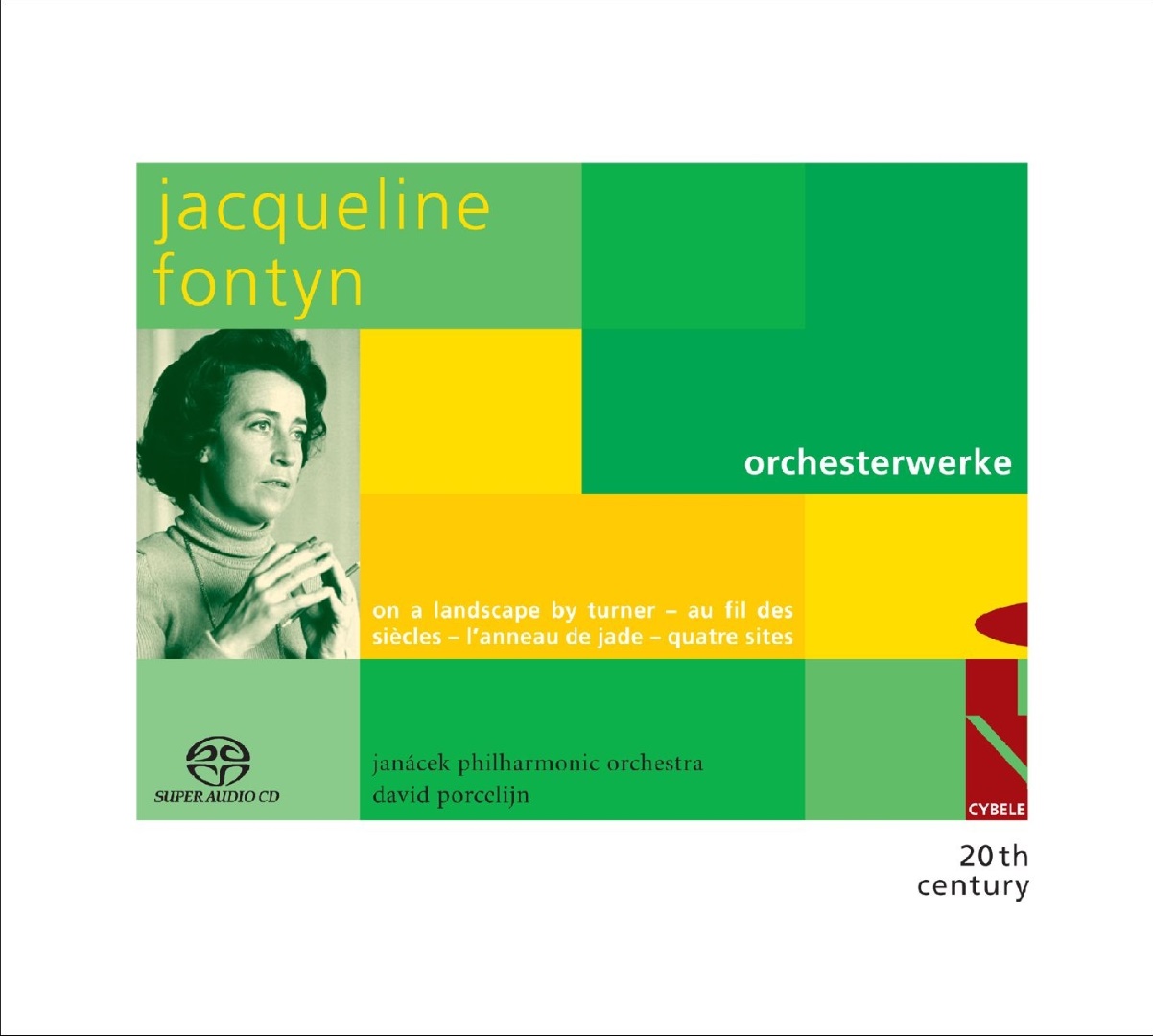
Asked about her favourite instrument, Jacqueline Fontyn always gives the same answer: the orchestra, with its wealth of tone colours and combinations. Her musical language, she writes in the booklet, consists of the superimposition and succession of notes that create harmonies changing more or less quickly. She chose the four works on this SACD for their diversity, above all in form, and hopes that the listener will notice a stylistic development from the earliest to the most recent. She sees little point in detailed analyses and cites Béla Bartok: the music should speak for itself. Fontyn received daily piano lessons from Ignace Bolotine from the age of five, studied composition with Marcel Quinet and Max Deutsch and, in 1956, conducting with Hans Swarowsky in Vienna; from 1970 to 1990 she taught composition at the Royal Conservatory in Brussels.
QUATRE SITES (1977) was commissioned by the mayor of Ottignies-Louvain-la-Neuve for the centenary of the town hall. The pastoral atmosphere of the first movement is followed by a noisy, explosive bustle suggestive of life in a university town; the third movement sets loud outbursts against obstinate, laconic figures, and the lyrical fourth, repeatedly interrupted by calls from the wind and returning motifs, seems like a composite memory of the whole work. In 1987 it received the Prix Musical International Arthur Honegger of the Fondation de France.
ON A LANDSCAPE BY TURNER (1992), commissioned by the Antwerp orchestra De Filharmonie and dedicated to the Romanian composer Sigismund Toduta, opens with tubular bells and a very static section that gradually rises through transformations to a great climax. After a delicate passage dominated by vibraphone, harp and celesta, fragments of the opening strive towards another peak, break off abruptly and give way to a serene conclusion; a last bell motif closes the circle. L’ANNEAU DE JADE (1996), commissioned by the Association of Swiss Musicians, was written under the impression of a journey to China in 1995. The serene, rather meditative music is essentially linear, in unisons and polyphonic melodies that make room for dialogues between solo instruments and ever denser superimpositions, and briefly returns to the opening at the end.
Fontyn wrote AU FIL DES SIECLES (2001) for the 500th anniversary of the orchestra of the Staatstheater Kassel. Its contrasting sections recall stages in the orchestra’s history, set in a freely invented, pseudo-historical context. It ends with an arrangement of a motet from the time when the orchestra was still called the Landgräfliche Hofkapelle Kassel: “Quid mea musa canet” by Johannes Heugel, commissioned around 1570 by Landgrave Wilhelm IV and his wife Sabine to celebrate the New Year and made accessible through the research of the musicologist Susanne Cramer. With its rhythmic and harmonic variety it spans the centuries.
The Janacek Philharmonic Orchestra Ostrava, which grew out of the radio orchestra in 1954, has devoted itself increasingly to contemporary music since the 1990s and organises summer festivals and workshops with the Ostrava New Music Centre. David Porcelijn studied in The Hague and Geneva and was, among other posts, chief conductor of the Adelaide Symphony Orchestra and the Tasmanian Symphony Orchestra; Fontyn had met him more than 15 years earlier at a concert in Sydney. The recordings were made in Ostrava at the end of 2006. In 2009 the SACD was included in the Topliste of the nmz record critics in the category of new music.