
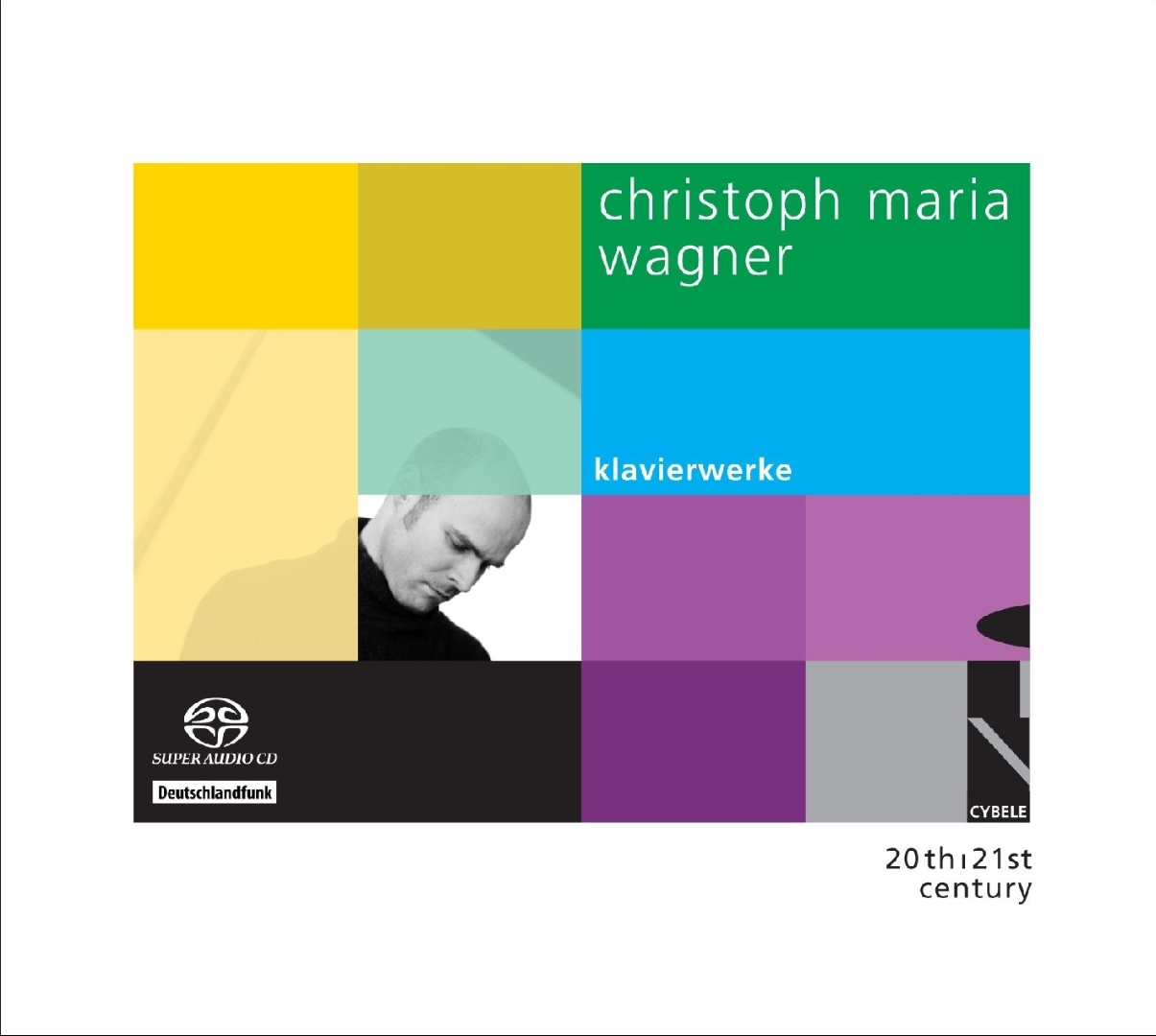
Writing for the piano today is a risky enterprise: the composer must hold his own against an overwhelming legacy associated with Chopin, Liszt, Bartok or Ligeti, and face the question whether piano music is not an anachronism. Christoph Maria Wagner, born in Pfullendorf in 1966, has nonetheless produced a diverse body of piano works. His affinity with the instrument has to do with the fact that he is not only a composer but also a pianist and a conductor — a type of musician whose golden age came in the nineteenth century with Mendelssohn, Chopin and Liszt, later with Busoni and Rachmaninoff, and which almost died out in the twentieth. Wagner studied piano with Klaus Oldemeyer, composition with Krzysztof Meyer and conducting with Volker Wangenheim in Cologne.
As a composer he began at fifteen, self-taught, but was never satisfied and broke off the work again and again. Only in 1987 did the first pieces appear that he still endorses today — piano pieces, of course. There he first tried out the arithmetical method that, as he puts it, allows plausible organic enlargements, diminutions and developments, and that he still uses.
Each of the ten études, five in each book, carries a particular rhythmic and harmonic concept through with rigour. The first links various ametrical rhythms and speeds with particular intervals — quavers with minor seconds, semiquavers with sixths — so that acceleration and deceleration also change the degree of consonance. In the second, large sections of uniform pulsation grow out of the gradual convergence of two strongly contrasting rhythms; its aggressive use of the octave is striking. The third takes up the traditional étude in sixths, only to move away from it again through a steady diminution of the interval down to the major second.
Chromatomanie of 1995/96 is, at almost twenty minutes, among Wagner’s longest piano pieces. Vier bis fünf Geister of 2001 is an hommage to composers and styles that mattered on his own path. The oldest ghost is Robert Schumann, whom Wagner conjures in the section marked agitatissimo come in stato di panico above all through dotted rhythms — the marking alludes both to a fragile mental state and to the famous “fast” and “faster still” of Schumann’s second piano sonata. In the last third Stockhausen’s Mantra is echoed, and the Feldman passage can be recognised by its extreme reduction: a repeated single note and a falling quaver motif over a pedal held for six pages. To these are added unconventional playing techniques as far as the harmonic glissando, for which the player strokes the strings with a finger.
The recording was made in January and February 2006 in the chamber music hall of Deutschlandfunk in Cologne, in co-production with Deutschlandradio. Le Monde de la Musique awarded four stars.