
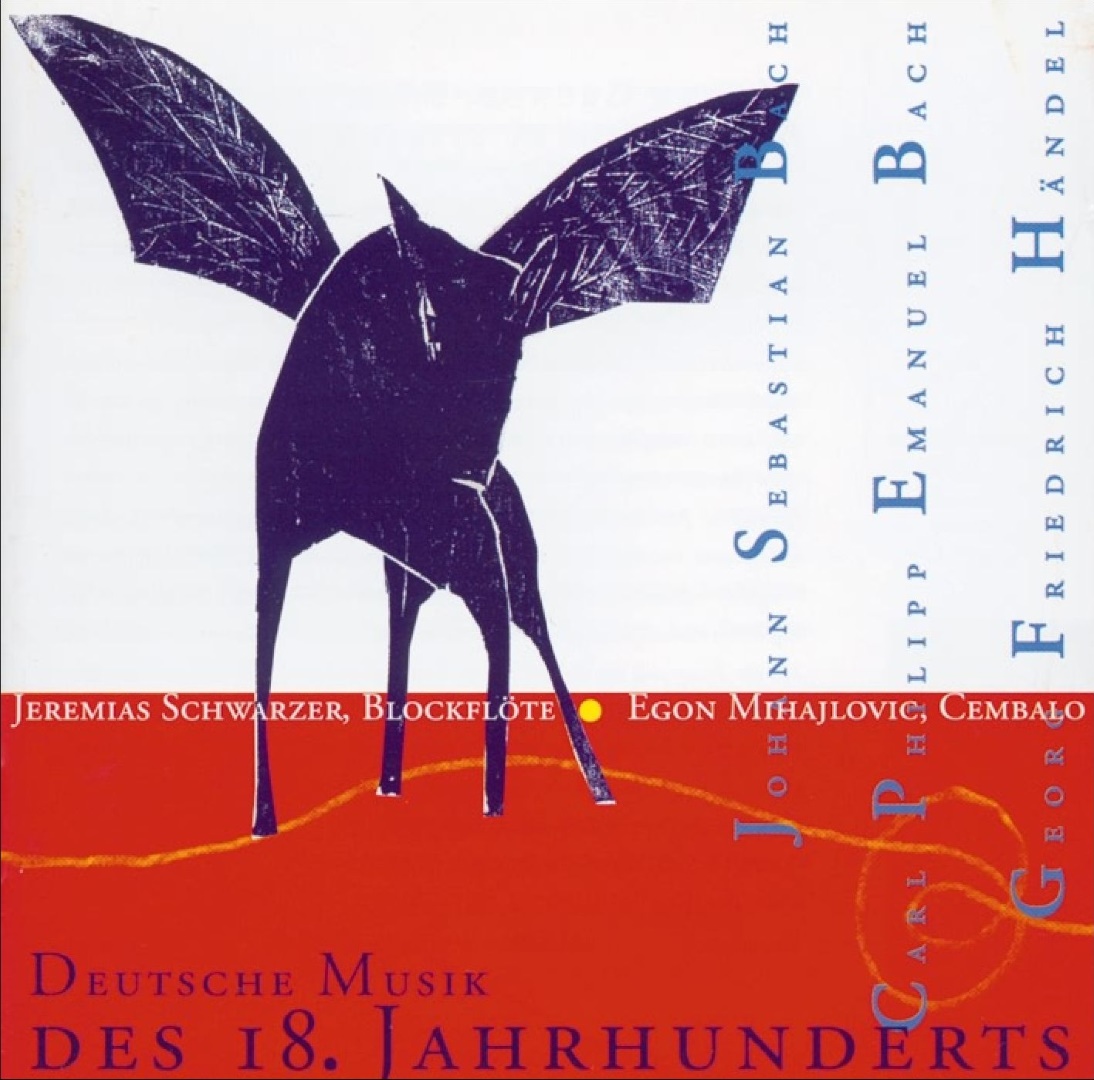
The production is an experiment in the sense of venturing something new: instead of on a transverse flute, as the composers intended, the sonatas of Johann Sebastian and Carl Philipp Emanuel Bach are recorded here on a recorder. The instrument was certainly in use when these works were written, yet it never played so significant a solo role that Bach would have written a demanding sonata for it — although his cantatas do contain some quite difficult recorder passages. In time the transverse flute was increasingly preferred to the recorder, held to be poorer in expression, and apart from one occasional piece for bass recorder, viola and basso continuo C. P. E. Bach seems to have lost interest in it altogether.
His flute sonatas are nevertheless highly interesting for today’s recorder players, Jeremias Schwarzer writes: wonderful music that seeks to summon up the whole expressive wealth of the instrument on which it is made to sound — or rather to sing. With such a recording one walks a tightrope between the composers’ prescribed scoring and the wish to engage with these works on one’s own instrument. His experience is that the essential in this music — its flow of energy, its structure and the relation between the players and the sound of their instruments — can be conveyed on the recorder with a harpsichord too, and that conversely the player, in trying to meet these demands, finds his instrument far less limited than he himself had assumed.
The counterpole in the concept of this CD is formed by the two Handel sonatas, in F major HWV 369 and B flat major HWV 377: typical recorder sonatas, composed at a technical level that hardly goes beyond the standard of the ordinary recorder player of that time — or of today. Both are nevertheless typical of Handel’s imagination and wealth of ideas. From Johann Sebastian Bach the programme takes the Sonata in E minor BWV 1034 and the great Sonata BWV 1030, the latter transposed from B minor to C minor; from Carl Philipp Emanuel the Sonata in E minor Wq 124 with its minuet and two variations and the three-movement Sonata in D major Wq 83.
The recording was made from 19 to 22 July 1997 in the Germanisches Nationalmuseum in Nuremberg, on whose historic keyboard instruments — among them a bentside spinet — Egon Mihajlovic plays. The instruments sounded different again and again over the days of the production, Schwarzer reports, and it was a delight to experience how they developed a life of their own that deepened and enriched the perception of the music. The CD runs to 72:29; the booklet has 32 pages in German, English and French.