
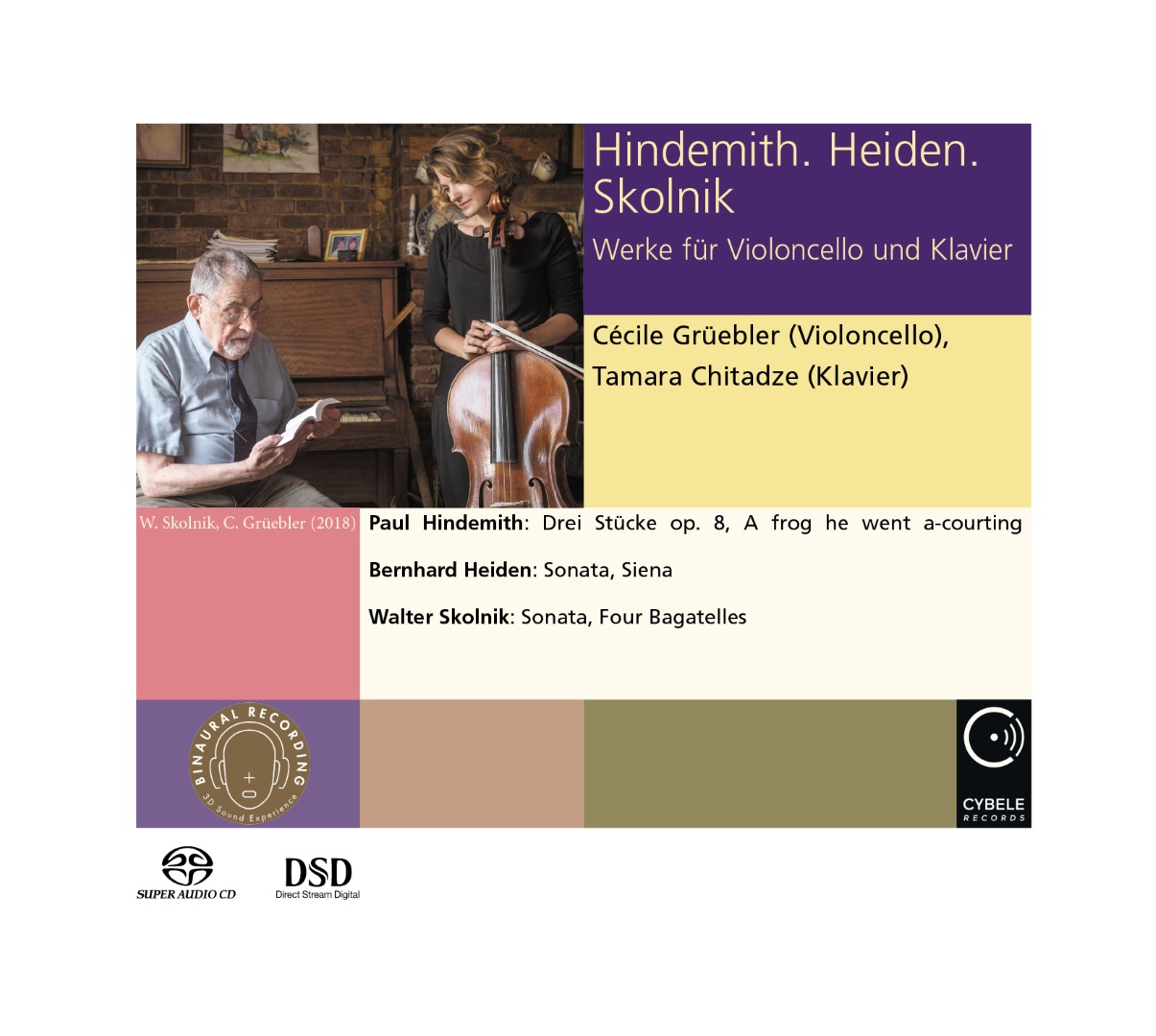
“I have already been asked many times why I have still not recorded any CDs,” Cécile Grüebler says in the booklet. “The reason is that I do not want merely to play beautiful works, but rather tell a story and design a programme whose aim is connecting people and generations.” She has now found that programme: the three composers are linked by teacher–pupil relationships. Bernhard Heiden studied with Paul Hindemith — a photograph of 14 July 1934 shows him beside his teacher on an outing to the Märkische Schweiz, together with Harald Genzmer, Franz Reizenstein and Konrad Noetel — and Heiden later became Walter Skolnik’s most important teacher.
The album owes its existence to a coincidence. In 2017 the Swiss cellist spent several months in New York with her long-standing duo partner, the pianist Tamara Chitadze. “As I was walking on the streets, cello in tow, I got wrapped up in a thrilling conversation with the Manhattan-based 80-plus-year-old composer Walter Skolnik.” Many hours of music-making together followed, and Skolnik’s stories from his student days — and with them the discovery of the line that leads back to Hindemith.
From Hindemith (1895–1963) come the Three Pieces op. 8 of 1917 that open the album: a concise Capriccio, an extended Phantasiestück and a Scherzo which, at over eleven minutes, is the longest movement here. They belong to the early works about which Hindemith remarked in retrospect in 1935 that he had always written, to be sure, but that only after consuming mountains of music paper and seeing some of his attempts in print did he begin, at about twenty-four, to believe in his compositional talent. Quite different are the thirteen variations on the old English nursery song A frog he went a-courting of 1941, most of which do not even last half a minute.
Bernhard Heiden (1910–2000) is represented by the sonata of 1958 and the single-movement Siena of 1961, Walter Skolnik (b. 1934) by the four-movement sonata of 2004 and the Four Bagatelles of 1998. Two of the three composers are virtually unknown in Europe and their music is hardly ever heard here — one more reason for Grüebler to record this programme; even the two Hindemith works, among her favourite pieces, are rarely played.
The recording was made from 16 to 20 October 2018 at the Erholungshaus of BAYER AG in Leverkusen, in stereo, 5.1 surround and 3D binaural stereo; Tamara Chitadze plays a Steinway D grand. The total playing time is 72:08, and the booklet runs to 32 pages in German and English.