
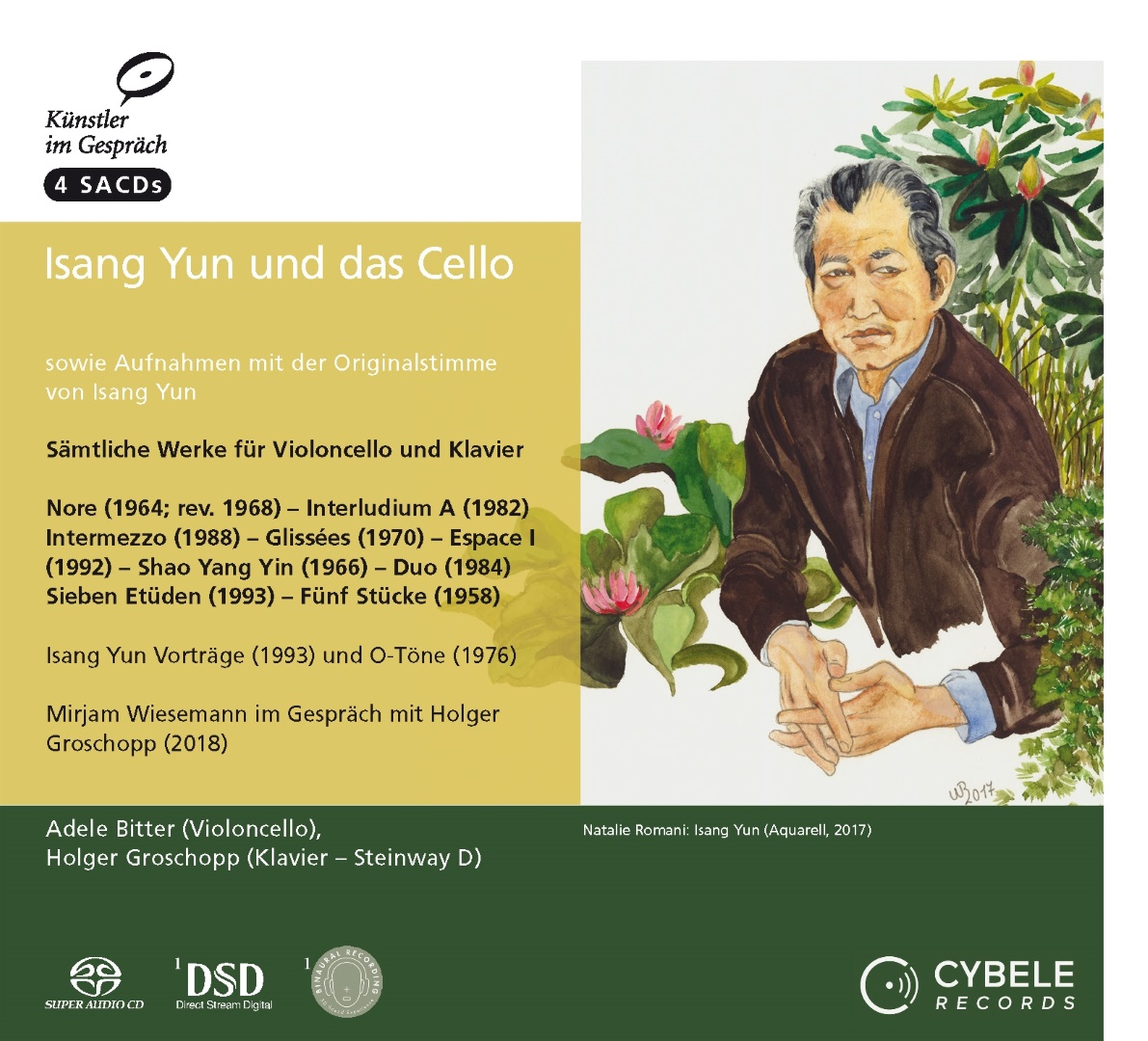
Anniversary edition Künstler im Gespräch Vol. 11 – In my imagination I was free (Isang Yun). Isang Yun’s life is as many-layered and gripping as a well-written novel. His complex character, with all its polarities and conflicts in the face of the challenges he had to meet, offers material for many chapters of human, artistic and historical relevance — and not only because of his spectacular abduction from West Berlin to Seoul (South Korea) at the end of the 1960s, which he recounts in our original recordings, movingly and grippingly, as part of his own life story. No — also, and above all, because of his fascinating work: over the decades Yun developed out of the Eastern and Western influences that shaped him a wholly individual and unmistakable language, so that at the end of his life he could say: The division within me is entirely overcome, even though to the last he suffered greatly from the division of his beloved homeland Korea.
The cello was like a spouse to me, as Isang Yun himself relates in the original recordings (1976, SACD 2-4).
All the more fitting, then — as Holger Groschopp puts it in conversation with Mirjam Wiesemann (SACD 4) — that Yun’s most autobiographical instrument should stand at the centre of this production marking the tenth anniversary of our Edition Künstler im Gespräch.
Of his great Cello Concerto (1975/76), for instance, Yun says: since the cello had been my favourite instrument from my youth, I took it as the centre. He regarded the cello as his own beautiful, frail voice, confronted with the dramatic, destructive world.
The selection of works (SACD 1/2), performed by Adele Bitter (cello) and Holger Groschopp (piano), is like a sketched portrait — the art of catching the impression of a personality in a few strokes. The chosen pieces lead to various stations in Isang Yun’s output – from the first compositions written in Europe, which established a new style, „his“ style, to one of his last works, the Sieben Etüden für Violoncello solo.
Every listener sees my position between East and West differently, and that is as it should be, Isang Yun remarked to Luise Rinser. You can hear my music either way, as Eastern or as Western. That you can do so marks precisely where I stand.