
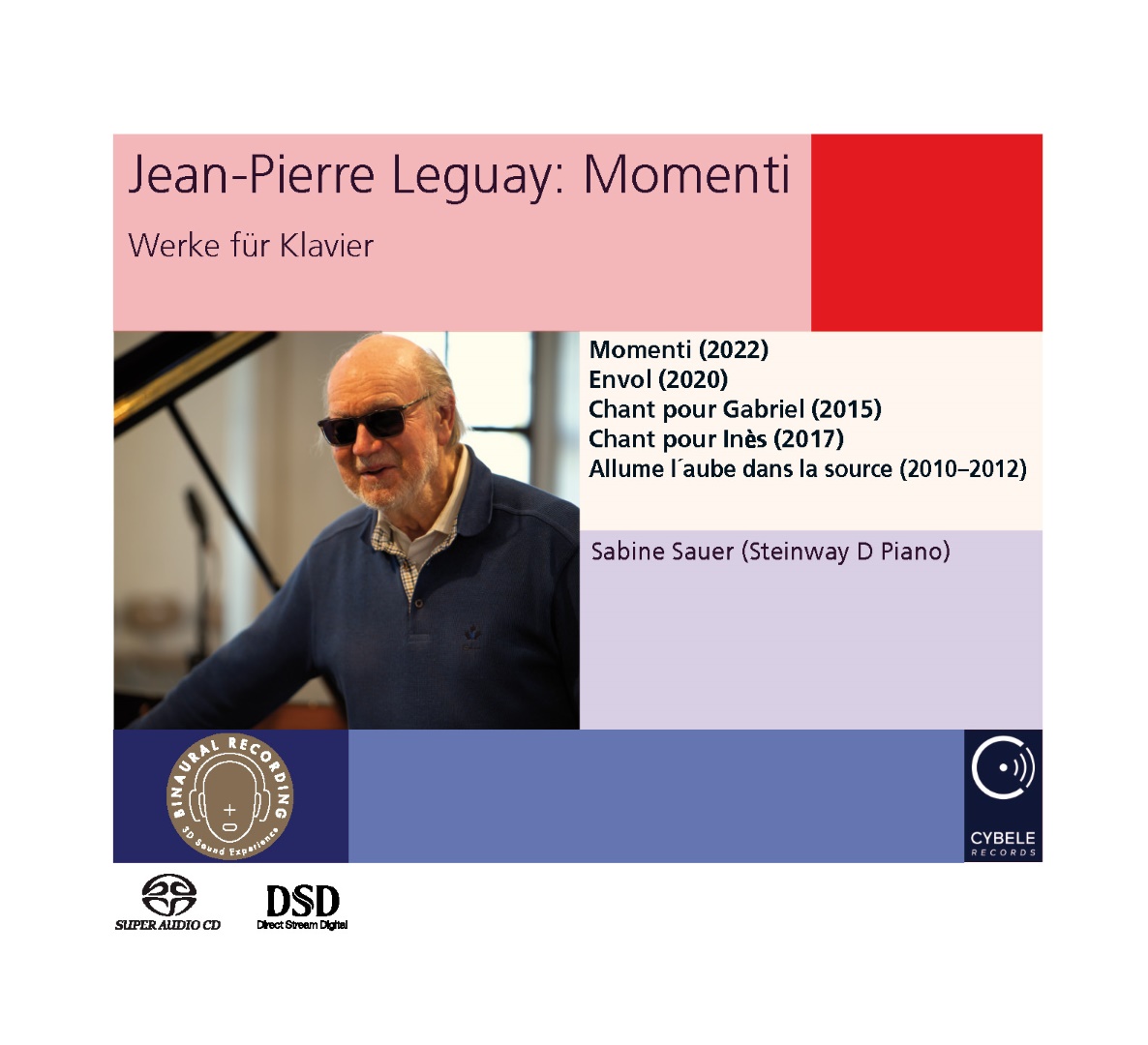
The piano, Jean-Pierre Leguay writes in the booklet, was his first instrument — a distant but indelible dawn. He names the pianos that shaped him: Chopin’s sonorous, flamboyant playing without heaviness, Schubert’s lingering song, Mussorgsky’s unvarnished, at times stony humanity, Bartok’s orchestral thinking, and alongside them Liszt, Skrjabin, Debussy, Ravel. Besides the solo works he has repeatedly combined the piano with other instruments — organ, wind quintet, saxophone, ondes Martenot and percussion. By his own account the breakthrough to a large solo piece came only with Azur (1990-1991), after an early attempt from Messiaen’s class had been abandoned.
Momenti was written in June and July 2022 for Sabine Sauer. The impulse came from the publication of improvisations Leguay had recorded on the great organ of Notre-Dame, on the piano at the Festival de Musique Improvisée in Lausanne and, most recently, on two pianos with Samuel Liégeon. The piece was to be composed quickly, its steps governed by the urgency and immediacy of improvisation; at the back of his mind, Leguay says, were the impromptus of Schubert, Fauré and Skrjabin. Each “moment” was worked on as long as necessary; when he felt the urge to move on, he entrusted the answer to the sources of improvisation and evaluated it only afterwards.
Envol, written in April and May 2020 for Valéry Aubertin, consists of seven short pieces: seven stages traversed without lingering, freeze frames and potential points of departure whose continuation is left open. In fixing the order Leguay accepted interferences between the episodes — slowed or enlarged figures, sleet, bells return from one piece to the next. Chant pour Gabriel and Chant pour Inès were written for his grandchildren, born in 2015 and 2017.
Allume l’aube dans la source goes back to the piano part of Cendres d’ailes, four melodies for tenor and piano; Leguay found the title only after composing, in Paul Éluard. From the three pieces derived directly from it grew a second group of three, interwoven with the first: two concise, incisive pieces, two expansive rhapsodic ones and two slow, contemplative ones. Sabine Sauer, who has taught piano at the Staatliche Hochschule für Musik und Darstellende Kunst in Stuttgart since 2014, has known Leguay for many years; in 2017 she organised a portrait concert in Bad Cannstatt at which he himself improvised on the organ. In 2020 the plan matured to record all his piano works not yet on disc. The recording received the Opus d’Or Award from opushd.net.