
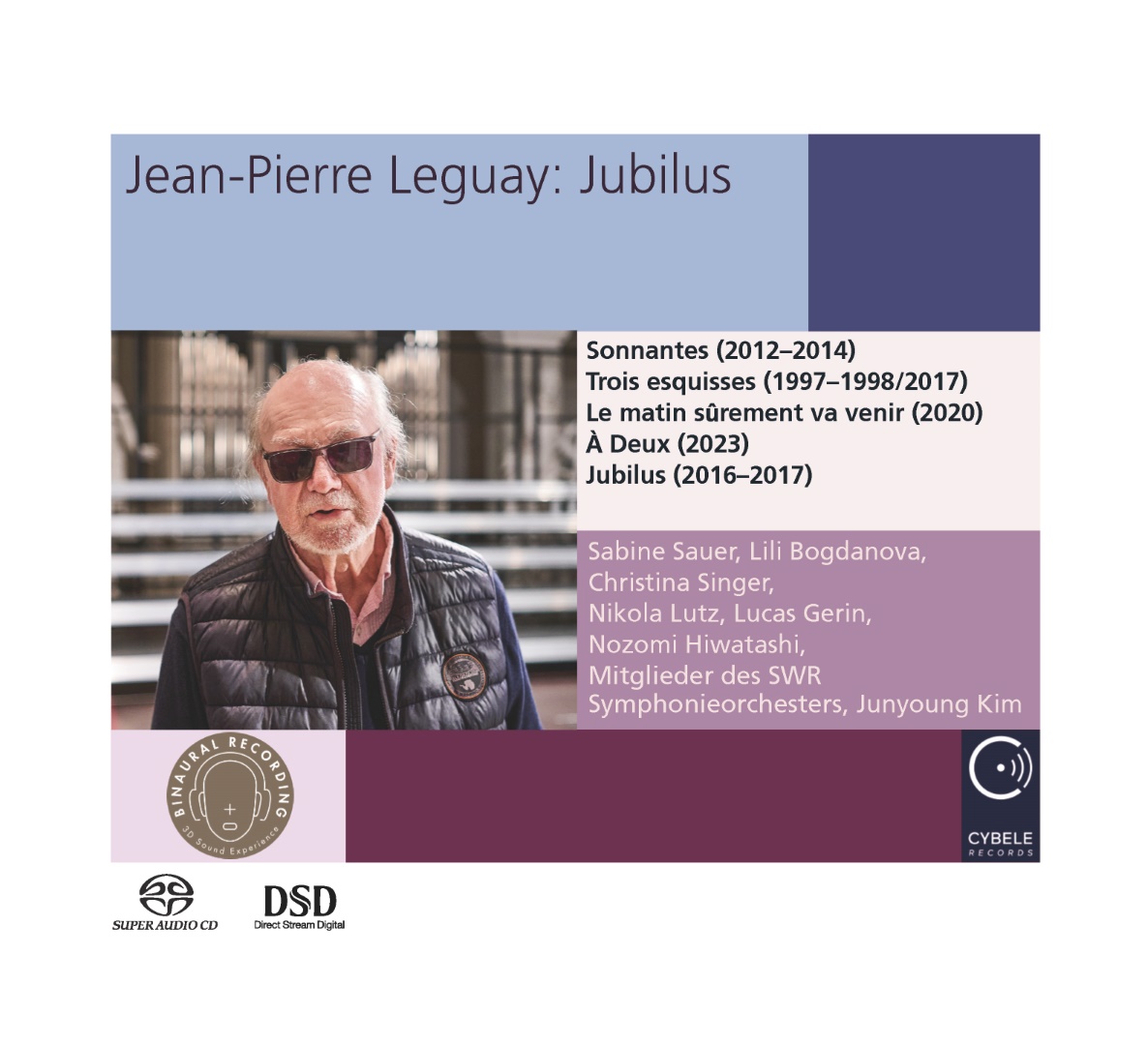
Jean-Pierre Leguay: Jubilus places Jean-Pierre Leguay’s Sonnantes, Trois esquisses, Le matin sûrement va venir, À Deux and Jubilus at the centre. The programme follows no mere succession of separate titles but develops an arc of its own: formal proportion, sonic gesture and the transformation of movement into repose can be experienced as a continuous narrative. Sabine Sauer, Lili Bogdanova, Christina Singer, Nikola Lutz, Lucas Gerin, Nozomi Hiwatashi, members of the SWR Symphonieorchester, Junyoung Kim opens up this music with a reading that makes detail audible without losing sight of the larger whole.
Leguay, Jean-Pierre is the compositional point of reference for this edition. Set against the horizon of Contemporary music, it becomes clear how many shapes the language of sound, compositional technique and expression can take together. This survey traces the many facets of Leguay’s chamber-music thinking: from piano duet by way of flute miniatures to the six-part ensemble constellation of Jubilus. The selection leads not into a museum-like retrospective but into a living present of listening: structures become intelligible, the particularities of the works take on profile, and familiar as well as unexpected turns gain weight.
The scoring — Chamber music, piano duo, flute, alto saxophone, percussion, vibraphone, chamber ensemble — decisively shapes the character of the album. Registration, resonance, breath, touch and silence are treated as musical forces. Where lines overlap, rhythmic impulses gather or tone colours merge into one another, the layout remains transparent. It is precisely this that creates the fine relations which open up further on repeated listening.
Sabine Sauer, Lili Bogdanova, Christina Singer, Nikola Lutz, Lucas Gerin, Nozomi Hiwatashi, members of the SWR Symphonieorchester, Junyoung Kim joins technical command to a clear, unforced musicianship. The playing follows the individual character of the works while maintaining an overarching dramaturgy: fragile moments lose none of their tension, virtuoso passages stay articulate, and strong contrasts are not put on display but developed out of the musical material itself. This gives the edition concentration and a convincing inner calm.