
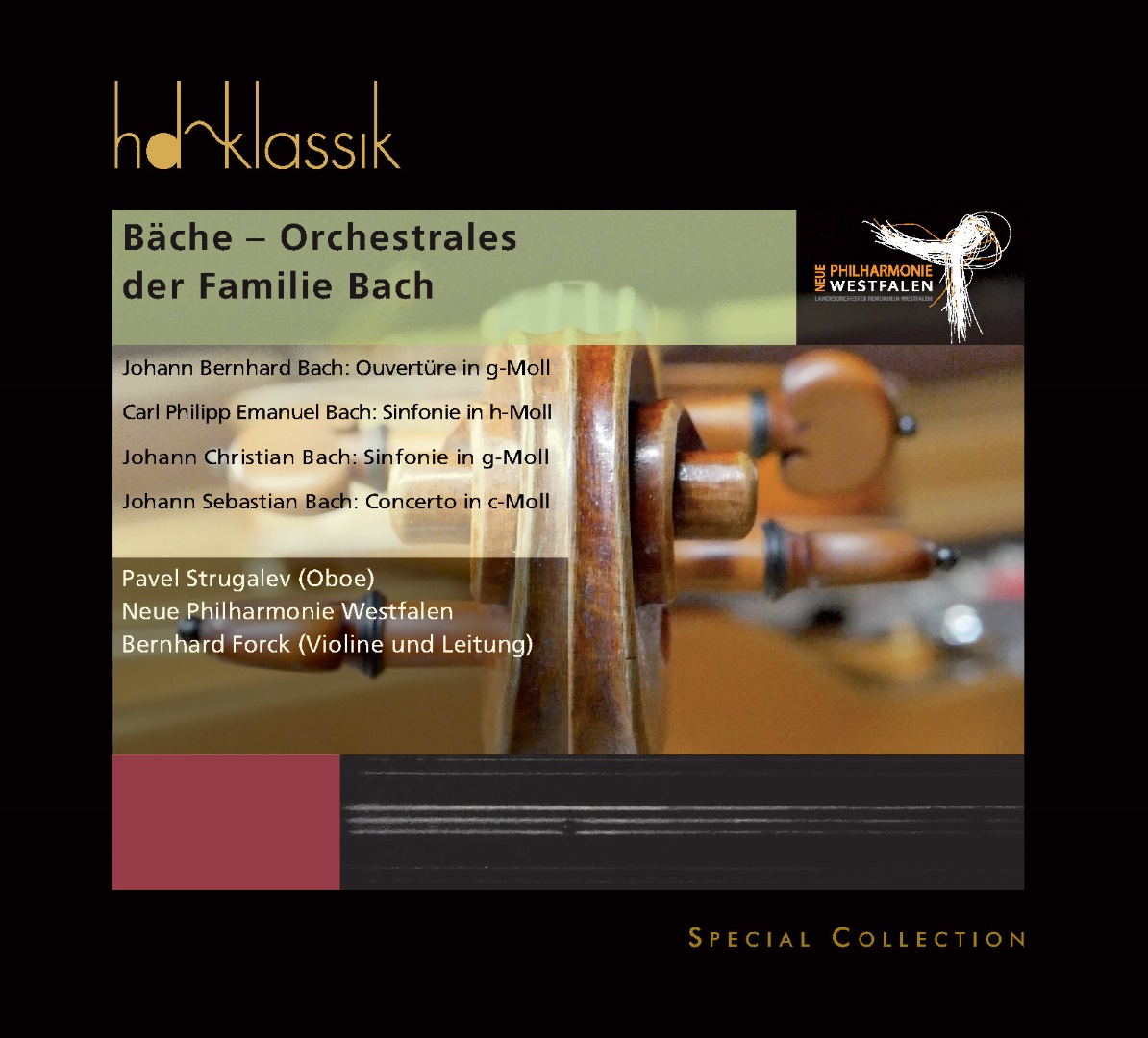
Bach should have been called not “Bach” (stream) but “Meer” (sea): the exclamation attributed to Ludwig van Beethoven, with which Kerstin Schüssler-Bach opens her booklet text, refers first of all to the inexhaustible richness that flowed from the Thomaskantor’s pen. But Johann Sebastian Bach also passed on his gifts: of his 20 children, ten reached adulthood, and four sons became successful composers. He himself came from a family of musicians with a long tradition. His second cousin Johann Bernhard Bach was organist in Erfurt and Magdeburg before moving to Eisenach in 1703 as organist and harpsichordist; musical life flourished there under the music director Georg Philipp Telemann, and Duke Johann Wilhelm supported him. Little of his music survives, among it four overtures in the French suite style; Johann Sebastian had them copied for his Collegium Musicum in Leipzig, thereby preserving them for posterity. The Overture for Violin, Strings and b.c. in G minor combines French courtly dances such as the Loure and the Passepied with Italian virtuosity in the “mixed taste”.
Carl Philipp Emanuel Bach, the second-eldest son, by his own account never had any teacher other than his father, yet he soon turned to new influences and radicalised the emerging galant style. As a long-serving court musician to Frederick the Great he mixed with the brightest minds of his time; his father found the new manner somewhat alienating and called Emanuel’s pieces “Berlin blue that fades away”. In Hamburg, where he succeeded Telemann as music director, he wrote the six Hamburg symphonies in 1773, concise pieces for string orchestra full of sudden changes of mood. They were commissioned by Baron Gottfried van Swieten, later a patron of Haydn and Mozart, who asked the composer to let himself go completely, without regard for the difficulties of performance. The Symphony No. 5 in B minor Wq 182/5 responds with original twists, brusque dialogues and bold contrasts.
Johann Christian Bach, the youngest son, was more than 20 years younger than his half-brother Carl Philipp Emanuel and went down in music history as the “Milan” or “London Bach”. Not yet 15 when his father died, he moved to Emanuel in Berlin. He was the only member of the family with a particular interest in opera; in Italy he converted to Catholicism, and in 1762 he moved to London as music master to the queen. There he gave the eight-year-old Wolfgang Amadeus Mozart impromptu lessons, and his Symphony in G minor Op. 6 No. 6 seems to have directly influenced Mozart’s early symphony in the same key, KV 183. Febrile forward drive, powerful unisons, agitated tremolos and wide leaps shape the outer movements, and the minor-key middle movement also reflects emotional unrest; the genre’s origins in the Italian opera overture become tangible here. The symphony was very probably first heard in the 1760s at the Bach–Abel Concerts, which Johann Christian organised with the gamba virtuoso Carl Friedrich Abel.
As chamber musician, concertmaster and Kapellmeister in Weimar and Köthen, Johann Sebastian Bach knew the concerto literature of his time intimately. The Concerto for Oboe, Violin, Strings and b.c. in C minor BWV 1060 has come down to us only in a version for two harpsichords; the original form for two melody instruments, probably oboe and violin, was presumably written around 1720 in Köthen and was first reconstructed around 1920. The violin plays rapid arpeggios and semiquavers, the oboe sings cantilenas, and in the Adagio both float above a restrained accompaniment. The oboist is Pavel Strugalev, principal oboe of the Neue Philharmonie Westfalen since 2000; the orchestra was formed in 1996 from the merger of the orchestras of Recklinghausen and Gelsenkirchen and has worked closely since 2014 with Bernhard Forck, concertmaster of the Akademie für Alte Musik Berlin, who also directed the Händelfestspielorchester Halle from 2007 to 2019. The recording was made from 4 to 6 May 2021 in the Großer Saal of the Neue Philharmonie Westfalen in Recklinghausen; the album appeared in 2023 in hd-klassik’s Special Collection.