
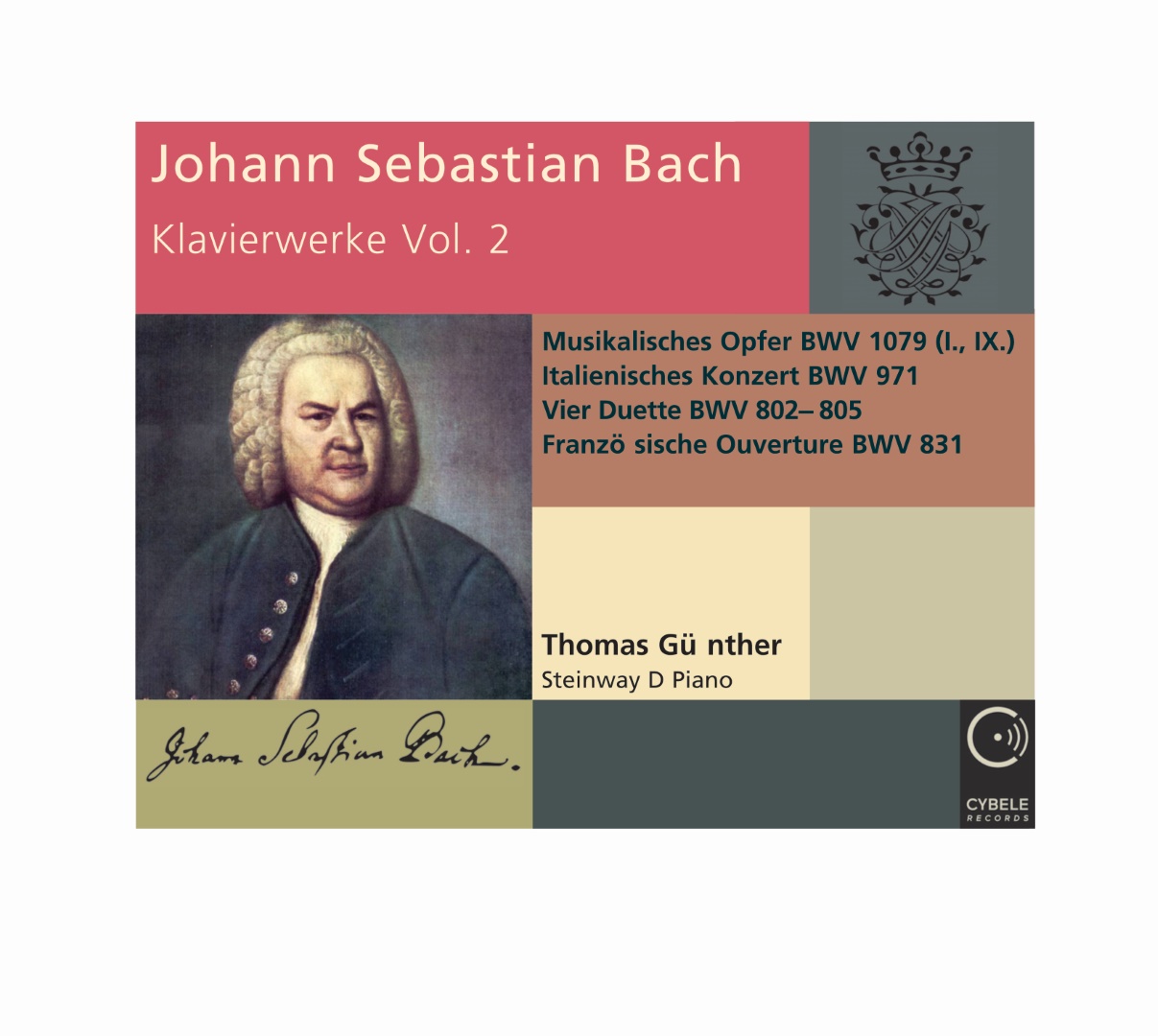
For this recording Thomas Günther did not simply assemble a programme but, as Stefan Orgass writes in the booklet, built a meta-form: the complete second part of the Clavier-Übung, together with the four duets from its third part and the two ricercari from the Musikalisches Opfer. The combination makes audible how Bach, from a German perspective, engages with the prevailing European ways of composing of his day: with fugue and canon, which were assigned to Germany, with the Italian concerto and with the French suite and overture. Such an allocation of genres to nations follows a crudely simplified typology, yet it corresponds to the contemporary discourse on national styles in music. Even opera, notoriously absent from Bach’s output, is according to Orgass conjured up musically in the second movement of the Concerto nach italienischem Gusto in F major BWV 971.
That concerto appeared in 1735 together with the Ouverture nach französischer Art in B minor BWV 831 as the second part of the Clavier-Übung. As early as his Weimar years Bach had arranged solo concertos by Antonio Lucio Vivaldi and others for the organ; in the Italian Concerto the fluid boundary between arrangement and original composition itself becomes the theme, for the piece can be heard as a keyboard version of an imaginary solo concerto. The outer movements are conceived in markedly keyboard terms — “Clavier” at the time meant the manual and any instrument possessing one or more of them — and behind the tonal differentiation the distinction between tutti and soli remains audible. In the French overture Bach proceeds the other way round: from the core of the dance sequence he removes the Allemande, precisely the reference to something German, and expands it with gavotte, passepied and bourrée, in each case repeating the first piece; after the gigue an echo movement follows. The additions halve themselves from four to two to one, matching the groups of eight, four and two bars that articulate the first movement of the Italian Concerto.
The four duets BWV 802–805 come from the third part of the Clavier-Übung, printed in 1739, where they stand within the so-called organ mass of chorale preludes, immediately before the closing fugue in E flat major. That sacred context suggests specific theological content for these two-part, strictly contrapuntal pieces; Orgass demonstrates it in the second duet in F major, an arch form of 37 + 31 + 13 + 31 + 37 bars. The diatonic outer sections with their vigorous major-key subject are set against highly chromatic canonic sections. In the short middle section the two are interlocked: the subject in the lower part is answered not by the expected comes but by its exact inversion, seconded by an ascending passus duriusculus that spans a minor sixth instead of the usual fourth. The bare confrontation of strength and suffering is thus given meaning by conversion — suffering in the awareness that conversion is necessary makes a purified existence possible.
The two ricercari of the Musikalisches Opfer, published in July 1747, realise the opposing meanings of their title: the three-part ricercar represents the act of searching itself, the six-part one presents what has been found. During his visit to the court of Frederick II on 7 and 8 May 1747 Bach was asked to extemporise a fugue on a theme supplied by the king; the Ricercar a 3 voci probably goes back to that occasion. The six-part fugue he was also asked for he played on a subject of his own choosing, requesting time to work one out on the Thema Regium. Six-part writing is a solitary novelty in Bach’s fugal output, and the term ricercar occurs nowhere else in his work. One explanation Orgass offers is that a fugue written according to the rules of the art requires stretti, which the Thema Regium does not permit. In the last section of the Ricercar a 6 voci Bach introduces a diatonic motif identical with the first seven notes of the subject of the fugue in A flat major BWV 886: with such an opening, stretti would have been possible. That he nonetheless does not replace the royal theme, Orgass reads as a final gesture of humility towards its author. Immediately after the journey to Potsdam, Bach joined Lorenz Christoph Mizler’s Correspondierende Societät der musikalischen Wissenschaften as its fourteenth member, and the Musikalisches Opfer found its place among the parcels circulating there.
Thomas Günther, professor of piano at the Folkwang Universität der Künste in Essen since 2007, has been intensively occupied since the late 1980s with Bach’s keyboard music and the questions raised by playing it on the modern grand. His other focal points are the Russian futurists around Nikolai Obukhov, Alexander Mosolov and Nikolai Roslavets and the forgotten piano music of the exiled German-Jewish generation and of the circle around Arnold Schoenberg; John Cage, Dieter Schnebel and Juan Allende-Blin entrusted premières to him. He has worked regularly with Cybele Records since 2003. The recording was made from 20 to 22 September 2015 in the Stadthalle Meinerzhagen. The long version of Stefan Orgass’s booklet text can be downloaded from the label’s website. The recording appeared on the longlist 2/2016 of the Preis der deutschen Schallplattenkritik in the piano music category.