
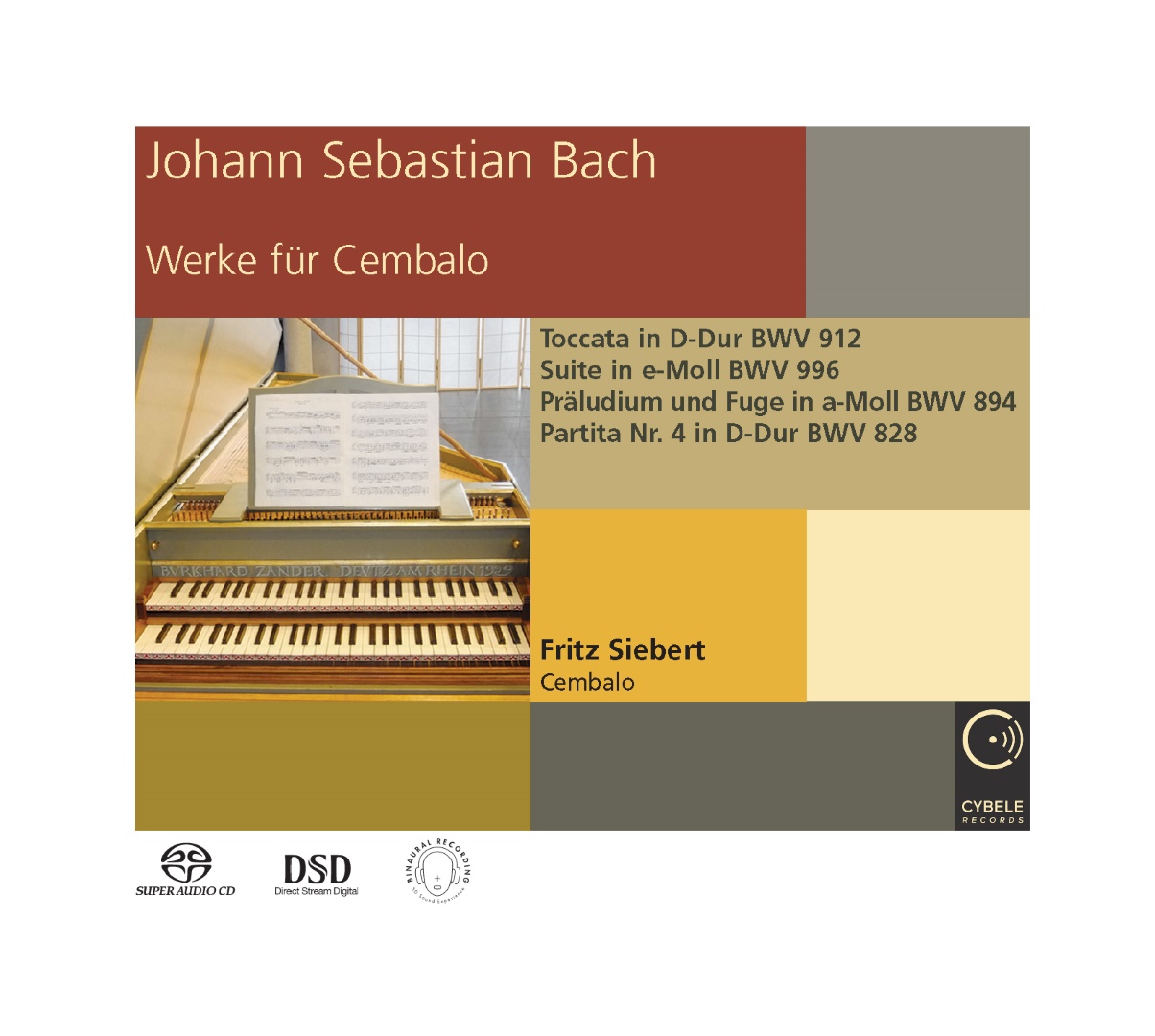
Cybele 3D-031517

Cybele 3D-031517 2015

3D binaural stereo 5.0 surround DSD Stereo Classical music Baroque music 1:13:09

To the description

Johann Sebastian Bach: Werke für Cembalo

Contributors

Fritz SiebertOrganist / Harpsichordist

Composer

Johann Sebastian Bach

Short description

Johann Sebastian Bach: Werke für Cembalo is devoted to Toccata in D-Dur BWV 912, Suite in e-Moll ‘aufs LautenWerck’ BWV 996 – Praeludio, Suite in e-Moll ‘aufs LautenWerck’ BWV 996 – Allemande, Suite in e-Moll ‘aufs LautenWerck’ BWV 996 – Courante and Suite in e-Moll ‘aufs LautenWerck’ BWV 996 – Sarabande by Bach, Johann Sebastian. Fritz Siebert shapes the recording with clear contour, a feeling for tone colour and an eye for the inner dramaturgy of the programme. Solo instrument, harpsichord shape the album’s profile and make the relations between form, gesture and space directly audible. A carefully produced Cybele edition that brings together repertoire, context and sonic presence.

Details

Fritz Siebert (harpsichord by Burkhard Zander, 1999, after Ruckers / Couchet, Antwerp, mid-17th century)

Recording Producer: Ingo Schmidt-Lucas

Booklet languages: German and English (24 pages in a digipak)

Three-dimensional dummy-head sound quality

This Super Audio CD (SACD) contains three different versions of the recording:

– 1D: familiar, one-dimensional stereo CD sound (-> CD layer of the SACD)
– 2D: two-dimensional surround sound (-> SACD layer, multichannel version)
– 3D: three-dimensional, 3D binaural stereo sound (-> SACD layer, stereo version)

To play the two high-resolution versions (2D or 3D) you need an SACD player. Alternatively you can buy the 2D and 3D versions as downloads from our website in various audio qualities.

The 3D version is a dummy-head recording in three-dimensional sound quality, made in wholly purist fashion with just two microphones, without any filters or effects, and intended for headphone listening.
Played back over headphones, this unique technique places you virtually at the scene itself, as though you were experiencing the recording live. That is what sets this recording technique apart from all others: it creates a natural impression of sound and space (including front-back and up-down localisation) that comes close to human hearing.

You will find all of Cybele’s 3D binaural stereo recordings online at: www.cybele.de/3d

3D reference sound with the hd-klassik Headphone Optimizer

The Headphone Optimizer is an award-winning amplifier developed specifically for headphones, which compensates individually for manufacturing tolerances and non-linearities in headphones. To this end hd-klassik first measures your own headphones precisely; after this calibration your headphones and the hd-klassik Headphone Optimizer form a single sonic unit.

The merits of such a reference system are clearly audible: with a calibrated Headphone Optimizer, 3D recordings are reproduced more vividly and more realistically, because the individual weaknesses of your headphones (emphases or attenuations in the various frequency ranges) are minimised and the original sound of the recording is thus very nearly restored.

Conventional stereo recordings played back through a Headphone Optimizer also sound far more realistic as a result.

About the dummy head used

Three-dimensional localisation of sound sources is an essential part of normal hearing, which takes place automatically at both ears. The dummy-head measuring technique developed by HEAD acoustics GmbH makes it possible to record acoustic signals exactly as the ear perceives them.
The geometry of the dummy head is a mathematically describable replica of the human head and shoulders, and it guarantees the correct reconstruction of every acoustically relevant component of the human outer ear. www.head-acoustics.de

Awards

Preis der deutschen Schallplattenkritik — Longlist 1/2016, organ & harpsichord category

Specifications

Catalogue number
Cybele 3D-031517
Year of release
2015
Genre
Classical music
Period
Baroque music
Instrumentation
Harpsichord, Solo instrument
Label
Cybele Records
Barcode
809548017124
GTIN
4068992487359
Booklet (pages)
24

Track listing

16 tracks · 1:13:09

  1. 01 Toccata in D-Dur BWV 912 Composer: Johann Sebastian Bach (1685-1750) Performer: Fritz Siebert 11:33
  2. 02 Suite in e-Moll 'aufs LautenWerck' BWV 996 – Praeludio Composer: Johann Sebastian Bach (1685-1750) Performer: Fritz Siebert 2:32
  3. 03 Suite in e-Moll 'aufs LautenWerck' BWV 996 – Allemande Composer: Johann Sebastian Bach (1685-1750) Performer: Fritz Siebert 3:15
  4. 04 Suite in e-Moll 'aufs LautenWerck' BWV 996 – Courante Composer: Johann Sebastian Bach (1685-1750) Performer: Fritz Siebert 2:16
  5. 05 Suite in e-Moll 'aufs LautenWerck' BWV 996 – Sarabande Composer: Johann Sebastian Bach (1685-1750) Performer: Fritz Siebert 3:21
  6. 06 Suite in e-Moll 'aufs LautenWerck' BWV 996 – Bourrée Composer: Johann Sebastian Bach (1685-1750) Performer: Fritz Siebert 1:04
  7. 07 Suite in e-Moll 'aufs LautenWerck' BWV 996 – Gigue Composer: Johann Sebastian Bach (1685-1750) Performer: Fritz Siebert 2:51
  8. 08 Präludium und Fuge in a-Moll BWV 894 – Präludium Composer: Johann Sebastian Bach (1685-1750) Performer: Fritz Siebert 6:17
  9. 09 Präludium und Fuge in a-Moll BWV 894 – Fuge Composer: Johann Sebastian Bach (1685-1750) Performer: Fritz Siebert 4:59
  10. 10 Partita Nr. 4 in D-Dur BWV 828 – Ouverture Composer: Johann Sebastian Bach (1685-1750) Performer: Fritz Siebert 6:20
  11. 11 Partita Nr. 4 in D-Dur BWV 828 – Allemande Composer: Johann Sebastian Bach (1685-1750) Performer: Fritz Siebert 10:24
  12. 12 Partita Nr. 4 in D-Dur BWV 828 – Courante Composer: Johann Sebastian Bach (1685-1750) Performer: Fritz Siebert 4:16
  13. 13 Partita Nr. 4 in D-Dur BWV 828 – Sarabande Composer: Johann Sebastian Bach (1685-1750) Performer: Fritz Siebert 5:42
  14. 14 Partita Nr. 4 in D-Dur BWV 828 – Aria Composer: Johann Sebastian Bach (1685-1750) Performer: Fritz Siebert 2:19
  15. 15 Partita Nr. 4 in D-Dur BWV 828 – Menuet Composer: Johann Sebastian Bach (1685-1750) Performer: Fritz Siebert 1:32
  16. 16 Partita Nr. 4 in D-Dur BWV 828 – Gigue Composer: Johann Sebastian Bach (1685-1750) Performer: Fritz Siebert 4:28

Description

Johann Sebastian Bach: Werke für Cembalo places Toccata in D-Dur BWV 912, Suite in e-Moll ‘aufs LautenWerck’ BWV 996 – Praeludio, Suite in e-Moll ‘aufs LautenWerck’ BWV 996 – Allemande, Suite in e-Moll ‘aufs LautenWerck’ BWV 996 – Courante and Suite in e-Moll ‘aufs LautenWerck’ BWV 996 – Sarabande at the centre. The programme is laid out not as a loose sequence but as an audibly articulated whole: different pieces, textures and states of sound enter into relation with one another and give the album a profile of its own.

The selection belongs to the field of Classical music; stylistically it leads into Baroque music. Bach, Johann Sebastian is the decisive point of reference here. The booklet opens up the genesis of the works, their aesthetic premises and the connections between them, without reducing the music to mere commentary. Historical layers, formal ideas and personal spaces of expression remain present as an audible experience.

The scoring – Solo instrument, harpsichord – is essential to what this production has to say. Stops, articulation, resonance and silence are treated as shaping forces. Where lines overlap, rhythmic impulses gather or tone colours merge into one another, the recording preserves transparency while letting the physical presence of the instruments and voices be felt.

Fritz Siebert joins interpretative precision to a natural musical breath. The playing follows the character of each individual work while keeping the long line in view: fragile moments retain their tension, virtuoso passages remain intelligible, and the transitions between repose, movement and concentration acquire a convincing inner logic.

The technical realisation supports this kind of listening without overstating the effect. Hybrid-SACD allows a finely graded presentation of dynamics, space and tone colour; the total playing time of 73:09 is deliberately proportioned. Individual voices, ensemble balance and reverberation are thus not merely documented but become experienceable as part of the musical architecture.

As is typical of Cybele, this edition combines careful work on repertoire, editorial context and attentive sound direction. It addresses curious listeners as much as connoisseurs: the immediate musical impression remains central, while repeated listening opens up further connections, details and perspectives.

Cybele 3D-031517