
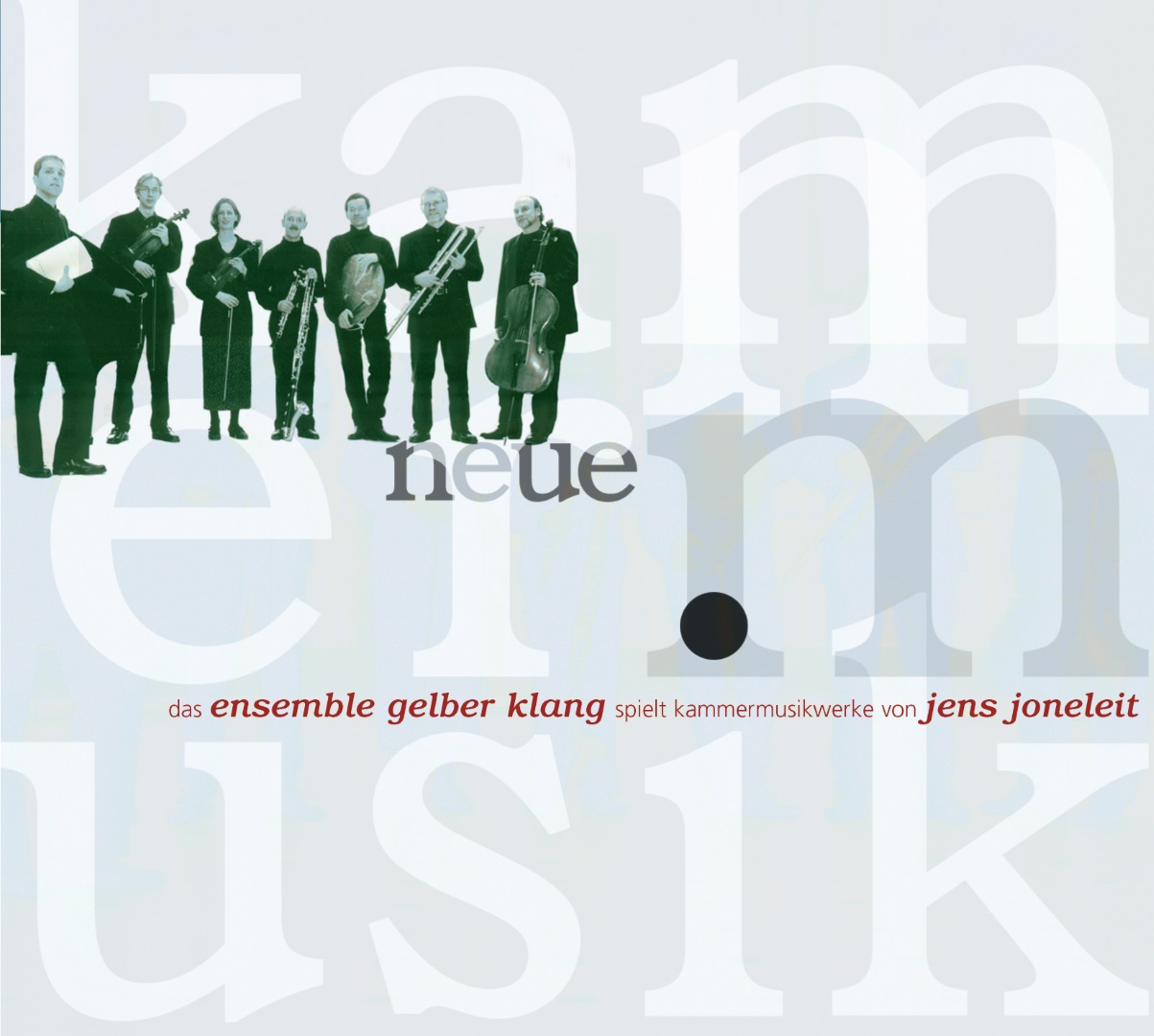
Jens Joneleit, born on 17 September 1968 in Offenbach am Main, studied composition with Stephen Yarbrough, Lewis Hamvas, Robert Marek and Joel Naumann in Vermillion (South Dakota) and Madison (Wisconsin); in Germany he received significant support from Franz Hummel. In an interview he named as decisive for his own work the sound monoliths of Anton Bruckner and Bruckner’s ability to create out of silence. From there the line leads to new music: to the gesture of letting be and letting flow, as Morton Feldman teaches it, but also to the gesture of revolt, which no one brought to life so purely and so flamingly as Luigi Nono.
Il canto l’interno, … nell’intimo is a rhapsodic fantasia with improvisatory and cadenza-like elements, a wordless, inward song from which a wealth of images springs. The booklet calls it the witching hour of the instruments: when they lie at night in their cases under their covers they sound as if dreaming, and in the dark sounding-boards everything shapes itself of its own accord — clown-like screams, violin ricochets as delicate as porcelain, dancing ostinatos, ebony-black French jazz. Sung duets unite the two woodwinds in a virtuoso game of question and answer, and the two strings likewise; before the apparition is over, a deceptive calm reigns.
In the String Quartet No. 6 contrast and cut techniques are as characteristic as the dissolution of a figure into disparate single lines that diverge and fade away. The sobriety of the musical disposition stands in remarkable contrast to the strong emotional content: it is affect that guides the bow, from the first bar to the last. The second movement exposes a strict two-part chant that later returns several times — shortened, condensed, rhythmically displaced, transposed by octaves. The third movement also begins cantabile, with a Lento molto espressivo to be played by all with wooden mutes, out of which a heavily veiled texture in up to eight voices arises, followed by cold, chromatically marbled sound fields.
Behind the piano trio … in Sicht stands an image: above a great, bright, mirror-smooth lake the horizon is hidden by a bank of fog, sky and water pass into one another and cannot be told apart — a scene as still and beautiful as a painting, but the deeper one is drawn into it the lonelier the observer’s gaze becomes; drawn by the shapeless, colourless depth, for one suspended moment he lets go of all hold and all memory until nothing remains but white, faded expanses. The three movements circle that moment; into the whiteness the signs of the music are inscribed. The work was written in the summer of 1999, between the divertimento Schallrisse for large orchestra and the piano concerto Konnex, as a moment of radical reflection and self-assurance.
The cello solo Abbild, written for Scott Roller, conjures a playful fugato out of a motif in fourths: one kind of sound leaps over into another that it resembles — the harmonic is the effigy of the fundamental, the pizzicato the effigy of the bowed note, the shimmering tone behind the bridge its distortion. Io sol uno, finally, arose from the wish to perceive timbre as an independent musical quality: in the beginning there is just one pitch wandering astray in space, breathy dust coalescing into phosphorescent clusters; over circling ostinatos in the low strings chords take shape, and at the end the music emanates so finely that one hardly feels the return into infinite, undifferentiated silence. The recording was made in June 2001 in the Theater an der Halle in Ostfildern-Nellingen; the CD runs to 76:47.