
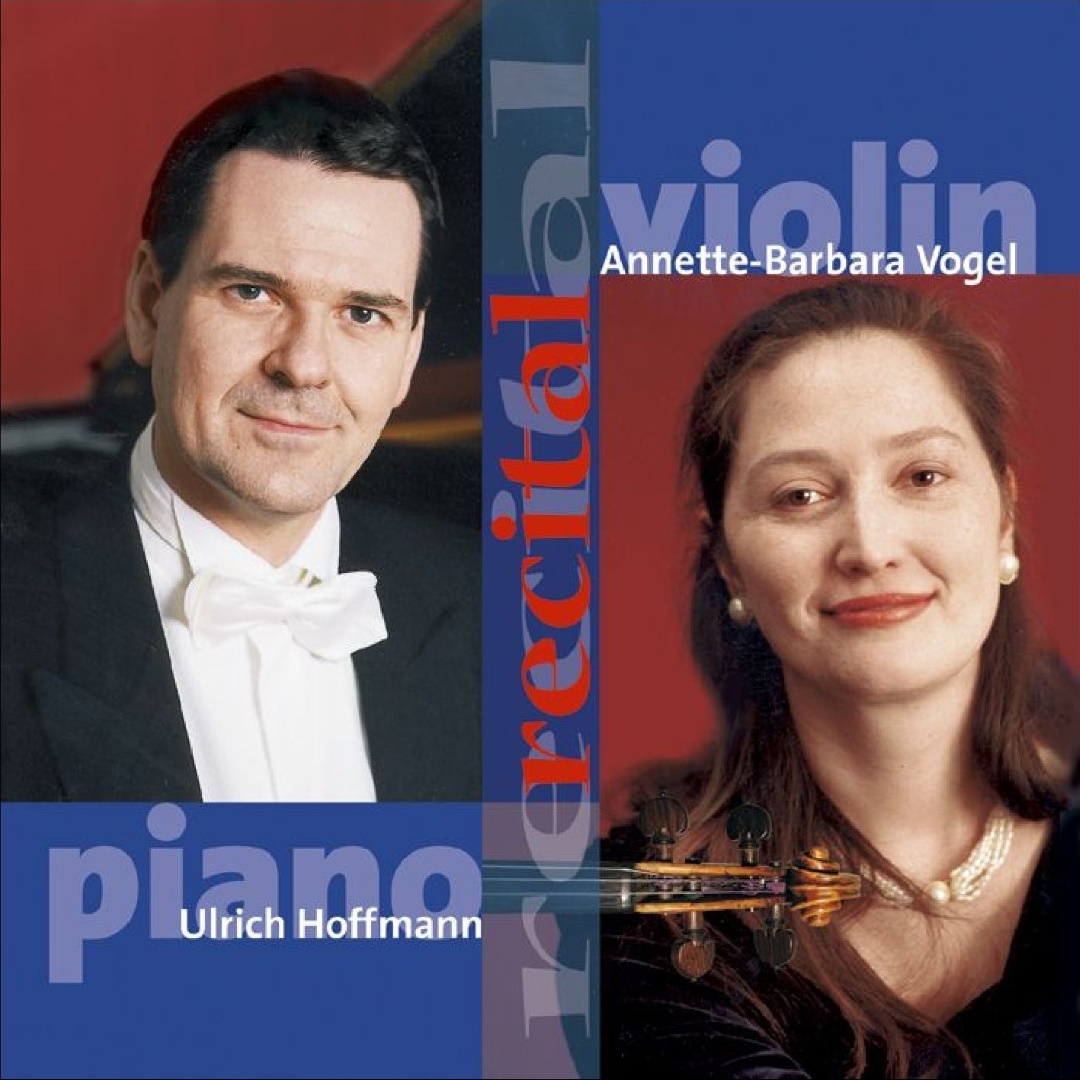
“It is the future that determines the continuity of music” — this comment on the uncertain life-span of his own work was made by Witold Lutoslawski in one of his last newspaper interviews, in January 1993. With it he touches on a question that is existential for many artists: will the artefacts survive their creator’s biological end, will they mean anything to later generations — or will they remain the concern of specialists alone, brought out on the occasion of the all too rare anniversaries? The durability of the four compositions in this recital is beyond question, even though they are not the best known for violin and piano; charm, grace and expression secure them a lasting place.
The oldest of the four pieces is by Johannes Brahms. Conceived for clarinet and piano, he wrote the Sonata in F minor Op. 120 No. 1 in the summer of 1894, although four years earlier he had told Clara Schumann that he wished to compose nothing more. He did not keep to that resolve — though afterwards he wrote chamber music only. The outward occasion for this austere, folk-like piece was his acquaintance with Richard Mühlfeld, the clarinettist of the Meiningen court orchestra, for whom he had already composed the clarinet trio Op. 114 and the clarinet quintet Op. 115 in 1891; a second sonata in E flat major followed immediately. That the clarinet may be replaced by a viola or a violin is the composer’s own idea — his two actual violin sonatas, the “Regenlied” Sonata Op. 78 and the “Thun” Sonata Op. 100, had already been written in 1878/79 and 1886.
Max Reger, forty years younger, was interested in the violin-and-piano duo all his life. The work he gave the opus number 1 is written for this combination, and he composed eight further sonatas as well as two suites and the Prelude and Fugue in A minor; together with the string trio Op. 77a and the clarinet quintet they are among the best loved pieces of his chamber music. The rather exquisite Two Pieces Op. 87, probably written in the summer of 1905 and consisting of an Albumblatt and the Romance in E minor, are heard far less often — unjustly, as this probably first recording of the Romance shows.
Like Reger, George Enescu turned early to this combination. At sixteen he — an outstanding pianist as well as a brilliant violinist — wrote his first sonata in D major; the second in F minor Op. 6 followed two years later, and a third in A minor Op. 25 in 1926. Already in the second sonata, which Enescu premièred as the pianist together with the French violinist Jacques Thibaud, the ever homeland-bound composer took up elements of Romanian folklore. Recalling the time of its composition he once remarked that he had felt himself developing very fast, becoming himself; from then on he had felt his way forward. Carl Flesch called the sonata one of the strongest contemporary works of its genre, in which sensibility and technique stand at an equally high level.
The youngest of the four compositions is Lutoslawski’s Partita, written in the autumn of 1984; four years later came the far better known version for orchestra. The chamber piece was written at the request of the Saint Paul Chamber Orchestra for the violinist Pinchas Zukerman and the pianist Marc Neikrug, who premièred it a year later in St Paul, Minnesota. It consists, the composer says, of five movements: the most important are the first (Allegro giusto), the third (Largo) and the fifth (Presto), while the second and fourth are only short interludes to be played ad libitum; a further short ad libitum section appears before the end. The three main movements follow, rhythmically at least, the tradition of pre-classical keyboard music — though, as Lutoslawski adds, no more than as a hint. The recording was made in July 2000 and January 2001 in the Stadthalle Rheinberg; the CD runs to 69:52.