
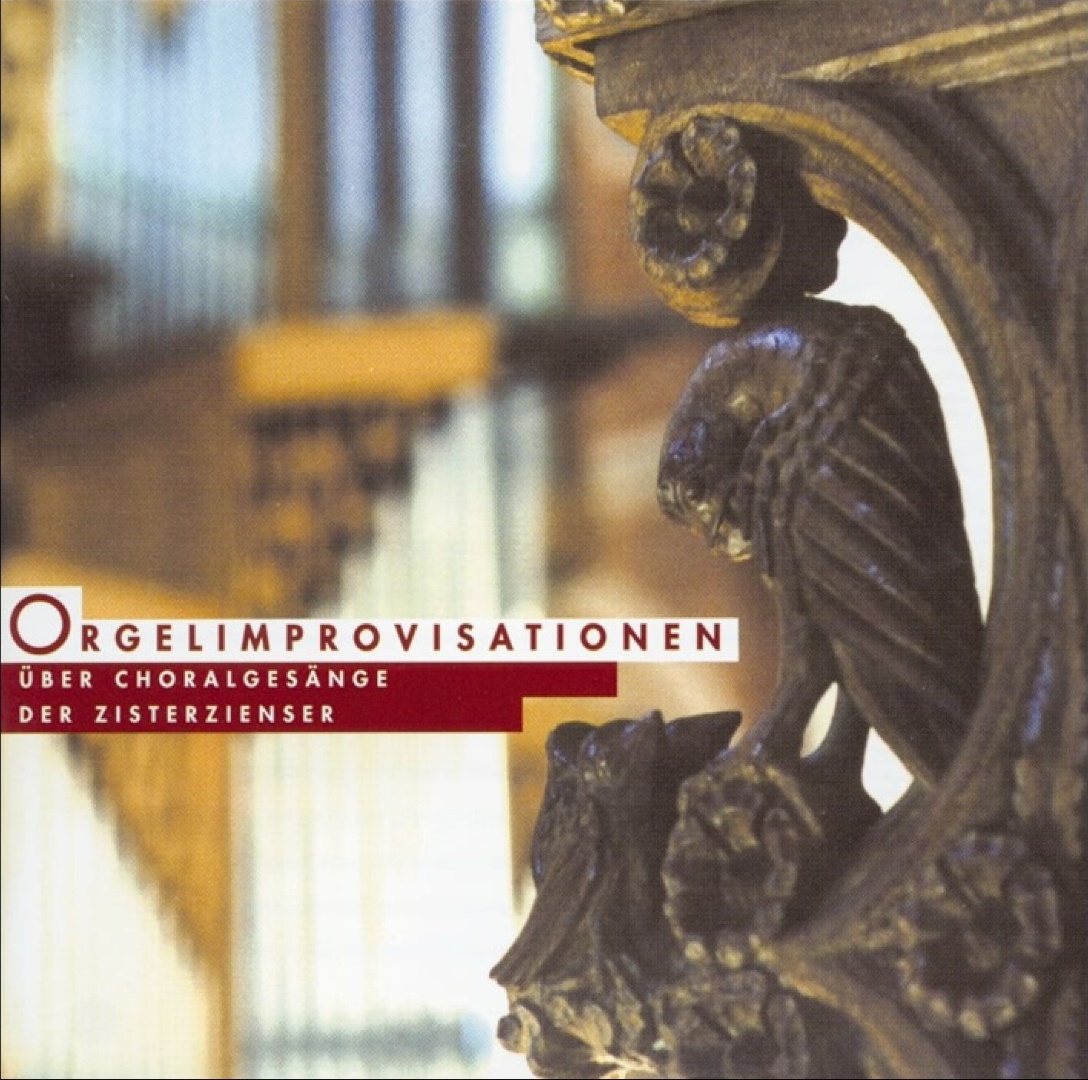
Gregorian chant, the booklet explains, is still heard today in its original form, monophonic and unaccompanied. Yet just as it has been handed down through the centuries, it can also be carried over into the styles of those times: in chant improvisation a chant theme combines with the spirit of the age, whether in the form of a Baroque suite or fantasia or in the guise of a French symphony. The recording of the concert, given on 26 April 1998 within the Marienstatt abbey concerts directed by Fr. Gregor Brandt to mark the 900th anniversary of the order, is described there as a snapshot of such appropriations, which will never recur in this form.
The themes come from the chants of the feast of St Bernard on 20 August and of the feast of the Seven Sorrows of Mary on 15 September, and from the daily Marian praise of the Salve Regina. Bernard of Clairvaux, who was given the epithet “Doctor marianus”, felt very close to the Mother of God throughout his life. According to legend, after a sermon in Speyer Cathedral he added the final invocations “O clemens, o pia, o dulcis virgo Maria” to the Salve Regina. While he otherwise shortened and simplified the Gregorian chants when revising them, he liked to add notes to Marian hymns and antiphons, as Fr. Jakob Schwinde explains in the booklet; one example is the great Cistercian Salve Regina at the end of the CD.
In the Suite française in the Baroque Style on the Hymn “Bernardus Doctor inclytus”, verses of the Vespers hymn sung by the schola alternate with six organ movements, from the Plein jeu as prelude through Duo, Trio, Basse de trompette and Récit de Nazard to the Dialogue as postlude; the unknown author of the hymn quotes the opening line of another hymn in the last line of each verse. The Fantasia and Fugue in the German Romantic Style on the Antiphon “Salve Regina” follows the singing of the antiphon. In the Versets on the Hymn “Stabat Mater dolorosa” the organ responds in the French Romantic style to five verses of the hymn for the feast of the Seven Sorrows of Mary.
The Symphonie pour Grand-Orgue takes up chants of the feast of St Bernard and the Marian praise: the Allegro maestoso is preceded by the Introit “In medio ecclesiae”, the Andante cantabile by the first verse of the Vigil hymn “Bernardus inclytis ortus natalibus”, the Scherzo by the Alleluia “Charitate vulneratus” and the Final by the Salve Regina.
Wolfgang Seifen, born in 1956, attended the music grammar school of the Regensburger Domspatzen from 1967 and studied Catholic church music in Aachen and at the Robert Schumann Hochschule in Düsseldorf. In 1983 he was appointed to the Papal Basilica of St. Marien in Kevelaer. Since 1992 he has led a class for improvisation and liturgical organ playing at the Düsseldorf Hochschule, which made him a professor in 1995; he is also a co-founder of the Internationale Altenberger Orgelakademie für Improvisation. The Rieger organ of the abbey basilica, built in 1969/70, has four manuals and a Spanish division.