
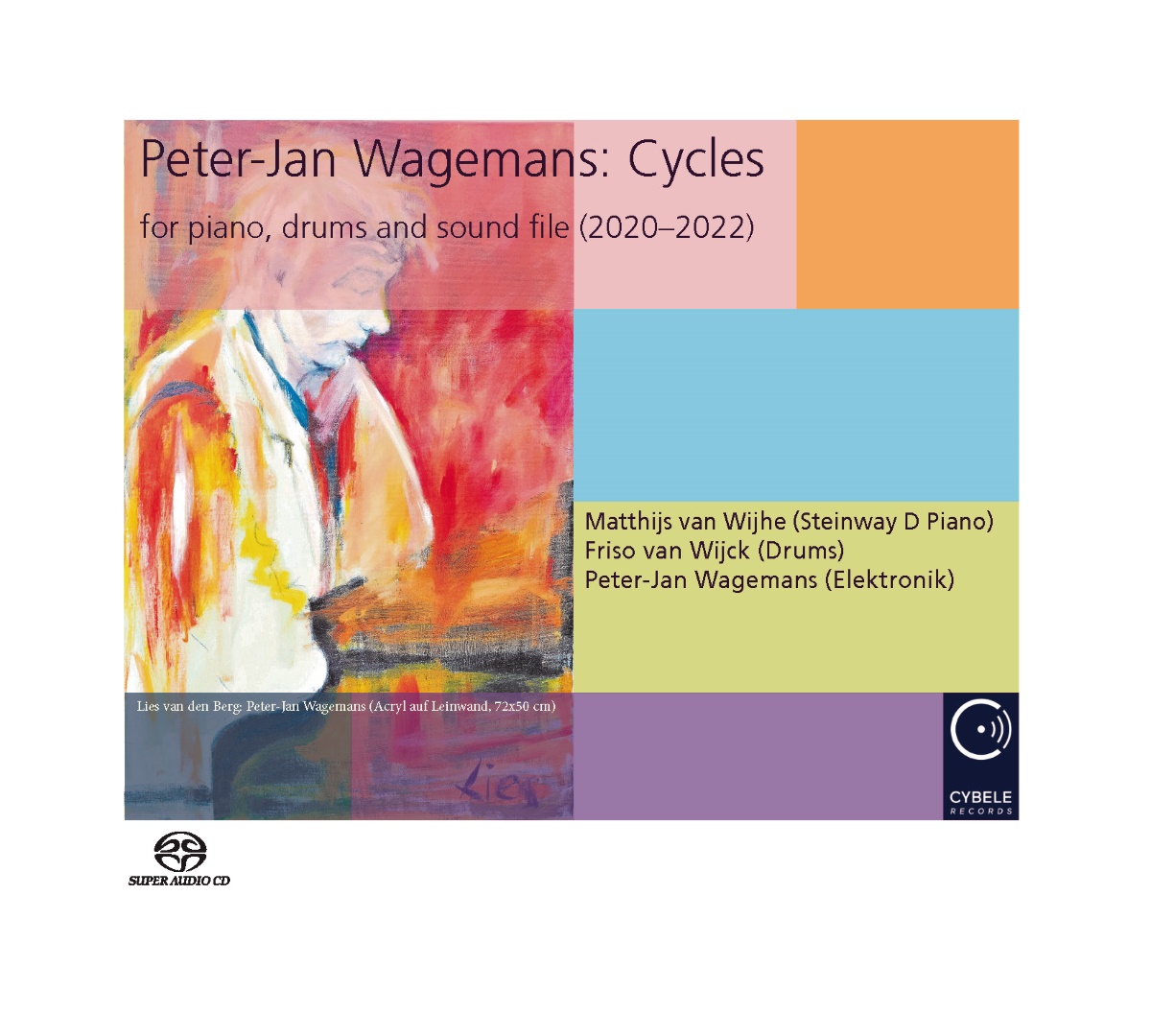
“There was no demand or commission for the work,” Peter-Jan Wagemans (b. 1952) writes in the booklet; he took advantage of the social calm caused by the pandemic to realise an old dream — the dream of a music situated between modernism and jazz. At the Rotterdam conservatory (Codarts), where he taught for many years, he had heard small ensembles of piano, drums and a melody instrument, formed by students who had developed an intelligent, almost Bach-like idiom far removed from all jazz clichés. To this came records that had been on his shelf for decades: Cecil Taylor’s Silent Tongues and Weather Report’s Mysterious Traveller, along with the videos of drummer Dave Weckl. And the thought that he was beginning to grow old and would like to write one great cycle, a little like the late variation works of Bach and Beethoven. Cycles was written between October 2020 and February 2022.
The work consists of eight cycles of three pieces each; the exceptions are Cycle IV for drums solo and Cycle V for piano solo, each with a short coda for both instruments. The cycles can be played separately or in other combinations. Cycle I opens with a long, flowing, strongly diatonic line — for the composer “a kind of modern Gregorian chant”, with something of Cecil Taylor’s lines; in the second piece two such lines are set against each other, one short and fast, the other slow in repeating notes, accented by the drummer on the crotales, and the third is a reprise of the first, more widely spun out.
In Cycles II, III, IV, VII and VIII electronics are added, in the simplest possible way: a stereo sound file created by Wagemans and mixed with the live sound during the performance. Sometimes it doubles the piano and drum parts, mostly it functions as an additional player. At the beginning of Cycle II the fast line of the opening returns slowed down and doubled with itself, raised by twenty cents, which produces a marked interference against the real piano; the drummer meanwhile plays a “trash xylophone” he has built himself from tiles, pieces of iron and wood. In the following piece a piano sound made of accumulated fifths, raised by fifteen cents, stands softly in the hall while the piano plays a polyphony dominated by fifths and the drums fast, quasi-improvised lines. “I tried to know as little as possible about jazz,” Wagemans writes, “so that what I composed is a memory of heard jazz, an echo, not the thing itself.”
Wagemans met both performers at the Rotterdam conservatory. Friso van Wijck studied composition with him and is also a jazz and pop drummer; Matthijs van Wijhe was the only pianist there willing to play the composition students’ new piano pieces — the two share a love of Alexander Skrjabin’s piano sonatas, and van Wijhe is Wagemans’s own piano teacher. The recording was made on 24 and 25 October 2022 in the Jurriaanse Zaal of De Doelen in Rotterdam, on the Steinway D grand with the trash xylophone in front. The 32-page booklet contains Wagemans’s commentary on every single piece; the cover shows a portrait of the composer by Lies van den Berg.