
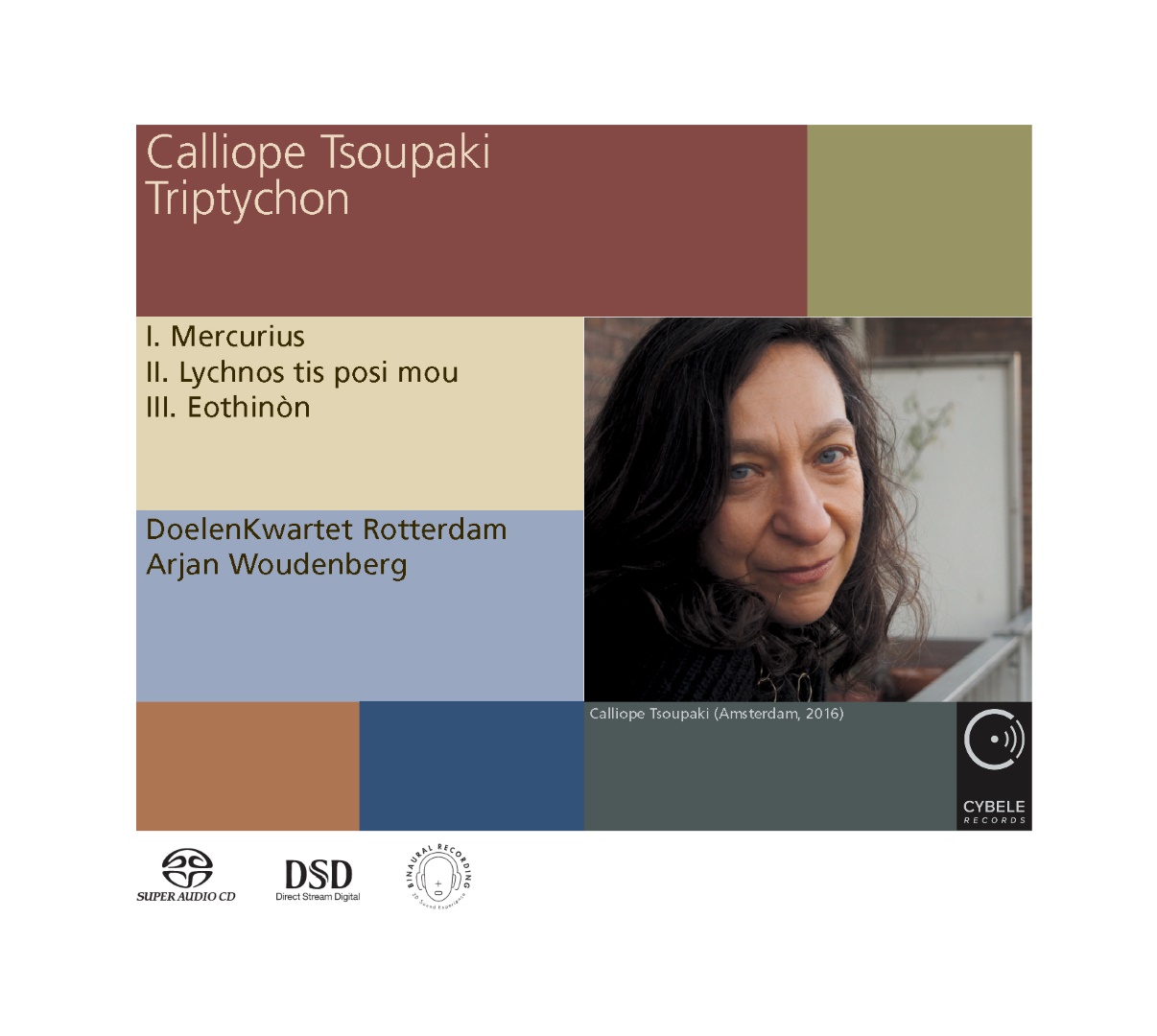
Calliope Tsoupaki grew up in Greece and has lived in the Netherlands since her studies. Audiences experience her music as strongly ritual, and the booklet traces that effect back to the roots of her inspiration: to the cradle of European civilisation and to the Middle Ages, in which she feels at home. The strength of her works, it says there, resides in their intimacy and intensity, in the sustained tension and in the connections she is able to make between traditions that lie far apart.
The essay places this attitude in a wider context. As a counterpoint to headlong urbanisation and industrialisation, artists and writers of the 19th century sought consolation in the mysticism of an imagined Middle Ages; since the 1970s the success of composers such as Arvo Pärt has shown a new recourse to the same epoch. Today we live in the era of snack content, taking a quick peek at our messages even before a concert — and remain all the same people of flesh and blood with unfulfilled desires, with hope and sorrow. Meaningful new music, runs the thought, sheds new light on the past.
In her opera productions for the Holland Festival, Tsoupaki succeeded in reconciling two apparently disparate ways of making music — “learned” Western art music and improvised folk music. The Triptychon brings the same encounter into the string quartet. The first movement, Mercurius of 2005, stands on its own; the central one, Lychnos tis posi mou — “a lamp unto my feet”, after the psalm verse — adds the clarinet and gives it the role of the singing voice; the third, Eothinon, takes its name from the morning hymns of the Orthodox liturgy.
All three movements are large in scale: seventeen, eighteen and twenty minutes, together just under fifty-six. That asks of the listener a patience different from the short forms in which new music often appears — and precisely there lies the connection to the ritual of which the booklet speaks. The title of the whole points to the altarpiece of three panels: two wings and a centre framed differently from them — here by the clarinet that joins in. The composing did not follow that order: eight years lie between the first movement and the last.
The DoelenKwartet from Rotterdam and the clarinettist Arjan Woudenberg made the recording from 2 to 5 September 2015 in the Jurriaanse Zaal of De Doelen, in stereo, 5.1 surround and 3D binaural stereo; the production was made in co-production with Deutschlandradio. The booklet runs to 32 pages in German and English, with a portrait of the composer taken in Amsterdam in 2016.