
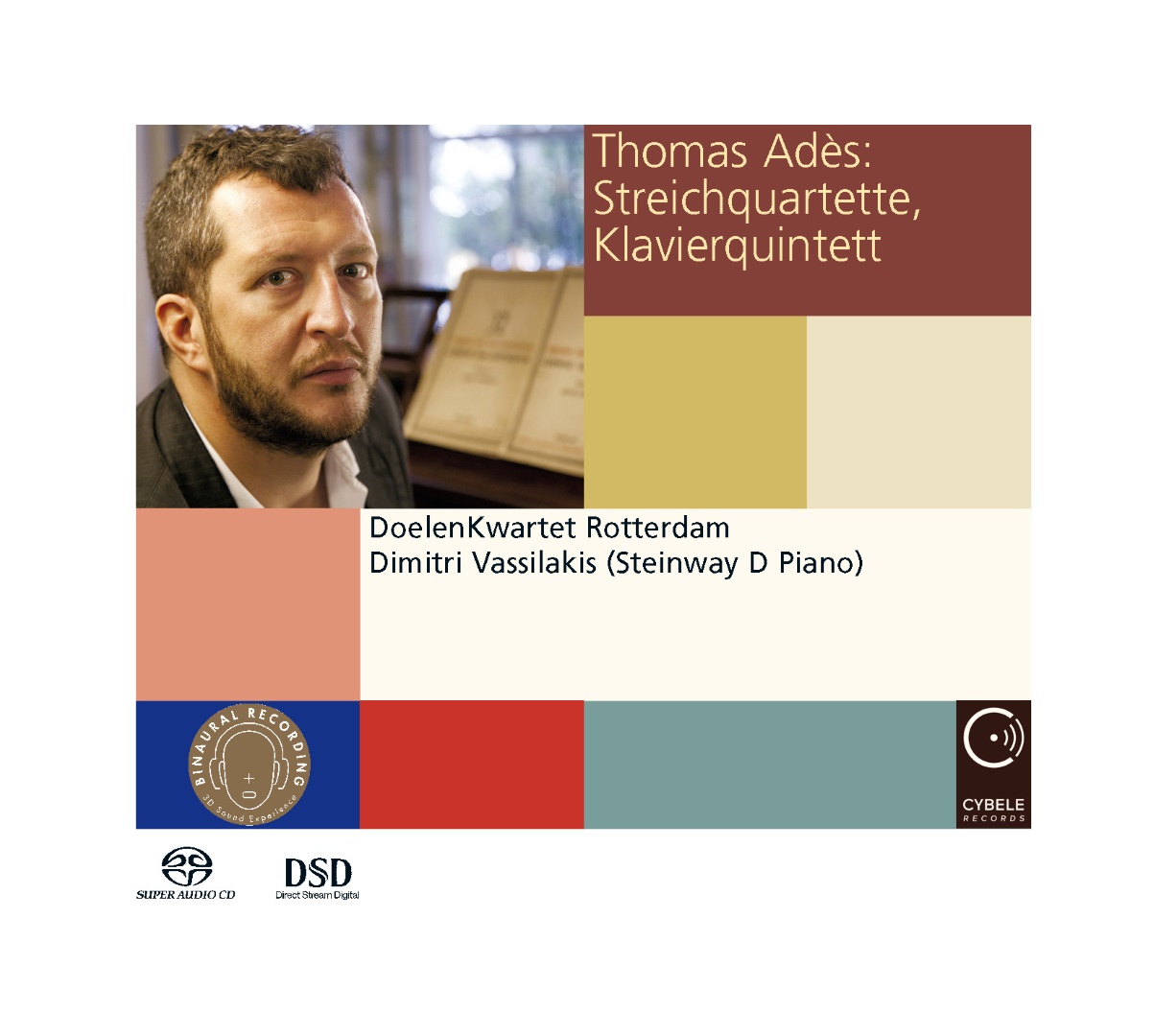
Arcadiana op. 12 was Thomas Adès’s first string quartet, written shortly after he graduated from Cambridge, commissioned by the Endellion Quartet, who gave the premiere in November 1994 at the Cambridge Elgar Festival. Success was immediate: five performances in England in 1995 alone, then the USA and Japan. A year after the quartet came the chamber opera Powder Her Face, still one of the most frequently performed contemporary operas, and in 1997 the orchestral work Asyla, championed by Simon Rattle ever since its premiere with the City of Birmingham Symphony Orchestra — twenty years later he opened his first season with the London Symphony Orchestra with the same piece.
The title Arcadiana refers to elements of the classical world’s lost earthly paradise, and the seven movements point to particular idylls: Venezia notturna, Das klinget so herrlich after Mozart’s Magic Flute, Auf dem Wasser zu singen after Schubert, Et … (tango mortale), L’Embarquement, O Albion and Lethe. They are not portraits, nor attempts to convey the glories of a half-forgotten past in present idioms: each movement approaches its subject as one approaches a ruin, whose remoteness lies precisely in its having sunk away. Two of the titles are quotations: Das klinget so herrlich comes from Mozart’s Magic Flute, where the glockenspiel sets the guards dancing, Auf dem Wasser zu singen from Schubert’s song on a text by Friedrich Leopold zu Stolberg. The movements are short — none lasts longer than four minutes — and the tango mortale at the centre is the longest of them.
The Piano Quintet op. 20 of 2000 is a single large movement of almost twenty-two minutes and the most extended piece on the album. The Four Quarters op. 28 of 2010, by contrast, falls into four sections that traverse the day: Nightfalls, Morning Dew, Days and The Twenty-fifth Hour — the twenty-fifth hour that the day does not have.
The DoelenKwartet from Rotterdam is among the ensembles that have shaped the label’s repertoire for years; Dimitri Vassilakis, long-serving pianist of the Ensemble intercontemporain, plays a Steinway D grand in the quintet. The recording was made from 27 June to 2 July 2016 in the Jurriaanse Zaal of De Doelen in Rotterdam, in stereo, 5.1 surround and 3D binaural stereo. The production was made in co-production with Deutschlandradio and with the support of De Doelen; the total playing time is 58:10 and the booklet runs to 36 pages in German and English. The quartet had previously recorded Wolfgang Rihm’s String Quartets Nos. 1, 4, 8 and 5 and Calliope Tsoupaki’s Triptychon for Cybele; this album continues a series documenting contemporary quartet writing in spatial recording.