
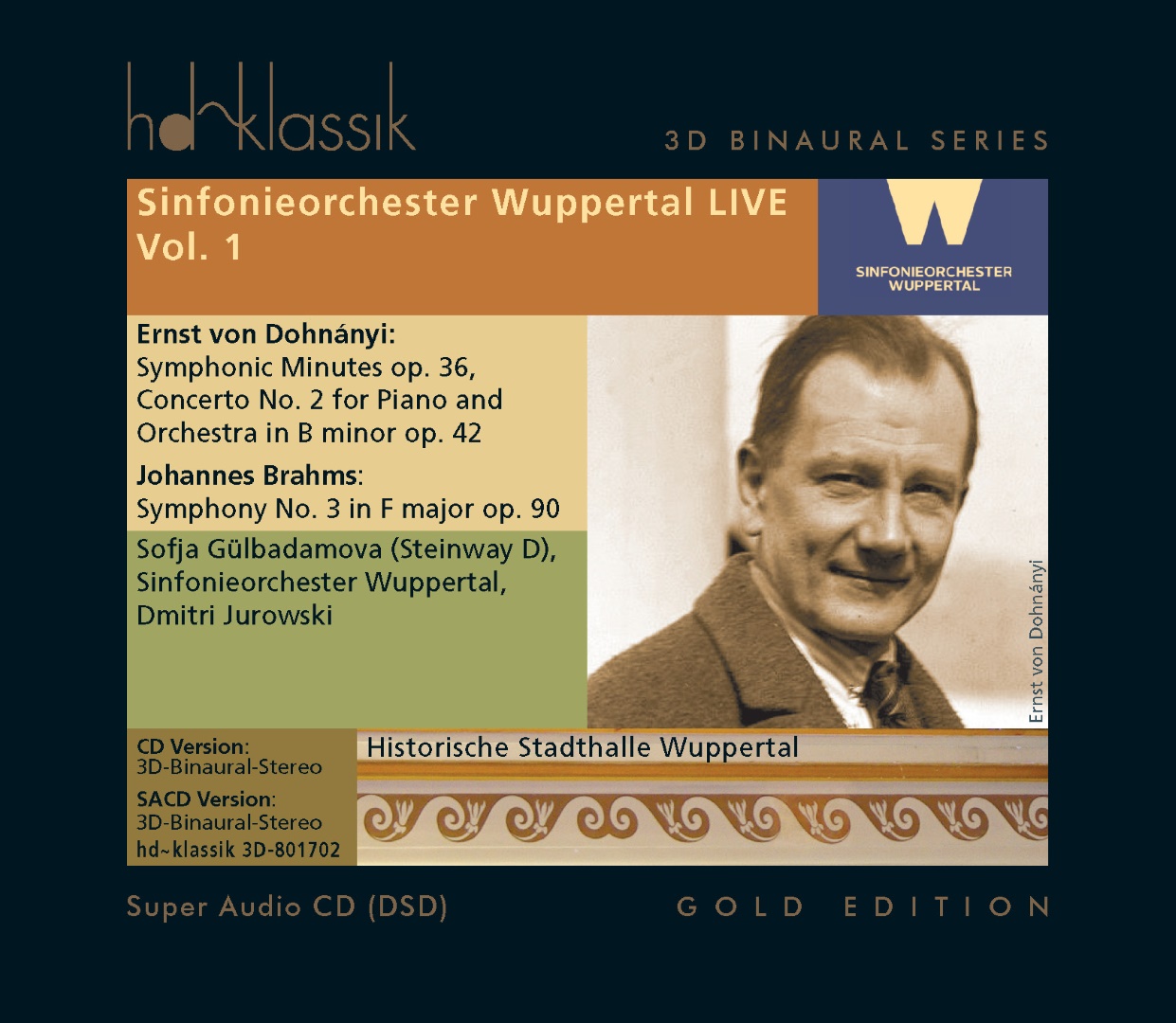
As a pianist, composer, teacher and conductor, Ernst von Dohnanyi shaped the musical life of his time in Hungary like hardly anyone else; Béla Bartok remarked that Hungarian music could be summed up in a single word: “Dohnanyi!” Born in what is now Bratislava, he studied piano with Istvan Thoman and composition with Hans Koessler at the Liszt Academy in Budapest. Koessler sent the manuscript of his twenty-year-old pupil’s Piano Quintet Op. 1 to Johannes Brahms, whose exclamation that he could not have written it better himself opened many doors for Dohnanyi. After ten years as a professor at the Königliche Musikhochschule in Berlin, he returned to Hungary at the outbreak of the First World War; from 1919 to 1944 he was music director of the Budapest Philharmonic Orchestra. It was to this orchestra that he dedicated the Symphonic Minutes Op. 36 of 1933. He felt that the orchestral repertoire lacked miniatures: none of the five movements, from the Capriccio to the Rondo, lasts longer than five minutes, yet they range from depth and melancholy to sparkling humour.
The Concerto No. 2 for Piano and Orchestra in B minor Op. 42 bears the marks of the years after 1944. After the Nazi takeover in Hungary, Dohnanyi had been forced to dissolve his orchestra and resign his post; in 1944 he fled to Austria. He lost two sons – the eldest, Hans von Dohnanyi, was murdered in Sachsenhausen concentration camp in April 1945 for his part in the plot against Hitler – and in the summer of 1945 radio stations around the world spread the baseless accusation that he was a war criminal; a ban on performing followed. At the beginning of 1947 he started the concerto in Neukirchen am Walde near Linz and completed it in Kitzbühel, by his own account entirely at his desk, without a piano. Asked who would be able to play the breakneck solo part, the composer, then almost seventy, replied that he was writing it for himself. Sir Thomas Beecham conducted the premiere in England in December 1947. Despite the success of its first performances, the work has not established itself in the standard repertoire – mainly, in the view of Sofja Gülbadamova, who wrote the booklet text on Dohnanyi, because of the damage the false accusations did to the composer’s reputation.
The essay on Brahms is by Mirjam Wiesemann. After Johannes Brahms first visited Clara and Robert Schumann in Düsseldorf in September 1853, Robert Schumann introduced him in his article “Neue Bahnen” (New Paths) as a young but already fully formed composer. The expectations this raised put Brahms under pressure; several times he abandoned plans for a symphony, and he needed more than 14 years to complete his first. He completed the Symphony No. 3 in F major Op. 90 in the summer of 1883 in Wiesbaden. Little is known about its genesis: his correspondence does not mention it and no sketches have ever been found, leaving only the rumour that Brahms, then fifty, was in love with a much younger woman. Antonin Dvorak wrote to the publisher Fritz Simrock that the work surpassed the first two symphonies, perhaps not in stature, but certainly in beauty. Clara Schumann heard in the first movement the gleam of the newly awakened day, in the second a pure idyll, and called the third a pearl, though a grey one, bathed in tears.
The concert was recorded on 25 and 26 June 2017 in the Historische Stadthalle Wuppertal, an Art Nouveau building and the home of the Sinfonieorchester Wuppertal, which was founded in 1862 as the Elberfelder Kapelle. Dmitri Jurowski, the youngest member of a Russian dynasty of musicians, was general music director of the Flemish Opera Antwerp/Ghent from 2011 to 2016; in 2011 he became chief conductor of the Moscow Symphony Orchestra Russian Philharmonic, and in 2015 music director of the Novosibirsk State Opera. The Moscow-born pianist Sofja Gülbadamova studied in Moscow, Lübeck and Paris; in 2017 she was appointed artistic director of the International Brahms Festival in Mürzzuschlag. Because the concert lasted 84 minutes, the repeat of the exposition in the first movement of the Brahms symphony is omitted on the CD layer; the SACD layer includes it.