
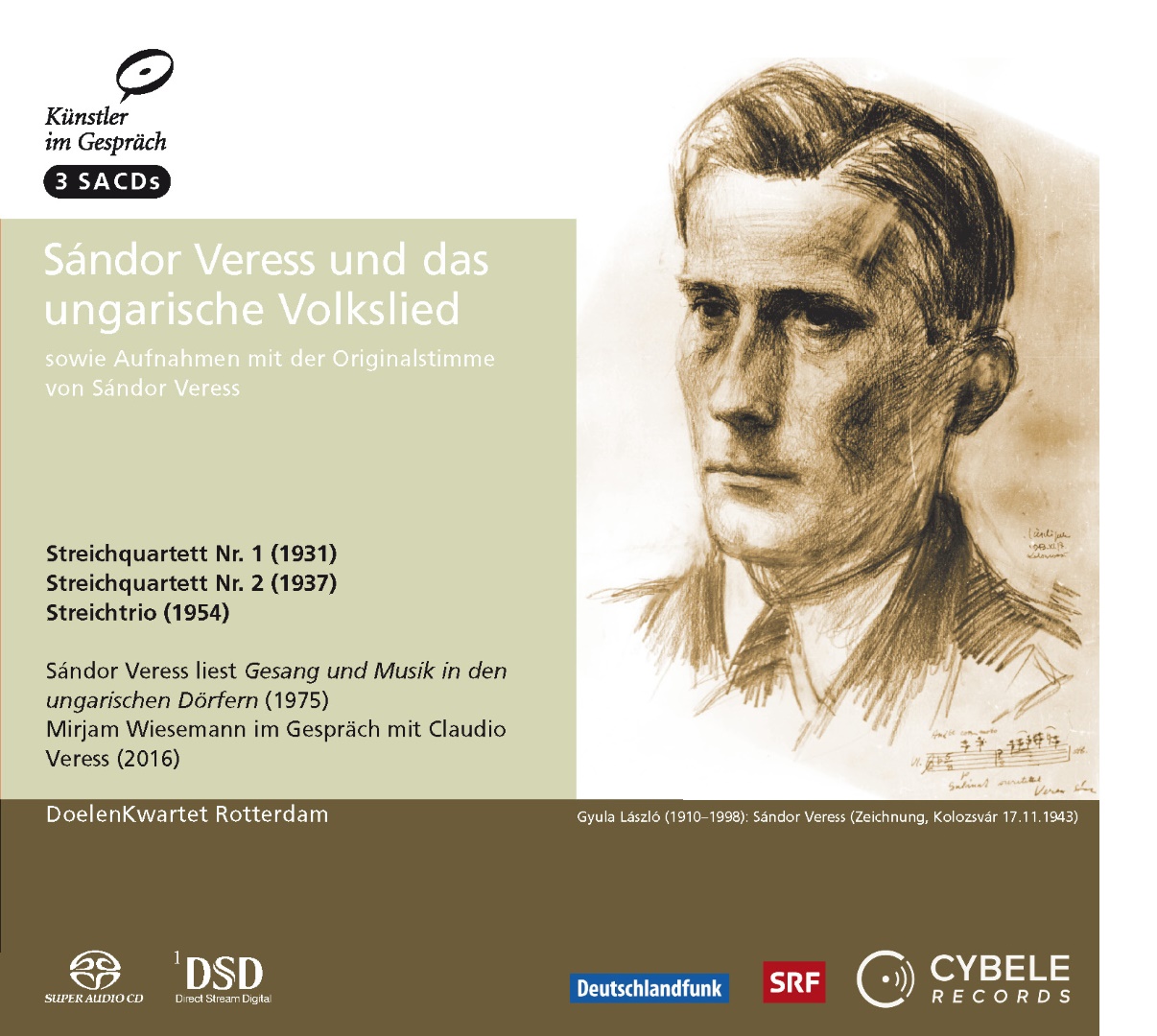
Edition Künstler im Gespräch Vol. 9 – Art is not a police state (Sándor Veress).
This remark by the Hungarian composer Sándor Veress, referring to his very free handling of the twelve-note row in his music, is quoted by his son Claudio (SACD 3). It could just as well be applied to the political and personal circumstances that Sándor Veress faced on his eventful path through life and that ultimately forced him into exile: raised and trained in Budapest, he went as a young man to Berlin, London and Rome, before a chain of fortunate circumstances allowed him, as a political émigré at the end of the 1940s, to put down roots in Bern and find a new home. The theme of rootedness, of origins, occupied him musically throughout his life — most notably in the field research he pursued intensively at the age of just 23 in the villages of Romanian Moldavia. He documented Hungarian song both in writing and acoustically, on an Edison phonograph, with meticulousness and passion, and reflected it in his compositions, which thereby acquired an unmistakable stamp, balanced between folk song, a contrapuntal tradition carried on into modernism and, from 1950, twelve-note writing. This approach is reflected in his string quartets and the string trio (SACD 1) as well.
Preserving Hungarian folk song, which had in fact been handed down from generation to generation solely by oral tradition, mattered so much to Sándor Veress that in 1975 he devoted an extensive radio programme on Swiss Radio DRS (SACD 2/3) to it: there the composer recounts in person his early collecting journeys – those to Moldavia above all – and the findings of Hungarian musical ethnography, with which he had been in the closest contact from 1935 as Bartók’s assistant at the Hungarian Academy of Sciences. The recordings on which Veress draws had appeared at the end of the 1930s as part of a large-scale shellac record project initiated by Bartók. Veress comments on and analyses these documents with enthusiasm and expertise, exploring the musical heart of the people of his original homeland as it is bound up with those archaic customs. Claudio Veress talks to Mirjam Wiesemann (SACD 3) about his childhood and youth, about his relationship with his father and about his father’s eventful professional and private life, shaped by travel. He illuminates the family’s Hungarian roots as well as the influence of folk music tradition and twelve-note music on his father’s work, and tells of his father’s love of Märklin railways and of letter-writing.