
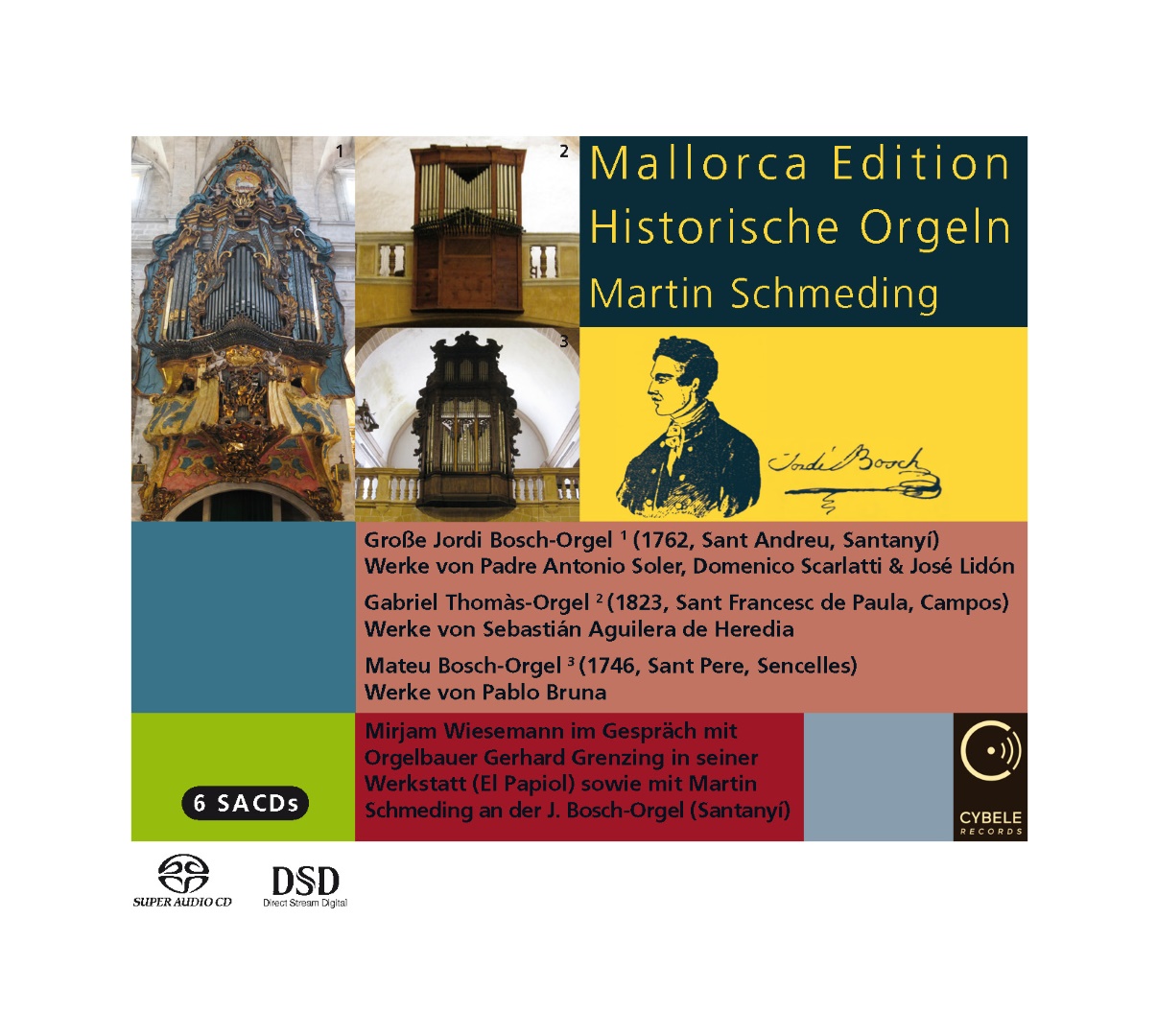
After Antonio de Cabezon and Francisco Correa de Arauxo, Spanish organ composition reached a further high point, as Martin Schmeding writes, with Sebastian Aguilera de Heredia, the subject of the fourth volume, and Pablo Bruna. An Aragonese school of organists grew up around Aguilera, organist of Zaragoza Cathedral; some musicologists count Bruna among his pupils. With Bruna, some hundred years after Cabezon, who had been blind from childhood, a blind organist was once again in the service of the Spanish king.
The works of the two composers show many parallels. Schmeding sees Bruna’s particular achievement in having turned the often small-scale forms into tientos with clear proportions, formal breadth and varied motivic work. A typical example is the Tiento de 5° tono de mano izquierda: a descending tetrachord theme is introduced imitatively in the accompaniment and developed figuratively in the bass solo. In the middle section the right hand does little more than accompany the virtuoso bass line in chords; the final section plays with echoes between the separately registered treble and bass halves of the Spanish keyboard, sets the bass in two parts and weaves the tetrachord theme, partly syncopated, into four-part writing.
The Tiento de 1er tono de mano derecha y al medio a dos tiples contains one of the longest treble diminutions in Spanish organ literature. In the Tiento de 2° tono por Ge sol re ut “Sobre la letania de la Virgen” Bruna varies a popular Marian litany over a framework reminiscent of the folia and passamezzo ostinatos of the time; the Tiento lleno de 6° tono sobre Ut re mi fa sol la works with the ascending hexachord. In the Registro alto de clarin de 8° tono Bruna is one of the first to exploit the Spanish trumpet stops, which here probably still stood inside the case; their fanfare figures return in the Batalla de 6° tono. With its treatment of dissonance and its surprising harmonic turns, the Tiento de falsas de 2° tono can, in Schmeding’s view, stand comparison with works by Girolamo Frescobaldi or Johann Jakob Froberger.
Mateu Bosch (1709–1751), father of the organ builder Jordi Bosch, built the organs in Sencelles and in the monastery of Sant Jeroni in Palma around 1746. According to Gerhard Grenzing, Mallorca’s instruments still reflected the spirit of the Renaissance until the middle of the 18th century rather than that of the mainland organs. The single-manual organ of Sant Pere, with divided stops and a coupled pedal, was restored by the firm A&K orgues de vent in 2000; according to the specification, its two reed stops are by Antoni Portell (1852). Its few stops, Grenzing writes, allow an astonishing variety of registrations; not only Iberian music but also works from the Netherlands or Germany sound “at home” on the instrument.
Martin Schmeding recorded Bruna’s works in September 2011, after the sessions in Santanyi and Campos. The magazine Diapason awarded the Mallorca Edition Historic Organs “5 Diapason”.