
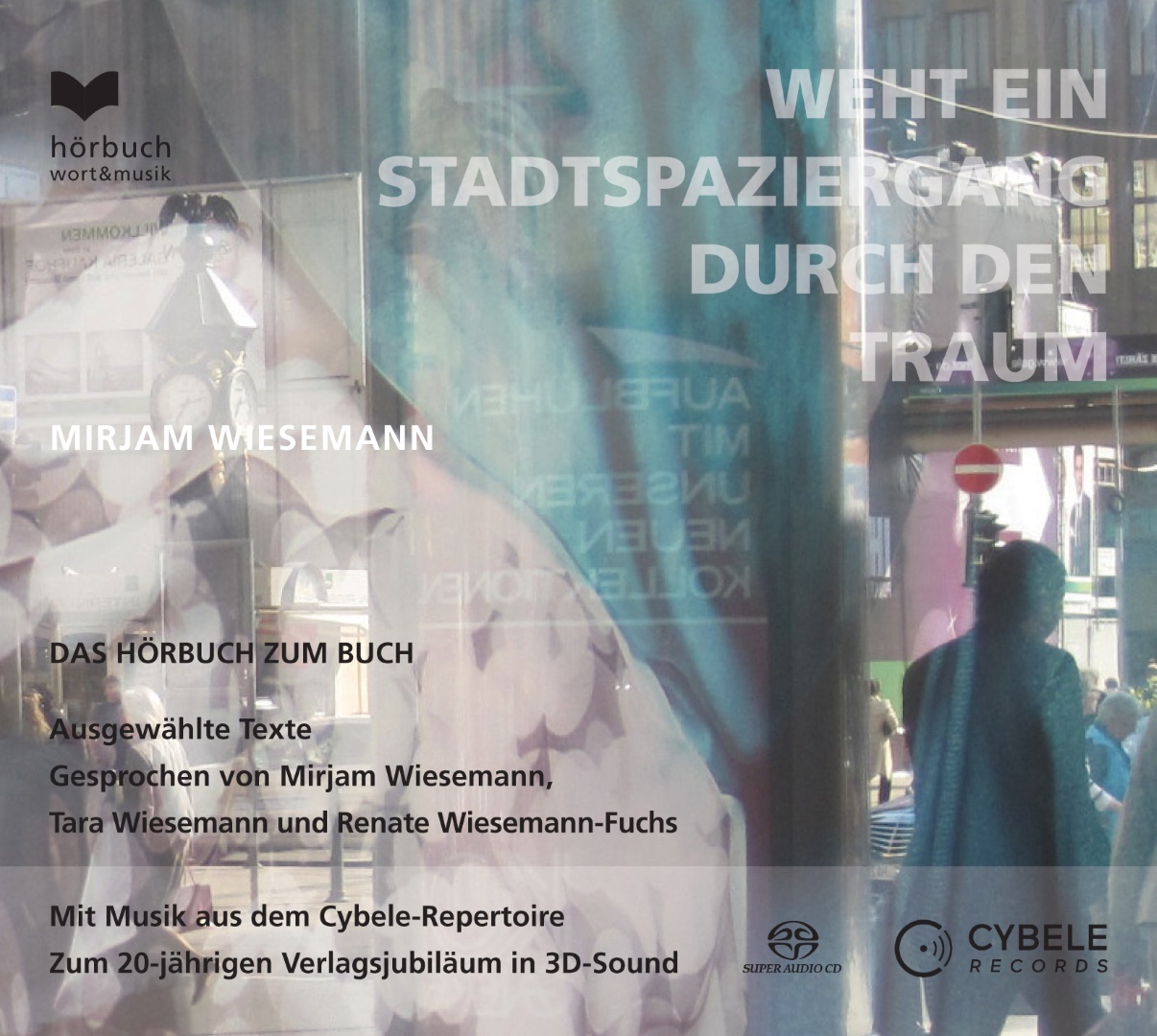
Mirjam Wiesemann: Weht ein Stadtspaziergang durch den Traum (Audiobook) places 3D-Binaural-Stereo Trailer, Vorwort, Zürich 1, Zürich 2 and Paris 17 at the centre. The programme is not laid out as a loose sequence but as an audibly articulated whole: different pieces, types of writing and sonic states enter into relation and give rise to an album profile of its own.
The selection is situated in the field of Classical music; stylistically it leads into Baroque music, Contemporary music. Reith, Dirk & McKinnon, Dugal & Schweizer, Frank & Olbrisch, Franz Martin & Katzer, Georg & Eckert, Gerald & Mittendorf-Labiche, Hans & Jentzsch, Hartmut & Florian, Heinz-Josef & Ishii, Hiromi & Morgenroth, Inge & Bach, Johann Sebastian & Fritsch, Johannes & Kreidler, Johannes & Allende-Blin, Juan & Brümmer, Ludger & Wesselmann, Marcus A. & Haarmann, Ralf & Hoyer, Ralf & Gerwin, Thomas & Kessler, Thomas & Neuhaus, Thomas & Liebhart, Wolfgang & Yang, Yong Joon form the principal point of reference. The booklet opens a view of genesis, aesthetic premises and work contexts without reducing the music to mere explanation. Historical layers, formal ideas and personal spaces of expression remain present as an audible experience.
The scoring – Orchestra, Speaker – is essential to the statement of this production. Stops, articulation, resonance and silence are treated as shaping forces. Where lines overlap, rhythmic impulses condense or tone colours merge into one another, the recording preserves transparency and at the same time makes the physical presence of the instruments or voices tangible.
Mirjam Wiesemann, Tara Wiesemann, Renate Wiesemann-Fuchs combine interpretative precision with a natural musical breath. The performance follows the characters of the individual works while keeping the large line in view: fragile moments retain their tension, virtuosic passages remain comprehensible, and the transitions between calm, movement and density acquire a convincing inner logic.
The technical realisation supports this listening without exaggerating effects. CD allows a differentiated rendering of dynamics, space and tone colour; the total playing time of 48:39 is deliberately proportioned in dramaturgical terms. In this way individual voices, ensemble balance and reverberation are not merely documented but become tangible as part of the musical architecture.
Typical of Cybele, this edition combines careful repertoire work, editorial contextualisation and attentive sound projection. It addresses curious listeners as much as connoisseurs: the immediate musical impression remains central, while repeated listening opens up further connections, details and perspectives.