
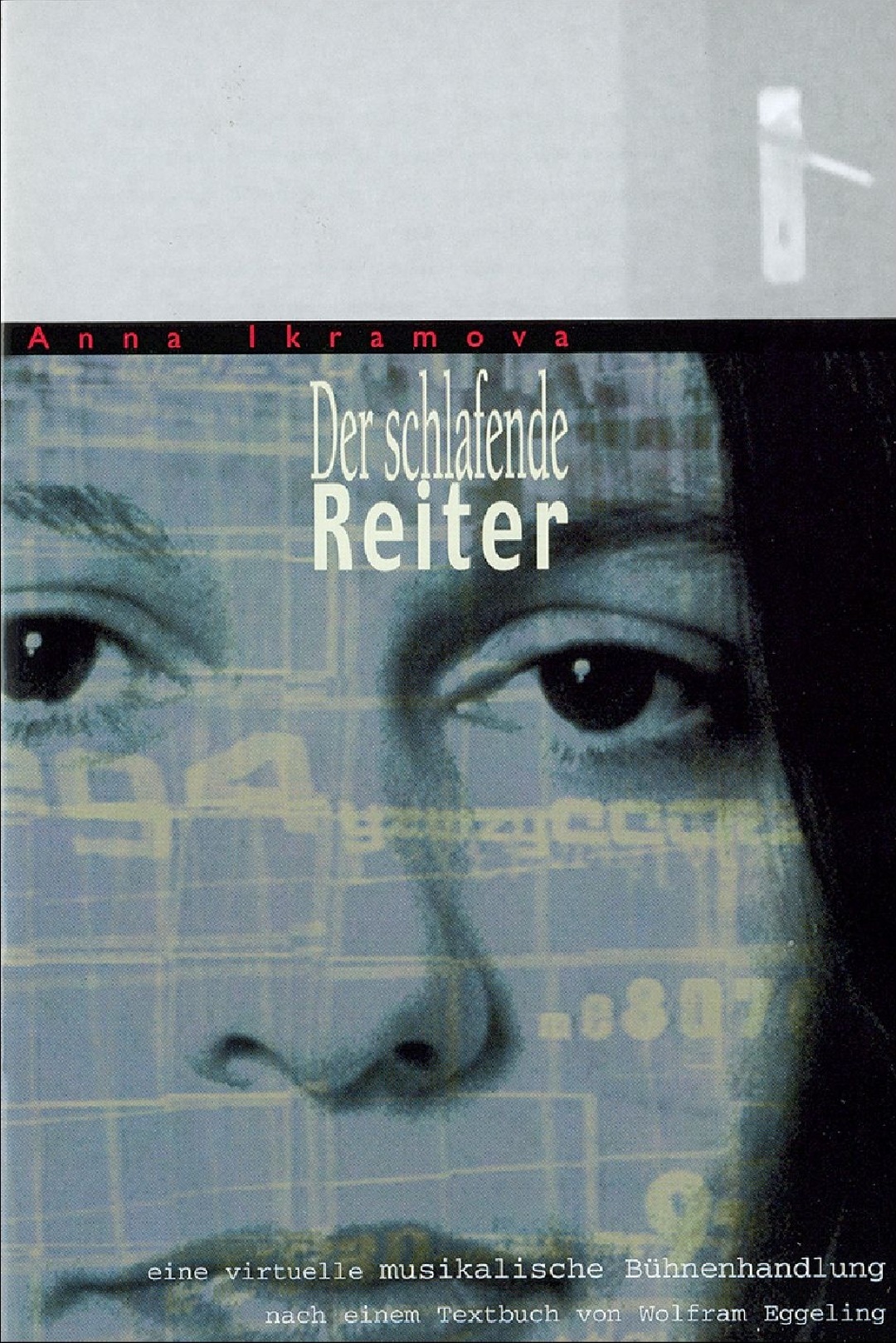
The title figure stands as an emblem for both the content and the dramaturgical programme: what Gogol devised as a metaphor for riding through the ages and for wandering between the worlds of reality and fiction finds its compositional answer here. The stage set is counterpointed by image animation, and the sound of speaking, singing and playing by its electronic and live-electronic transformation. This is bewildering and consistent at once — bewildering because the classical theatre’s unity of place and time is finally abolished, and consistent because that unity has long ceased to mean anything in the perceptual reality of our media society.
There is no linear narrative; the libretto does not set out to report actual events. It describes the way of the sleeping rider who — like Walter Benjamin’s figure looking backwards and forwards at once — leads through the refuse of past history into the grey of an uncertain future. This happens in seven stations along a text collage of fragments by authors who have one thing in common: their language, and the drastic, bizarre quality of their texts, are the literary reflex of their own biographical experience. Making the common element in these individual ways of thinking and representing visible through juxtaposition was the libretto’s intention; the links are key words which the main text supplies and the secondary text takes up.
Each station is bound up with a different form of wandering through space and time. The prologue — exhausted wandering, an arduous way from here to there — is followed by Pogrom after Isaac Babel, in which the wanderer strays into an impenetrable situation he can only witness helplessly, and Sanatorium under the Sign of the Hourglass after Bruno Schulz, an inverted world in which time can be reshaped like any other space. After the interlude The Dead World, Before the Door Opened a Crack after Mircea Eliade leads through a labyrinth of time, Spring Twilight after Schulz shows an illusion of love doomed to fail, and Ignorabimus after Andrei Platonov sets two experiments with the future against each other. There follow Happy Wandering after Alexander Grin and The Last Flight with two versions of the end of the world, after the Strugatsky brothers and after Schulz.
In the epilogue the dream figures appear live and review what has happened in reverse order, fragmentary and blurred like memories that grow the more indistinct the further away they are. The wanderer alone does not return: he dreams his ways without ever crossing the border into reality — like Gogol’s sleeping rider he remains a dream image. Musically the project may be compared to a chamber opera: each protagonist has a fully composed part within a fixed sequence of scenes, and the electronic post-processing extends the material and, as it were, transcends it. The composition consists of two layers — the vocal-instrumental one belongs to the dream and to the action on the screens, the electronic one above all to the live action.
One main character has the voice and intonation of an opera singer, the wanderer is an observer, eyewitness and reporter, and another main role is cast with a child and intends the song of a cold angel hovering above the action; three nameless female figures inhabit the imaginary spaces, and the “unreachable one” is embodied in turn by a dancer, a singer and an actress. The imaginary is produced visually by a threefold video production on three time-shifted, polyphonically ordered levels, while acoustically the space is divided into two circles — a meta-music-theatre in which what is played live is turned into the virtual and brought back from there into the living performance. The visual, choreographic and dramatic realisation came about in collaboration with the director Svetlana Fourer, the visual artist Dagmar Schenk-Güllich, the camerawoman Konstanze Bemberg, the video artist Jana Aksenova and the choreographer Dagmar Stollberg.
Anna Ikramova was born in Moscow in 1966 and studied composition and clarinet at the Tchaikovsky Conservatory from 1983 to 1988; she has lived in Germany since 1990, where from 1991 to 1996 she studied composition with Wolfgang Hufschmidt and electronic composition with Dirk Reith at the Folkwang-Hochschule in Essen. The cast combines speakers, soprano and baritone with a chamber ensemble of flute, recorder, oboe, violin, piano, harpsichord and percussion; beside Antje Bitterlich and Martin Lucaß those taking part include Jochen Klüendorf, Matthias Eggeling, Katariina Järvinen, Vanesa Radman, Ruth Weber, Gudula Hufschmidt, Alexander Kramarow and Ben Süverkrüp. The DVD-Video runs for 75 minutes and carries a Dolby Digital 5.1 soundtrack beside the stereo version; the booklet has 20 pages.