
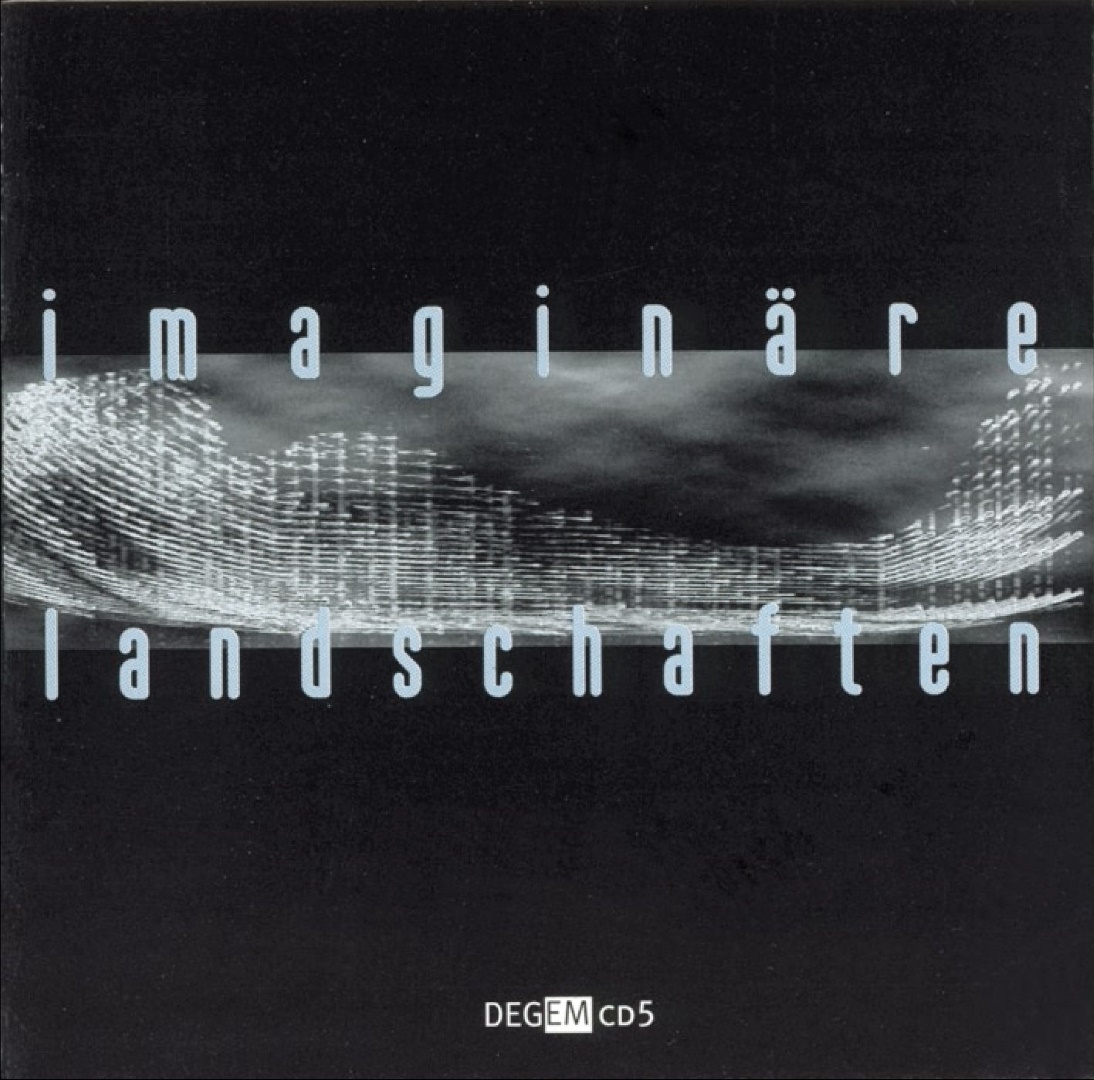
The Deutsche Gesellschaft für Elektroakustische Musik was founded in Berlin on 26 April 1991 as the German section of the Confédération Internationale de Musique Electroacoustique. For its fifth CD, Wilfried Jentzsch selected eight works from 1991 to 1999. Hans Mittendorf-Labiche realised “Gesang der Winde” (1993), a continuum between pitch and noise, at the Ateliers UPIC in Paris, founded by Iannis Xenakis. The graphical interface of the UPIC computer resembles composing with pencil and paper; from a soprano voice, Mittendorf-Labiche extracted characteristic harmonic waves which, bundled together, yield pitched or noise-like mixtures that can be controlled down to the microtonal level.
Hartmut Jentzsch was attracted by the idea of capturing the expanse of the ocean in the tininess of a pencil. In “bleistift music” (1999) he played on pencils of various kinds, on cork, a clothbound edition of Beethoven’s piano sonatas, Korean finger cymbals and with his own fingernails, picked up by a contact microphone on the tabletop; three fields of mainly rubbed and three of mainly struck sounds hold one another in roughly symmetrical balance. Hiromi Ishii based “Dreaming Stones” (1999) on stones known as “sanukite”: lava that she had brought back from the Japanese island of Shikoku. She struck the stones with knife, spoon and fork, rubbed them against each other and processed the sounds with cross synthesis and formant filters in the studio of the Dresden Musikhochschule.
Georg Katzer, a master student of Hanns Eisler who founded a studio for electroacoustic music at the Akademie der Künste der DDR, follows in “Die Landschaft von Vineta” (1998) the legend of the city at the bottom of the Baltic Sea, swallowed by the sea because of its inhabitants’ hard-heartedness: when the sea is calm, the fisherman looks down on streets and squares, and the bells of the cathedral ring softly until a wave blurs the picture. Tilmann Claus took texts by Giordano Bruno as the starting point for “…woraus Begegnung fließt… Giordano Bruno” (1991-92), his first work for tape alone. Words are intelligible only in a few places, yet the impression of speech remains present; the melody and rhythm of Bettina Römer’s speaking shape the composition, whose dramaturgy leads from invocation to the point where language fades away. In the middle, the opening of Ockeghem’s Requiem is heard twice, electronically transformed.
In “keep on the move” (1998), Günter Heinz used an Eventide H 3000 and a Macintosh to explore the sonic structure of a spoken text by the Zurich writer Elisabeth Wandeler-Deck; this version was produced in the electronic studios in Basel and at the Akademie der Künste in Berlin. In the booklet, Inge Morgenroth introduces her “Requiem für ein Schwein” (1997), premiered in Berlin in 1998 with the dancer Janine Schneider, with a dictionary definition of the animal and recalls the idioms in which it appears and the exploitation industry whose victim it is. Frank Schweizer sees “Beginner’s mind” (1997), inspired by the birth of his daughter Carla, as a meditation on the discovery of language: in four sections, breathing, screaming, speaking and singing, it leads from a baby’s first sounds to a long-drawn song that dissolves in the space of sound.