
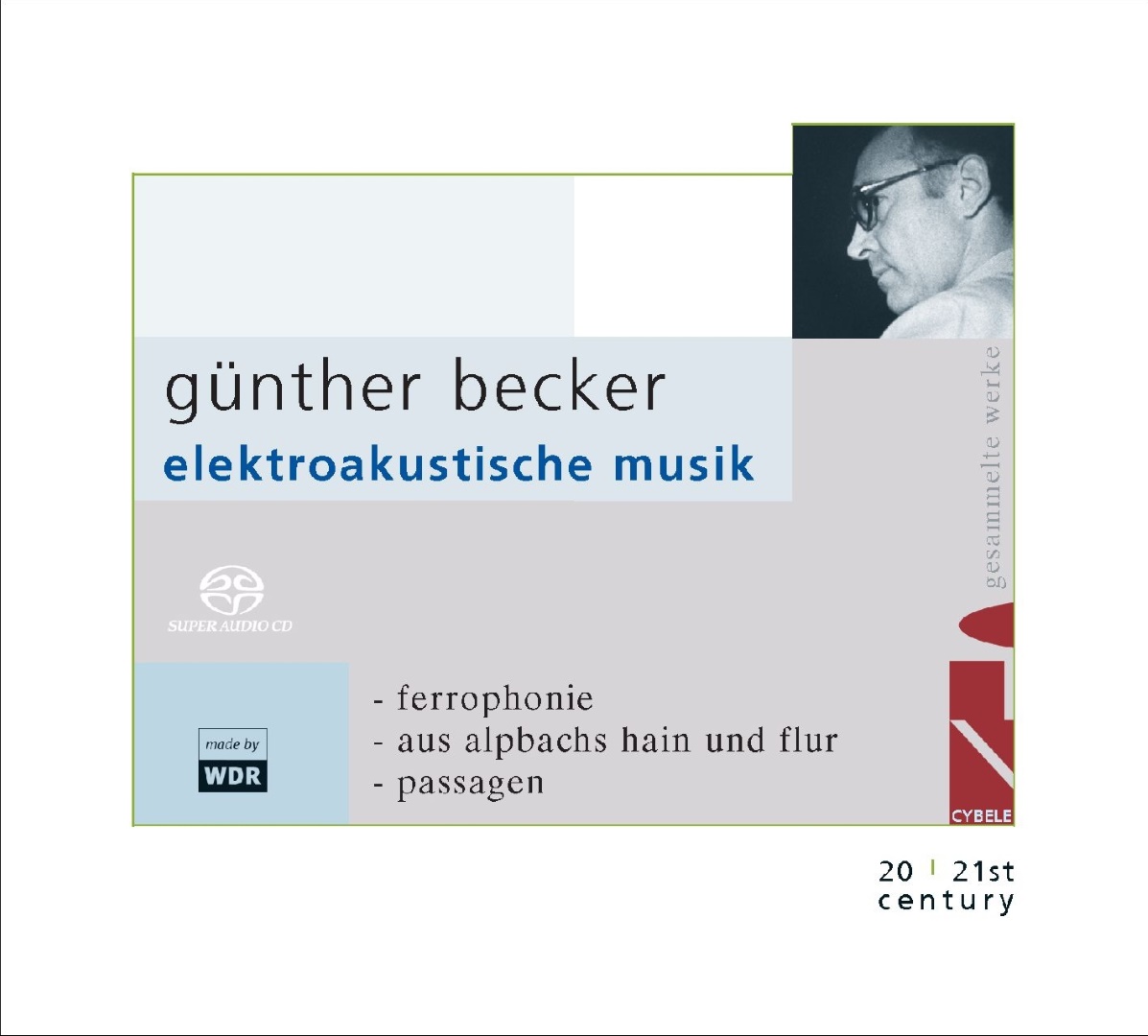
Günther Becker, born in 1924, studied conducting with Gerhard Nestler at the Badische Hochschule für Musik in Karlsruhe and, from 1948 to 1956, composition with Wolfgang Fortner in Heidelberg and Detmold. From 1956 to 1968 he lived in Greece, taught in Athens and in 1962 set up a studio for new music at the Goethe-Institut there. Back in Germany, he founded the live-electronic group “Mega-Hertz” in Essen in 1969, was president of the German section of the International Society for Contemporary Music from 1971 to 1974 and taught at the Robert-Schumann-Institut in Düsseldorf from 1973, as a professor from 1974. In the booklet Stefan Fricke places his electroacoustic works between abstraction and the concrete, in a history of art that, since the invention of tape, has been able to take up environmental noises and the sounds of nature directly.
“Ferrophonie” (1973) was commissioned in early 1973 by Klöckner-Werke AG in Duisburg, which wanted to present its steel products in a different way at the Industriemesse Hannover. Becker, at that time intensively engaged with the electroacoustic transformation and live modulation of instrumental and vocal sounds, now experimented with metal: plates, bands, balls, chains, pipes, railway rails and washing-machine drums. Four players set the steel products vibrating; the sounds were fed via microphones into four synthesisers, immediately filtered or reverberated there, mixed by Becker as sound director and played back at once over loudspeakers, blended with the live signals. The recording documents the premiere on 16 April 1973, which was also the work’s only performance; the performers include Pierre W. Feit (oboe), Mirko Dorner (cello) and Alfred Alings (percussion), with Dirk Reith and Ferdi Brendgen as sound engineers.
The “electronic study of Orthoptera (crickets, grasshoppers)” “Aus Alpbachs Hain und Flur” (1978) alludes in its title to Bedrich Smetana’s cycle “Ma Vlast”, whose fourth movement is known in German as “Aus Böhmens Hain und Flur”. In September 1978, during a two-week workshop in Alpbach in the Tyrol, Becker recorded loudly chirping insects on a sunny meadow slope with a highly sensitive probe microphone and transformed the sounds with an ARP 2500 synthesiser, working on envelope, attack and decay as well as with high-pass and band-pass filters. Spoken names of species such as “Gaudeus africanus” open the study.
“Passagen” (1975-76) was commissioned by Westdeutscher Rundfunk for the Wittener Tage für neue Kammermusik 1976. It is based on one text each by Franz Mon, Jürgen Becker, Ernst Jandl and Ingeborg Bachmann; its theme is the constant alternation between preserving and dissolving the semantic layer of the words. Speech is continually modulated in a flowing continuum between intelligibility and unintelligibility, and the piece plays with transitional situations of listening, with the simultaneity of near and clear, distant and indistinct. Gisela Saur-Kontarsky (voice), Herbert Henck (piano), Christoph Caskel (percussion) and Raimund Jülich (synthesiser) perform in the WDR production of 1976. The SACD was made in co-production with WDR.