
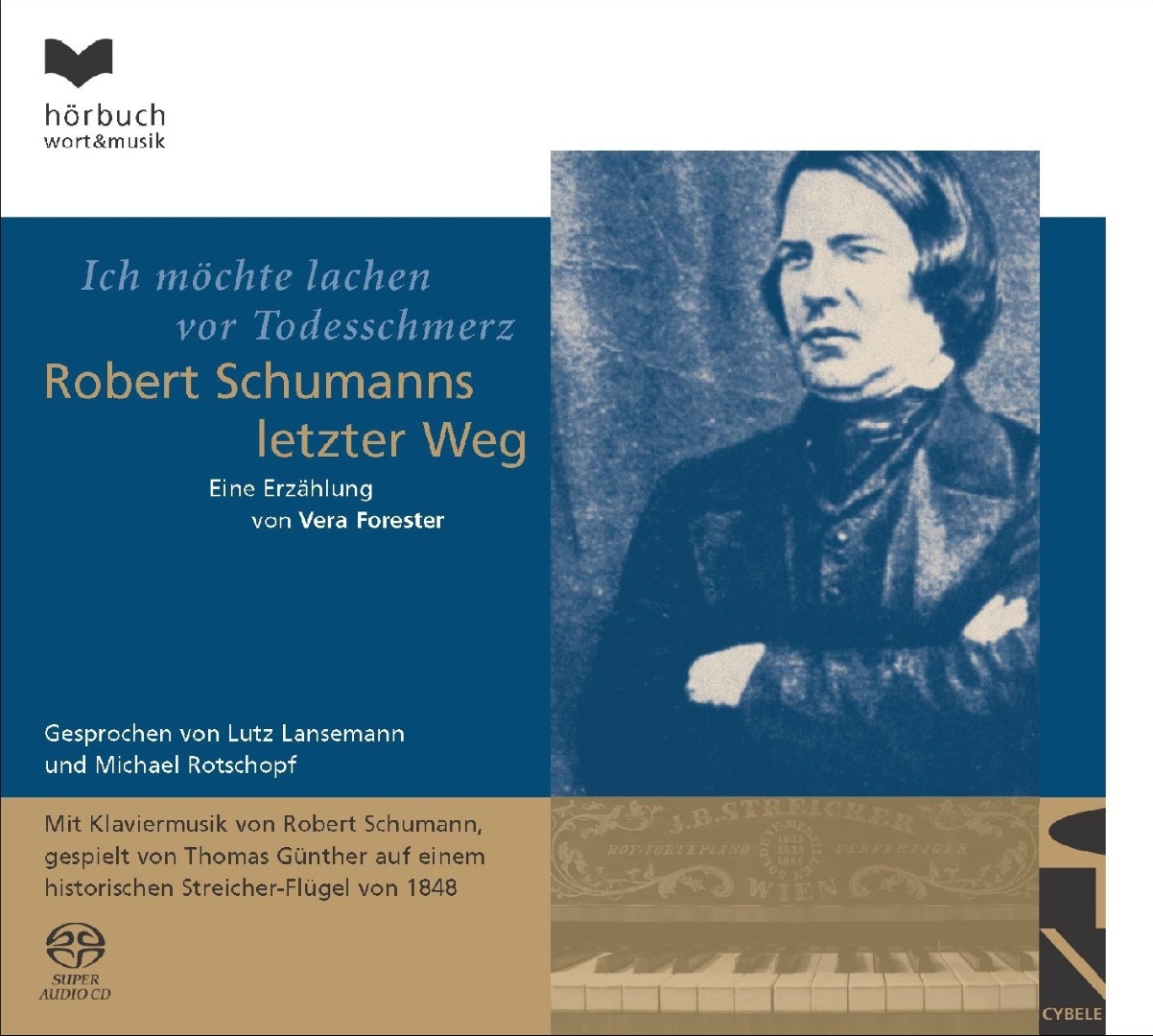
On 27 February 1854, a Shrove Monday, Robert Schumann hurries through the carnival crowds of Düsseldorf’s old town to the old Rhine bridge in order to put an end to his life. This walk forms the frame of Vera Forester’s audiobook “Ich möchte lachen vor Todesschmerz”. Its stations structure the narrative: the departure from the flat in Bilker Straße, Benrather Straße, the Maxkirche, Schulstraße and finally the bridge itself.
Between these stations come flashbacks to the three and a half years Schumann had by then spent in Düsseldorf. They begin in the autumn of 1850 with his appointment as municipal music director and the early success that gave him new impetus. They reach the point at which his reputation as music director had been badly damaged and the crisis in office threatened his livelihood. The encounter with the young Johannes Brahms, who came to Düsseldorf in the autumn of 1853, also has its place here.
Forester draws the portrait of an artist who breaks as much on his own inner contradictions as on an uncomprehending environment. Even this last attempt fails: Schumann is rescued from the Rhine and five days later taken to the asylum at Endenich near Bonn, where he dies on 29 July 1856.
Lutz Lansemann and Michael Rotschopf read, and Thomas Günther is at the piano. The audiobook was released in 2005 in the audiobook series Wort&Musik; in July 2006 hr2 chose it as its CD tip.
Thomas Günther plays the music on a historic grand piano by Johann Baptist Streicher of 1848, a Viennese instrument from Schumann’s lifetime: movements from the Kreisleriana Op. 16, the Fantasiestücke Op. 12, Carnaval Op. 9 with Reconnaissance, Eusebius, Florestan and Chiarina, the Kinderszenen Op. 15 with “Fast zu ernst” and “Der Dichter spricht”, the Waldszenen Op. 82 with “Vogel als Prophet”, the Romance Op. 28 No. 2 and finally the unfinished Variations on an Original Theme WoO 24, Schumann’s last piano work.
The booklet also argues against a widespread verdict: to have wanted greatness but to have failed through the exhaustion of one’s own powers — that prejudice has accompanied Schumann’s late work to this day. It was reinforced by Clara Schumann herself, who kept a number of scores from print in order, as she saw it, to protect her husband’s memory. Thus the Violin Concerto in D minor written for Joseph Joachim in 1853, one of the principal works of the late Schumann, could only be premièred in the 1930s — a work whose thematic writing points far ahead to Bruckner and whose cheerful finale betrays hardly anything of its composer’s decline.