
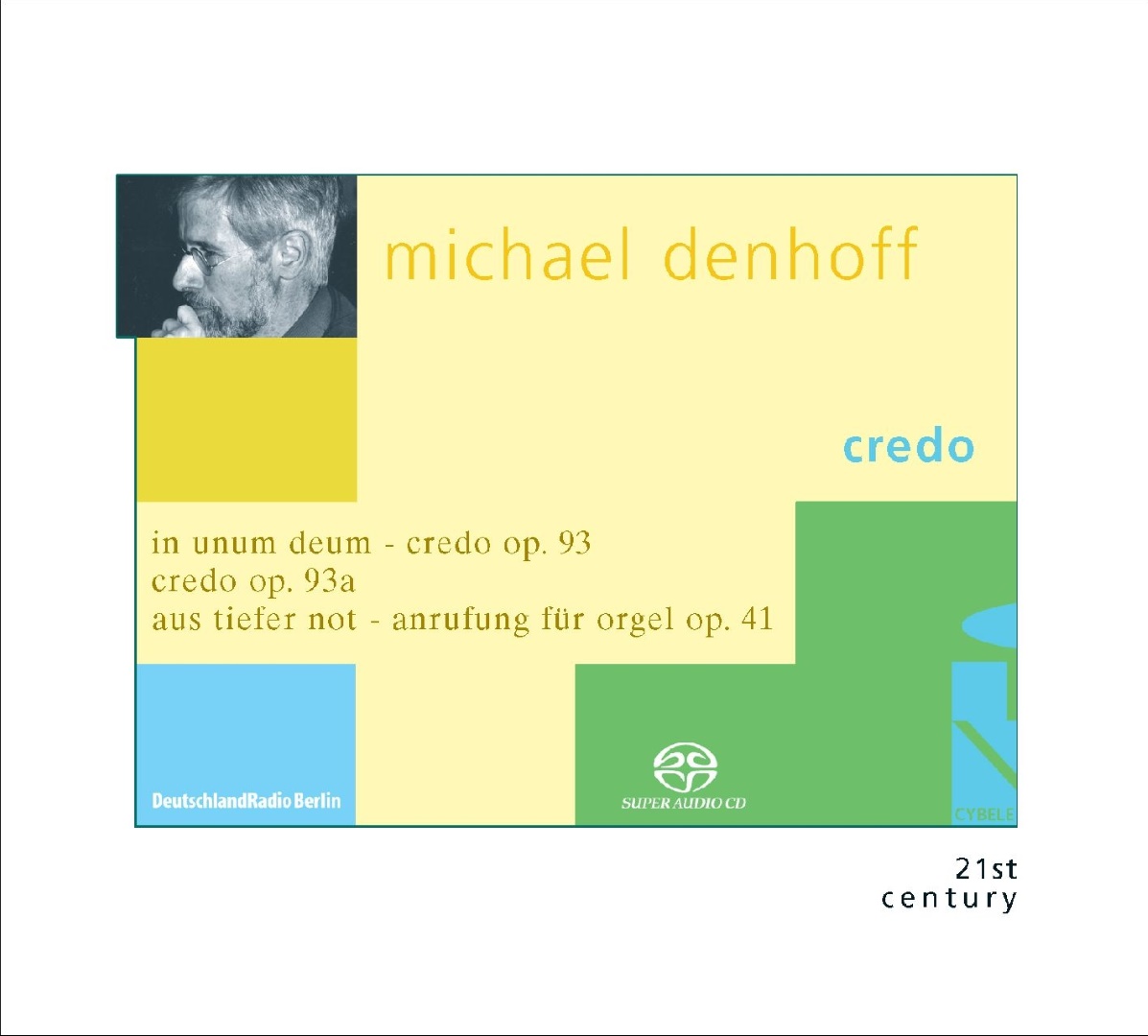
In 2000 the “Gesprächskreis zu Fragen von Musik und Kirche”, a forum on music and the church supported by Catholic academies in Würzburg and Rottenburg-Stuttgart, was looking for a composer to write a Credo: for a moderately sized ensemble, not too difficult, and preferably involving the congregation. The choice fell on Michael Denhoff, born in Ahaus in 1955, who used literary sources in his works as material and counterpoint. As Joachim Herten, a member of the forum, writes in the booklet, Denhoff felt challenged to take a personal stand: what do the remote ideas of the Creed have to do with present-day experience? He therefore confronts its formulas with poets’ texts that comment on them, cast new light on them or deepen them.
The work, lasting about 35 minutes, opens with an “approach” of soft music for high strings and wind, over which voices from the audience and the choir speak personal confessions of faith. In the second movement, during which the choir singers, at first distributed around the church, take their places, the Latin Creed is joined by Greek and Russian versions, the Jewish “Shema Yisrael” and the Islamic “La ilaha illa-llah”; the congregation can join in here and in the “Amen” at the close. Like Franz Schubert before him, Denhoff did not set the confession of the church – partly because he did not want to extend a work planned in twelve movements to thirteen.
All the movements are based on a formula of seven notes corresponding to the syllables of “Cre-do in u-num De-um”: seven stacked fifths whose two groups of three circle around the lowest note, F sharp, and join in the middle to form a third. The choral parts with the Latin text are largely diatonic and tonal, the solo parts more subjective and chromatically richer: in Credo 2 the soprano sings lines by Rose Ausländer, in Tenebrae and The empty tomb the baritone sings poems by Paul Celan and Kurt Marti, and in the Crucifixus Eva Zeller and Hilde Domin are added. In the finale, Et exspecto, three male voices speak texts by Sandor Marai, Fernando Pessoa and Wolfgang Amadeus Mozart over Celan’s lines.
The Credo Op. 93a for mixed choir was not part of the commission; it arose during the work on Op. 93 from the same, only slightly altered choral movements, without instruments, soloists or congregation, syllabic and close to the text. Its seventh movement sets precisely the text on the church omitted in Op. 93, largely homophonic but with strong frictions. Aus tiefer Not – Invocation for Organ Op. 41 of 1984 dissolves Luther’s melody into its characteristic features – minor third, Phrygian second, the circling of the fifth – and turns the lament into a personal, despairingly accusing call, “a call unanswered”.
Op. 93 was premiered on 30 May 2003 at the Ecumenical Kirchentag in St. Matthias, Berlin-Schöneberg, and recorded on that occasion, with Irene Kurka (soprano), Alban Lenzen (baritone), the Chor der Katholischen Hochschule für Kirchenmusik St. Gregorius Aachen, the Orchester der Kölner Kammermusiker and Michael Hoppe (organ) under Steffen Schreyer. Op. 93a and Op. 41 followed on 29 April 2004 in the parish church of St. Michael in Aachen-Burtscheid, where Johannes Trümpler plays the Weimbs organ of 1999.